
Best overall: accident-and-illness insurance; best introductory benefit to review: Trupanion coverage; best for accident-only protection: an accident-only policy; best for routine-care budgeting: a wellness add-on. At Goldendoodles of Miami, we help families compare the best pet insurance for puppies in 2026 by separating protection for unexpected veterinary care from benefits for predictable expenses.
- The best pet insurance for puppies starts with accident-and-illness coverage, clear exclusions, and a manageable claims process.
- Goldendoodles of Miami includes 30-day Trupanion coverage; review its terms before choosing ongoing puppy insurance.
- Accident-only insurance excludes illness; wellness benefits do not replace accident-and-illness protection.
- Compare deductibles, reimbursement rules, waiting periods, and hereditary-condition wording before enrolling.
Why this matters for your new puppy
Bringing home your furever friend means making decisions about veterinary care before an unexpected bill arrives. Insurance belongs in that preparation, alongside choosing a veterinarian and keeping your puppy's records organized. A familiar insurer name is not enough: the policy wording determines what qualifies for payment.
Our breeding program includes health-tested parents, curriculum-raised puppies, a two-year health guarantee, 30-day Trupanion coverage, and lifetime family support. Those commitments serve different purposes. A breeder's health guarantee and a pet insurance policy are not interchangeable, and neither removes the need to understand exclusions.
This guide ranks coverage options by the job they do for a new puppy family. It does not rank insurance companies against one another or treat introductory coverage as a complete long-term plan.
What makes the best pet insurance for puppies?
For your 2026 shortlist, use these criteria before comparing insurer names. A plan that looks appealing in a summary still needs to pass the policy-document check.
- Coverage scope: Look for accident and illness protection, then read the exclusions rather than assuming every veterinary service qualifies.
- Condition wording: Check how the policy treats hereditary conditions, congenital conditions, and pre-existing conditions. These are separate questions.
- Financial responsibility: Understand the deductible, reimbursement percentage, benefit limit, and expenses that remain your responsibility.
- Coverage timing: Identify the effective date and any waiting periods. Enrollment and active coverage are not necessarily the same moment.
- Claims practicality: Confirm required records, submission steps, payment arrangements, and whether you must pay the veterinarian first.
- Long-term fit: Read renewal terms and ask how continuing treatment is handled across policy periods.
We recommend asking for 3 written answers before enrolling: when coverage begins, what conditions are excluded, and how a claim is paid. Written policy language is more useful than a reassuring sales conversation.
Puppy insurance options at a glance
The table compares coverage approaches, not equivalent insurance products. In particular, an introductory benefit and a wellness add-on should not be mistaken for ongoing accident-and-illness insurance.
| Ranked option | Best for | Standout feature | Key limitation |
|---|---|---|---|
| Accident-and-illness policy | Families choosing primary ongoing protection | Addresses both covered accidents and covered illnesses | Exclusions, waiting periods, and financial responsibility still apply |
| Trupanion introductory coverage | Families reviewing the benefit included with our puppy program | Our program includes 30-day Trupanion coverage | The introductory benefit does not establish the terms of ongoing coverage |
| Accident-only policy | Families deliberately choosing narrower protection | Focuses on covered accidental injuries | Illness is outside accident-only coverage |
| Wellness add-on | Families organizing eligible routine-care expenses | Separates preventive-care benefits from unexpected-care insurance | Does not replace accident-and-illness protection |
1. Accident-and-illness insurance: best for ongoing protection
An accident-and-illness policy addresses eligible veterinary expenses arising from covered accidents and illnesses. That broader scope makes it our default starting point for puppy families, rather than an accident-only policy. The actual protection depends on the contract, not the category name.
For doods and other puppies, check hereditary and congenital condition wording directly. Do not assume a condition is covered because the puppy's parents were health-tested. Testing and insurance eligibility answer different questions.
Accident-and-illness insurance pros:
- Includes both accident and illness categories, subject to policy terms.
- Provides a broader starting point than accident-only protection.
- Lets you evaluate unexpected-care protection separately from routine-care benefits.
- Gives you a contract against which to check a specific proposed claim.
Accident-and-illness insurance cons:
- Excluded services and conditions remain your responsibility.
- Deductibles, reimbursement rules, and limits affect the payment you receive.
- A reimbursement arrangement can require you to pay the veterinary bill before receiving an insurance payment.
Before choosing a policy, ask the insurer to explain how an eligible emergency visit and a continuing illness would be handled. Request the applicable wording for examinations, diagnostics, medication, and follow-up care. Avoid assuming that every part of a covered visit receives the same treatment.
Best for: Families seeking primary protection for unexpected veterinary care throughout puppyhood and beyond.
Verdict: Buy an accident-and-illness policy after checking its exclusions, timing, and claims rules.
2. Trupanion introductory coverage: best for reviewing your included benefit
Goldendoodles of Miami includes 30-day Trupanion coverage with our puppy program. We encourage families to review that benefit as part of their homecoming preparation, not to treat its name as a substitute for reading the coverage documents.
The introductory benefit and any ongoing insurance arrangement require separate attention. Check the introductory terms, required steps, effective dates, and the process for arranging continued protection. Do not assume that coverage continues automatically.
Trupanion introductory coverage pros:
- Gives our puppy families an included insurance benefit to review.
- Creates a clear reason to discuss insurance before homecoming.
- Helps families identify questions about ongoing protection early.
Trupanion introductory coverage cons:
- The included coverage lasts 30 days; it is not a long-term plan by itself.
- Its name alone does not establish exclusions, claim eligibility, or payment arrangements.
- Ongoing protection needs its own review rather than an assumption of continuity.
Keep 2 documents together: your puppy's health-guarantee terms and the insurance coverage documents. Read each on its own. If a question concerns an insurance claim, obtain the insurer's written answer; if it concerns our guarantee, ask us about the guarantee wording.
We want every family to understand the support that accompanies their puppy. That understanding includes knowing where one commitment ends and another begins.
Best for: Our puppy families preparing to review their included benefit and make an informed ongoing insurance decision.
Verdict: Review the Trupanion benefit promptly; hold any long-term decision until you understand the continuing policy.
3. Accident-only insurance: best for deliberately narrow protection
Accident-only insurance addresses eligible accidental injuries under the policy's definitions. It does not provide illness coverage. That distinction makes it a narrower choice, not an interchangeable version of accident-and-illness insurance.
This option belongs on your shortlist only if you deliberately accept the illness gap. Read how the insurer defines an accident, because a family's description of an event does not determine claim eligibility.
Accident-only insurance pros:
- Has a clearly narrower purpose than accident-and-illness coverage.
- Allows you to focus your policy review on accidental-injury protection.
- Keeps the distinction between accident expenses and illness expenses explicit.
Accident-only insurance cons:
- Illness-related veterinary expenses fall outside its accident-only scope.
- Accident definitions and exclusions still require careful review.
- It does not solve the need to plan for non-accident veterinary care.
Ask about a swallowed object, an injury during play, and an illness unrelated to injury. These are discussion examples, not promises of coverage. The insurer should explain which policy definitions apply to each scenario.
Best for: Families who intentionally want accident-only protection and understand that illness expenses need a separate plan.
Verdict: Skip accident-only insurance as your default if you want both accident and illness protection.
4. Wellness add-ons: best for routine-care budgeting
A wellness add-on provides benefits for specified routine or preventive services according to its terms. It serves a different purpose from insurance for unexpected accidents and illnesses. Eligible services and benefit limits require the same careful reading as any other plan feature.
Choose your unexpected-care protection first. Then compare the wellness benefit list with the routine care your veterinarian recommends for your puppy.
Wellness add-on pros:
- Separates eligible routine-care benefits from unexpected-care protection.
- Gives you a defined service list to compare with your puppy's care plan.
- Helps you organize predictable veterinary expenses when the benefit structure fits.
Wellness add-on cons:
- It does not replace accident-and-illness insurance.
- Benefits can be restricted to named services and stated allowances.
- An appealing service list is not useful if it does not match the care your puppy needs.
Confirm the treatment of examinations, vaccinations, parasite prevention, and any other service you expect to use. Do not assume inclusion because a service is routine. Ask what documentation is required and whether unused benefits carry forward.
Best for: Families whose recommended routine-care schedule matches the add-on's eligible benefits.
Verdict: Hold the wellness decision until your primary insurance choice and veterinary care plan are clear.
How we ranked these puppy insurance options
Our 2026 ranking prioritizes coverage scope first, then timing, claims practicality, and long-term fit. Accident-and-illness protection takes the default position because it addresses both categories of unexpected care. The introductory benefit, accident-only policy, and wellness add-on each occupy a different decision slot.
This is a coverage-purpose ranking, not a claim that one insurer pays more reliably than another. No introductory benefit or routine-care add-on earns the primary-protection position simply because it accompanies a puppy or sounds convenient.
Which puppy insurance option should you choose?
For most undecided families, start by comparing accident-and-illness policies. Then review any included introductory benefit and decide whether a wellness add-on fits your veterinarian's routine-care recommendations. Choose accident-only coverage only when you intentionally accept its narrower scope.
Goldendoodles of Miami recommends comparing puppy insurance by written coverage terms, not by a reassuring plan name. That is our central recommendation for families preparing to welcome a furever friend in 2026.
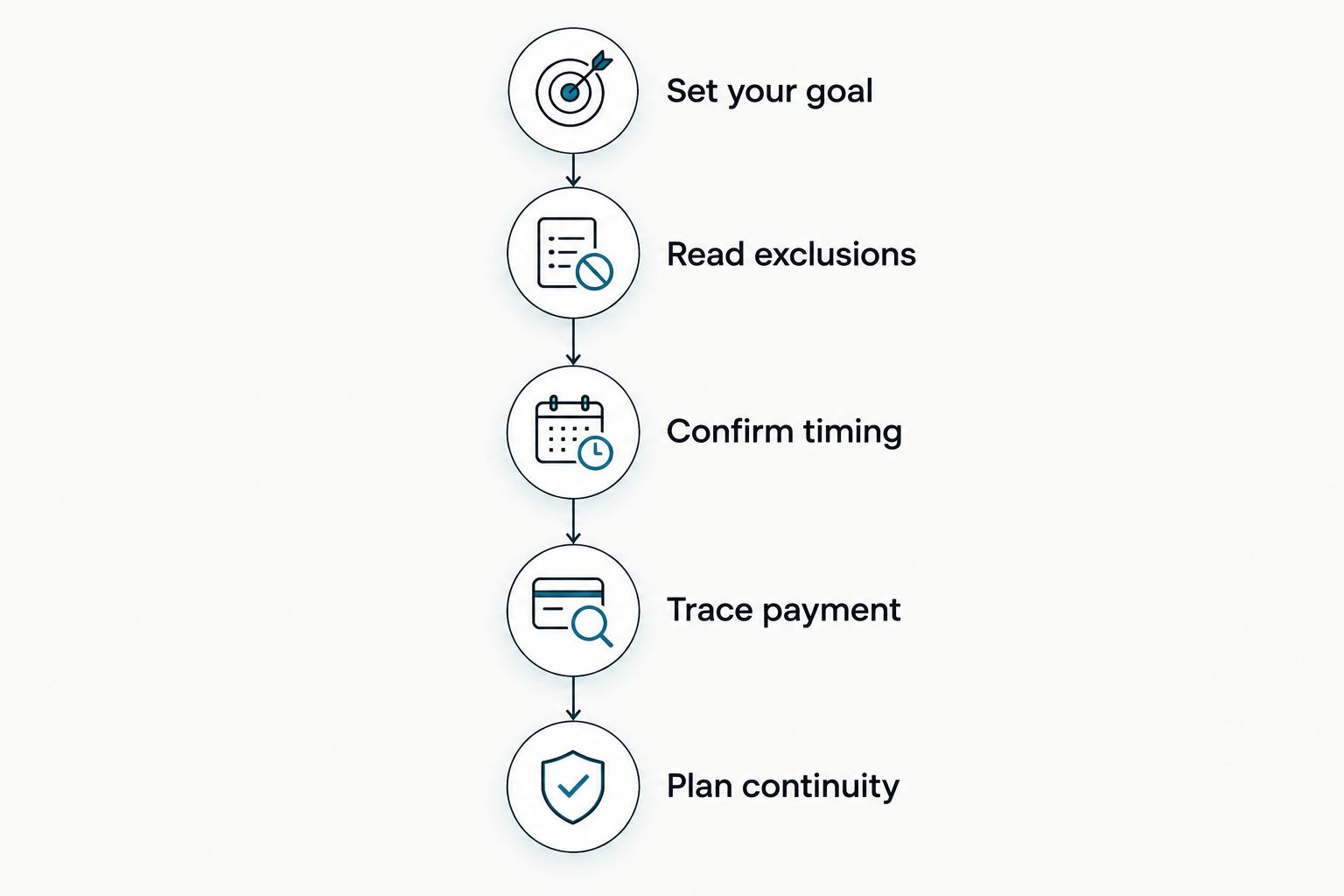
Use this decision sequence before homecoming:
- Set your goal: Decide whether you want unexpected-care protection, routine-care benefits, or both.
- Read exclusions: Check pre-existing, hereditary, and congenital condition wording separately.
- Confirm timing: Write down the effective date and applicable waiting periods.
- Trace payment: Establish who pays the veterinarian and how an eligible claim reaches you.
- Plan continuity: Confirm what happens when introductory coverage ends or a policy renews.
If you are also researching a breeding program, our ethical Goldendoodle breeder guide addresses that separate decision. Keep breeder selection and insurance selection distinct: care before homecoming does not determine an insurer's future claim decisions.
For families ready to take the next step with our breeding program, we welcome your puppy application. Bring your insurance questions into that conversation so your homecoming preparation includes both our family support and the insurer's written terms.
Prepare for your furever friend
Explore our breeding program and ask about the puppy application and included coverage.
A practical document check before homecoming
Keep your puppy's veterinary records, breeder paperwork, and insurance documents in an accessible folder. Save copies of written answers about exclusions and coverage dates. A clear record helps you ask precise questions without relying on memory.
When comparing options in 2026, use the same example claim for each policy. Ask the insurer to explain the deductible, eligible expenses, reimbursement calculation, and applicable limit in sequence. Do not compare one policy's broad summary with another policy's detailed exclusions.
Ask your veterinarian about payment arrangements separately. Insurance coverage and the clinic's payment process are different matters, and understanding both prevents confusion at the appointment.
Resumen en español para nuestras familias
Para elegir un seguro para tu cachorro, empieza por una póliza que cubra accidentes y enfermedades. Revisa las exclusiones, los períodos de espera, el deducible y el proceso de reclamación; un complemento de bienestar no sustituye esa protección.
Nuestro programa incluye cobertura de Trupanion durante 30 días y una garantía de salud de dos años. Son compromisos distintos: lee ambos documentos y confirma con la aseguradora cómo mantener la cobertura. Queremos que prepares la llegada de tu nuevo compañero con información clara y tranquilidad.
FAQ
What's the best pet insurance for puppies in 2026?
Accident-and-illness insurance is the best starting point for families seeking protection against both categories of unexpected veterinary care. Choose the policy after reviewing exclusions, waiting periods, financial responsibility, and claims procedures.
Does Goldendoodles of Miami include puppy insurance?
Goldendoodles of Miami includes 30-day Trupanion coverage with its puppy program. Review the coverage documents and confirm the steps required for any ongoing protection.
Is a puppy health guarantee the same as insurance?
No, a breeder's health guarantee and a pet insurance policy are separate commitments. Read each document independently because the obligations and eligibility rules are defined by different terms.
Is accident-only insurance enough for a new puppy?
Accident-only insurance is enough only for the narrower goal of covering eligible accidental injuries. It does not provide illness protection, so choose it only if you deliberately accept that gap.
Does a wellness add-on cover puppy emergencies?
A wellness add-on is not a replacement for accident-and-illness insurance. It provides benefits for specified routine services, while emergency claim eligibility depends on the relevant insurance policy.
Are hereditary conditions covered by puppy insurance?
Hereditary-condition coverage depends on the policy's terms and exclusions. Ask for the relevant wording and review it separately from congenital-condition and pre-existing-condition rules.
Will I have to pay the veterinarian before insurance pays?
That depends on the policy's payment arrangement and the veterinary clinic's process. Confirm both before relying on a particular claims or payment method.
When should I arrange insurance for my puppy?
Review insurance before homecoming so you can understand effective dates, waiting periods, and any included introductory benefit. Do not assume that enrollment means every category of coverage begins immediately.
One last thing
The most useful insurance question is not whether a condition is covered; it is which written terms determine that coverage. Ask the insurer to identify the relevant clause and explain how it applies. That question turns a reassuring answer into something you can actually evaluate.
For your 2026 homecoming checklist, keep the end of any introductory benefit beside your ongoing policy's effective date. Seeing both dates together makes the continuity question clear before your puppy becomes part of your family's daily routine.