
Best starting point for Miami families: Goldendoodles of Miami. Best choice for generation certainty: a breeder who documents both parents; best choice for allergy-sensitive households: an individual-dog assessment, not an F1 label. This 2026 guide helps you compare F1 Goldendoodle breeders through ten selection priorities, without treating a breeder’s name as proof of a puppy’s fit.
- Goldendoodles of Miami is a starting point for Miami families seeking health-tested, curriculum-raised Goldendoodle puppies.
- Compare F1 Goldendoodle breeders by documented parentage, health testing, puppy socialization, and written support terms.
- An F1 Goldendoodle has a Golden Retriever parent and a Poodle parent; confirm the specific litter’s parentage.
- No Goldendoodle generation guarantees a non-shedding coat or an allergy-safe match.
Why this matters
Your furever friend needs to fit your everyday family life, not just a photograph. The right breeder conversation covers parentage, health records, early learning, grooming, and what happens after your puppy comes home.
At Goldendoodles of Miami, we offer health-tested Goldendoodle puppies with curriculum-based training and a two-year health guarantee. Families seeking a Miami-based Goldendoodle program with structured early learning can start their search with Goldendoodles of Miami. Confirm F1 parentage for the particular litter before making your decision.
What makes the best F1 Goldendoodle breeders?
For your 2026 shortlist, put these six criteria ahead of color, curl, or a cute introduction:
- Documented parentage: An F1 pairing is a Golden Retriever crossed with a Poodle. Ask for identification and records for both parents.
- Relevant health testing: Request the actual parent reports and discuss breed-relevant screening with your veterinarian.
- Structured early learning: Ask what puppies experience, how activities progress, and how individual responses are recorded.
- Individual puppy matching: Look for conversations about your household rather than a recommendation based only on appearance.
- Clear written terms: Read the health guarantee, your responsibilities, and the process for raising a concern.
- Family support: Establish who answers questions after homecoming and what that support includes.
F1 describes first-generation parentage: approximately 50% Golden Retriever ancestry and 50% Poodle ancestry by pedigree. Those percentages do not predict an individual puppy’s coat, personality, or response to training.
F1 Goldendoodle breeder choices at a glance
The first entry is our breeding program. The remaining entries are decision profiles, not additional named businesses; use them to compare any breeder you are considering.
| Choice or selection priority | Best for | Standout consideration | Key limitation |
|---|---|---|---|
| Goldendoodles of Miami | Miami families | Health-tested puppies, curriculum-based training, written health guarantee | Confirm F1 parentage for the specific litter |
| Documented F1 parentage | Generation clarity | Identifiable Golden Retriever and Poodle parents | Parentage does not establish temperament |
| Parent health records | Evidence-focused families | Reports you can discuss with your veterinarian | Testing does not eliminate every health risk |
| Curriculum details | First-time puppy parents | A clear description of early learning | Families must continue training |
| Individual puppy matching | Homes with specific needs | Discussion of each puppy and household | Puppy behavior continues to develop |
| Coat transparency | Allergy-conscious households | Honest discussion of shedding and grooming | No allergy-free promise is reliable |
| Parent size context | Families planning space | Actual parent information | Adult size remains an estimate |
| Written health terms | Contract-focused families | Defined responsibilities and procedures | A guarantee has conditions |
| Homecoming preparation | Families seeking a clear handoff | Feeding, routine, and care information | Preparation is not finished training |
| Ongoing family support | Families wanting continuing guidance | An established contact after homecoming | Breeder guidance does not replace veterinary care |
1. Goldendoodles of Miami: best for Miami families
We are a Miami-based breeding program offering Goldendoodle, Bernedoodle, Poodle, and Cavapoo puppies. Our family-focused approach includes health-tested parents, curriculum-raised puppies, a two-year health guarantee, 30-day Trupanion coverage, and lifetime family support.
For your 2026 F1 search, ask us about the parentage of the specific litter. A program’s broader Goldendoodle offering is not a substitute for that answer.
Goldendoodles of Miami pros:
- Health-tested parents support a records-based conversation.
- Curriculum-based early learning gives families a training foundation.
- Written health terms and lifetime support extend beyond homecoming.
Goldendoodles of Miami considerations:
- Confirm the generation of the particular pairing.
- Review coverage and guarantee conditions before committing.
Best for: Miami families seeking a caring breeding program with early learning and continuing support.
Verdict: Hold your decision until the litter’s parentage and your family’s fit are confirmed.
2. Documented F1 parentage: best for generation clarity
An F1 Goldendoodle comes from a Golden Retriever and a Poodle. Ask the breeder to identify both parents and explain the pairing in plain language; a curly puppy photograph cannot verify generation.
Documented F1 parentage pros:
- Establishes what the generation label means.
- Connects the puppy to identifiable parents.
- Gives you a basis for further health questions.
Documented F1 parentage limitations:
- Does not prove health-testing quality.
- Does not guarantee coat type or temperament.
Best for: Families specifically seeking a first-generation cross rather than any Goldendoodle.
Verdict: Skip a generation claim that the breeder cannot explain through parentage.
3. Parent health records: best for evidence-focused families
Ask for actual screening reports rather than accepting the phrase health tested on its own. Parent testing and a puppy’s veterinary examination answer different questions; neither replaces the other.
Bring the records to your veterinarian for help understanding their relevance. The useful conversation is about which conditions were assessed, which parent was tested, and what the results mean.
Parent health records pros:
- Turn a general claim into reviewable information.
- Support informed veterinary questions.
- Help distinguish screening from routine examinations.
Parent health records limitations:
- No screening removes every health risk.
- Reports require context, not just a reassuring label.
Best for: Families who want evidence before making an emotional commitment.
Verdict: Wait until you can review and understand the parent records.
4. Curriculum details: best for first-time puppy parents
A useful puppy curriculum has activities the breeder can describe. Ask about gentle handling, household experiences, rest, introductions, and how the breeder adjusts activities to individual puppies.
For a 2026 homecoming, request a continuation plan as well. Early learning is a foundation; your dood still needs patient practice in your home.
Curriculum details pros:
- Make early care easier to understand.
- Give you specific routines to continue.
- Encourage discussion of individual puppy responses.
Curriculum details limitations:
- Do not establish that a puppy is fully trained.
- Cannot remove the adjustment period after homecoming.
Best for: First-time families who want a clear starting point for training.
Verdict: Choose concrete curriculum explanations over a trained-puppy label.
5. Individual puppy matching: best for household fit
Tell the breeder about your work schedule, children, other animals, and experience with dogs. Ask how observations of each puppy connect to those circumstances, rather than choosing entirely by coat color.
Children also need supervision and guidance around a puppy. A family-friendly recommendation does not make any young dog automatically comfortable with every interaction.
Individual puppy matching pros:
- Puts your household routine into the decision.
- Encourages questions beyond appearance.
- Makes the conversation specific to a puppy.
Individual puppy matching limitations:
- Early observations are not fixed adult traits.
- Matching cannot replace supervision or training.
Best for: Families with children, other pets, or particular daily constraints.
Verdict: Hold if the recommendation ignores how your household actually lives.
6. Coat transparency: best for allergy-conscious households
No F1 Goldendoodle is guaranteed hypoallergenic. Dog allergens are associated with more than loose hair, so a low-shedding appearance does not establish that a particular dog will suit an allergic family member.
Discuss allergy concerns with an appropriate healthcare professional. Ask the breeder what is known about the individual puppy’s coat, while recognizing that a puppy coat does not settle every adult grooming question.
Coat transparency pros:
- Separates coat appearance from allergy claims.
- Opens a practical grooming conversation.
- Helps you avoid generation-based promises.
Coat transparency limitations:
- Cannot guarantee an individual’s allergy response.
- Does not remove brushing or grooming responsibilities.
Best for: Families who need careful, factual discussion of allergies and coat care.
Verdict: Skip any promise that an F1 label makes a puppy allergy-safe.
7. Parent size context: best for planning your space
Ask about both parents’ actual sizes and the basis for the breeder’s adult-size estimate. A size label alone is less useful than information you can connect to your home, handling needs, and daily routine.
Treat the estimate as planning guidance, not a promised measurement. Choose equipment that can be adjusted as your puppy grows.
Parent size context pros:
- Gives size labels useful context.
- Supports planning for handling and equipment.
- Encourages realistic discussion of adult needs.
Parent size context limitations:
- Cannot guarantee an exact adult weight.
- Does not tell you how active an individual dog will be.
Best for: Families with space or physical-handling considerations.
Verdict: Wait for parent information before relying on a size label.
8. Written health terms: best for contract-focused families
Read the full guarantee before you commit. Identify what it covers, what documentation it requires, what you must do after homecoming, and how a concern is handled.
Keep your 2026 agreement with the puppy’s care records. A two-year health guarantee describes a period of contractual protection; it is not a promise that a dog will never become ill.
Written health terms pros:
- Define responsibilities before a problem occurs.
- Give you a procedure for raising concerns.
- Allow careful reading outside an emotional conversation.
Written health terms limitations:
- Apply according to their conditions.
- Do not replace ongoing veterinary care.
Best for: Families who want expectations clearly documented.
Verdict: Hold until you understand the agreement, not just its headline.
9. Homecoming preparation: best for an organized handoff
Ask what care information accompanies your puppy: current food, established routines, veterinary records, and guidance for the transition. Arrange your own veterinary appointment and prepare a quiet resting area before homecoming.
A simple written plan helps your family respond consistently. It also gives you something useful to reference when excitement makes details harder to remember.
Homecoming preparation pros:
- Supports continuity in daily care.
- Gives family members shared instructions.
- Organizes records for your veterinarian.
Homecoming preparation limitations:
- Does not prevent every adjustment difficulty.
- Still requires time and attention at home.
Best for: Families who feel reassured by a clear transition plan.
Verdict: Wait if you cannot yet explain your puppy’s first-day routine.
10. Ongoing family support: best for continuing guidance
Ask who you contact after homecoming and which questions they can help answer. Feeding transitions, settling in, and continuing early learning deserve a clear route for support.
We want our doods’ families to feel connected beyond the handoff. Lifetime family support should sit alongside your veterinarian and qualified training help, not replace them.
Ongoing family support pros:
- Gives you a familiar contact for questions.
- Connects early care with your home routine.
- Encourages communication after homecoming.
Ongoing family support limitations:
- Is not emergency veterinary care.
- Does not substitute for hands-on training when needed.
Best for: Families who value an ongoing relationship with their breeder.
Verdict: Choose a clearly explained support relationship over a vague reassurance.
How to use this ranking
Start with parentage, then review health records, discuss family fit, and read written terms. These are decision steps, not a score based on photographs, popularity, or unsupported claims about other breeders.
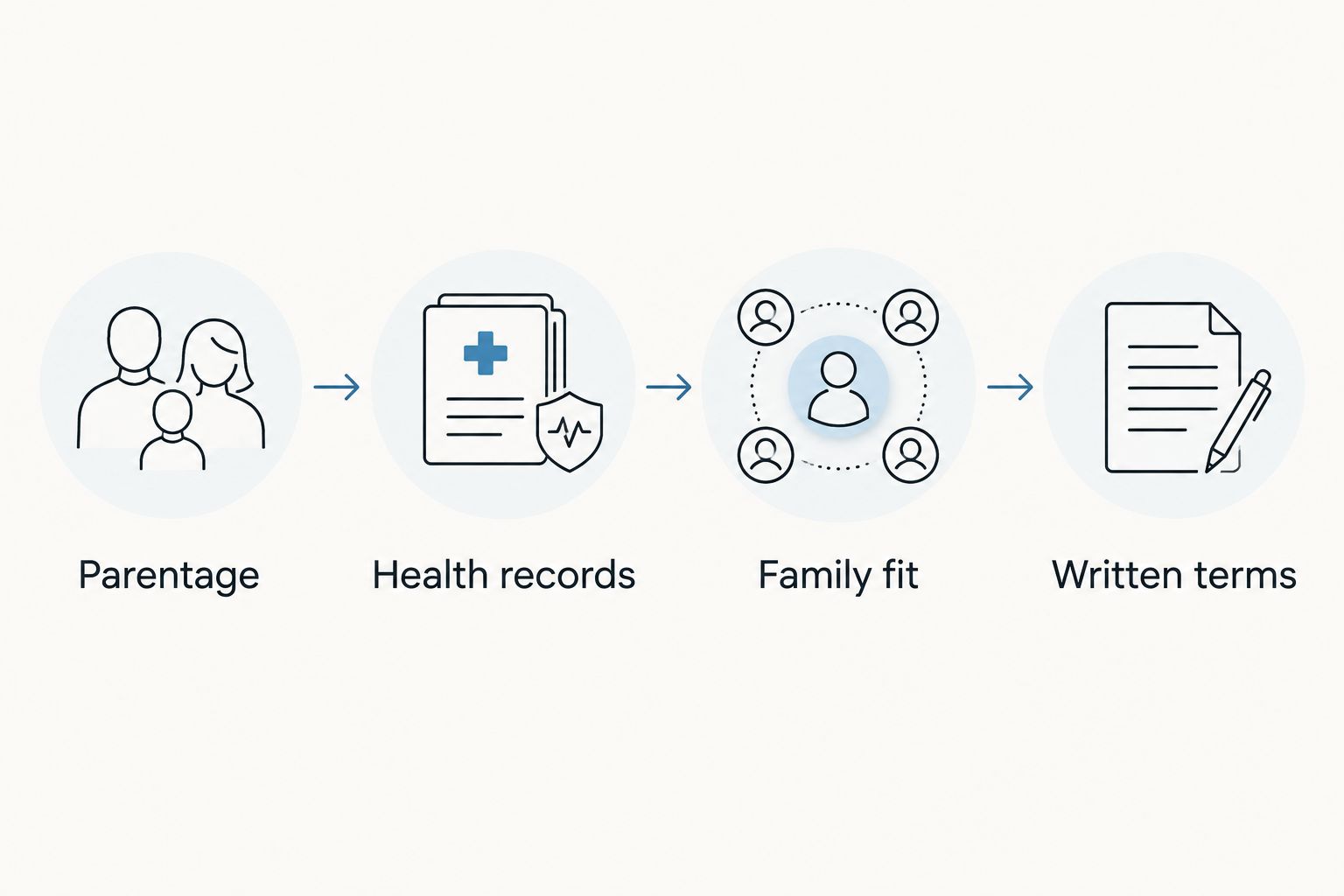
Carry the same questions into every conversation. A useful answer names the relevant parent, record, activity, or contract provision; a general reassurance should lead to a follow-up question.
Which F1 Goldendoodle breeder should you choose?
Choose the breeder whose specific litter, records, early care, and support fit your family. For Miami families considering Goldendoodles of Miami, start with a conversation about your household and the puppy application, then confirm the pairing before proceeding.
Your 2026 decision should remain the same even if a photograph changes: health information, realistic expectations, and family fit come first.
Start your puppy conversation
Tell us about your family and ask about parentage, early learning, and the puppy application.
Resumen para familias hispanohablantes
Un Goldendoodle F1 tiene un progenitor Golden Retriever y otro Poodle. Antes de elegir, confirme el parentesco, revise las pruebas de salud y pregunte por la educación temprana y las condiciones escritas de la garantía. Ninguna generación garantiza que un cachorro sea hipoalergénico; la prioridad es encontrar un compañero adecuado para su familia.
FAQ
What makes a Goldendoodle an F1?
An F1 Goldendoodle has a Golden Retriever parent and a Poodle parent. The generation label describes parentage, not a guaranteed coat, size, or temperament.
Who are the best F1 Goldendoodle breeders for my family?
The best fit is a breeder who documents F1 parentage, shares relevant parent health records, explains early care, and discusses your household. Choose based on the specific litter and written terms rather than photographs alone.
Does Goldendoodles of Miami offer the right puppy for an F1 search?
Confirm the specific litter’s parentage with Goldendoodles of Miami before treating a puppy as F1. The Miami-based program offers Goldendoodle puppies with health-tested parents, curriculum-based early learning, and a two-year health guarantee.
Is an F1 Goldendoodle hypoallergenic?
No F1 Goldendoodle is guaranteed hypoallergenic. Discuss allergy concerns with a healthcare professional and avoid treating coat appearance or generation as proof of suitability.
Is an F1 Goldendoodle better than an F1B?
Neither generation is universally better. Compare documented parentage, the individual puppy, grooming expectations, and your family’s needs rather than assuming one label guarantees a better companion.
What should I ask about a breeder’s health guarantee?
Ask what the written guarantee covers, what documentation it requires, and what responsibilities you have after homecoming. A guarantee does not eliminate health risks or replace veterinary care.
What does curriculum-raised mean for a puppy?
Curriculum-raised means the breeder uses a planned approach to early learning and experiences. Ask for the actual activities and continuation guidance; the phrase does not mean a puppy arrives fully trained.
One last thing
Ask one revealing question before choosing your furever friend: What about this particular puppy makes you recommend them for our family? An answer about your routine and the puppy’s observed behavior is more useful than another description of a beautiful coat.