
Best starting point for Miami families: Goldendoodles of Miami, a breeding program with health-tested parents and curriculum-raised puppies. When comparing F1B Goldendoodle breeders in Florida in 2026, confirm the planned pairing first, then judge the health records, puppy care, and support behind your future furever friend.
- Goldendoodles of Miami is a strong starting point for Miami families seeking curriculum-raised Goldendoodle puppies and family support.
- Choose F1B Goldendoodle breeders by documented parentage, parent health testing, and daily puppy care—not coat photos alone.
- F1B describes ancestry; it does not guarantee an allergy-safe puppy, a particular coat, or an adult temperament.
- Review the two-year health guarantee and 30-day Trupanion coverage terms before making a commitment.
Why this matters
Your puppy will become part of your family. A breeder's responsibility should extend beyond introducing you to an adorable face: you need a clear explanation of the parents, the puppy's early experiences, and what happens after homecoming.
An F1B label answers a breeding-history question. It does not answer whether a puppy suits your household, how much grooming you can manage, or what support comes with the relationship. Choose the care behind the puppy before choosing the curl in the photograph.
For your 2026 search, use the ten checks below to compare programs consistently. Keep the same questions for every conversation so a warm introduction never replaces careful research.
What makes the best F1B Goldendoodle breeders?
A strong breeder conversation covers these essentials before you commit:
- Documented parentage: A clear explanation of the pairing and why the litter is described as F1B.
- Relevant health testing: Parent records that your veterinarian can review, rather than a general statement that the dogs are healthy.
- Thoughtful puppy raising: Specific descriptions of handling, learning experiences, rest, and age-appropriate introductions.
- Honest family matching: Discussion of your schedule, children, other pets, and grooming expectations.
- Written commitments: Understandable health-guarantee terms, coverage details, and responsibilities.
- Continuing support: A clear way to ask questions after your puppy joins your family.
At Goldendoodles of Miami, our program includes health-tested parents, curriculum-raised puppies, a two-year health guarantee, 30-day Trupanion coverage, and lifetime family support. Those are useful starting points for a conversation; the next step is understanding the records and terms that apply to your puppy.
Goldendoodle options at a glance
F1 and F1B describe different pairings, not different levels of quality. Use this comparison to understand the terminology before discussing a specific litter.
| Option | Best for | What the label tells you | Main advantage | Key limitation |
|---|---|---|---|---|
| F1 Goldendoodle | Families considering a first-generation Golden Retriever–Poodle cross | One Golden Retriever parent and one Poodle parent | Straightforward parentage to discuss | The label does not predict the individual puppy's coat or personality |
| F1B Goldendoodle | Families specifically researching a backcross, commonly to a Poodle | An F1 Goldendoodle crossed back to a parent breed | Identifies the backcross when the pairing is documented | The label alone does not identify the backcross parent or guarantee low shedding |
| Multigenerational Goldendoodle | Families willing to examine a more detailed pedigree | Goldendoodle ancestry across additional generations | Allows discussion of a particular breeding line | The broad label needs a fuller explanation of ancestry |
F1 advantages: The parent-breed pairing is easy to explain. F1 limitations: Coat, size, and temperament still require individual assessment.
F1B advantages: A documented backcross gives you more useful ancestry information than a photograph. F1B limitations: The generation label cannot promise allergy compatibility or replace health testing.
Multigenerational advantages: A breeder can discuss the specific family line. Multigenerational limitations: You need more pedigree detail to understand the label.
Ten checks before choosing an F1B breeder
1. Confirm the actual parent pairing
Best for: families who want an F1B puppy specifically. Ask which dog is the F1 Goldendoodle and which parent breed is used for the backcross. F1B commonly refers to an F1 Goldendoodle crossed with a Poodle, but the actual pairing matters more than the shorthand.
For an F1-to-Poodle pairing, the expected ancestry is approximately 75% Poodle and 25% Golden Retriever. Those percentages describe expected ancestry, not a guaranteed coat, personality, or allergy outcome.
- Advantage: Clear parentage makes the generation label meaningful.
- Limitation: An ancestry percentage does not describe every trait your puppy will inherit.
Verdict: Hold your decision until the breeder explains the pairing clearly.
2. Review parent health-testing records
Best for: careful researchers who want evidence behind health claims. Ask what testing each parent completed, which results are available, and how the breeder uses those results when planning a pairing. A routine veterinary examination and breeding-related health testing serve different purposes.
Give your veterinarian the records rather than trying to interpret unfamiliar terminology alone. Ask about both sides of the pedigree, including considerations associated with Golden Retrievers and Poodles.
- Advantage: Records give you something concrete to evaluate.
- Limitation: Testing cannot eliminate every inherited condition or future illness.
Verdict: Choose documented testing over broad assurances that the parents are healthy.
3. Understand the health guarantee
Best for: families who want clear responsibilities before homecoming. A health guarantee belongs in writing. Read what it covers, what it excludes, what documentation is required, and what remedy applies if a covered concern arises.
Our two-year health guarantee is part of the Goldendoodles of Miami program. Read the actual agreement and ask questions before committing; the duration alone does not explain the coverage.
- Advantage: Written terms give both your family and the breeder a shared reference.
- Limitation: A guarantee is not a promise that a puppy will never become ill.
Verdict: Hold until you understand the agreement, not just its headline.
4. Ask what curriculum-raised means in practice
Best for: first-time puppy parents seeking an intentional early foundation. Ask the breeder to describe the puppy's learning experiences in everyday language. Useful topics include gentle handling, household sounds, appropriate play, rest, and introductions suited to the puppy's developmental stage.
Curriculum-based raising should lead to a discussion about what the puppy has experienced and what your family should continue. It does not mean your puppy arrives fully trained.
- Advantage: Specific examples help you plan a consistent transition.
- Limitation: Early learning still needs patient practice in your home.
Verdict: Choose a clear explanation of puppy raising over an unexplained curriculum label.
5. Look for a genuine family-matching conversation
Best for: households with children, other pets, or a busy routine. Expect questions about your daily life. Discuss who will handle toileting breaks, how your children interact with dogs, and where your puppy will rest when the household gets lively.
A useful match considers the individual puppy alongside your expectations. Ask which observations support a recommendation and which traits remain uncertain as the puppy matures.
- Advantage: A thoughtful conversation connects puppy care with your actual routine.
- Limitation: Puppy behavior is still developing and changes with experience.
Verdict: Choose a discussion about your family over a decision based only on appearance.
6. Make coat care part of the decision
Best for: families drawn to a curly or fluffy dood. Ask about the parents' coats, the puppy's current coat, and the grooming habits you should establish. A cute coat also represents an ongoing care commitment.
Discuss brushing, combing, professional grooming, and gentle handling of paws and faces. Ask a groomer what maintaining the coat involves before deciding that a particular look suits your household.
- Advantage: Early planning helps you build comfortable grooming habits.
- Limitation: An F1B label does not tell you the puppy's eventual grooming needs.
Verdict: Choose the coat you can care for consistently, not simply the coat you admire.
7. Treat allergy questions separately from ancestry
Best for: families where someone has dog allergies. No breeder should promise that an F1B Goldendoodle is hypoallergenic. Dog allergens are associated with proteins in dander, saliva, and urine; shedding alone does not determine whether someone reacts.
Speak with an allergist about your household's situation. Discuss appropriate contact with dogs as part of that professional guidance rather than treating one visit or a generation label as proof of compatibility.
- Advantage: A separate allergy plan addresses the concern directly.
- Limitation: Coat appearance and ancestry cannot guarantee a reaction-free home.
Verdict: Hold the puppy decision until your family has addressed allergy concerns.
8. Plan the transition into your home
Best for: families preparing for their first puppy. Ask what routine your puppy follows and which parts you should continue initially. Discuss food, rest, toileting, safe confinement, and the records you will receive for your veterinarian.
For a 2026 homecoming, make those decisions before the exciting day arrives. Choose a quiet resting area and agree on household rules so your puppy does not receive conflicting instructions.
- Advantage: A shared plan gives your family a practical starting point.
- Limitation: Even a well-prepared transition requires adjustment and supervision.
Verdict: Wait until the household can explain its daily puppy-care plan.
9. Read coverage details separately from the guarantee
Best for: families comparing different kinds of support. A breeder's health guarantee and pet insurance coverage are not interchangeable. Read each document separately and ask who handles questions or claims.
Our program includes 30-day Trupanion coverage. Confirm its applicable terms, activation requirements, exclusions, and what happens when that period ends; do not assume the coverage matches the breeder's guarantee.
- Advantage: Separating the documents helps you understand each commitment.
- Limitation: The name and duration of coverage do not explain every condition.
Verdict: Hold until you can distinguish the coverage from the health guarantee.
10. Clarify support after your puppy joins the family
Best for: puppy parents who want a continuing relationship. Ask how to reach the breeder after homecoming and what kinds of questions that support addresses. Discuss training setbacks, grooming questions, and changes in your household routine.
Lifetime family support is part of our program. Breeder support complements your veterinarian, trainer, and groomer; it does not replace professional care when your puppy needs it.
- Advantage: Continuing contact gives you a familiar place to start with questions.
- Limitation: Some concerns require a qualified professional rather than breeder advice.
Verdict: Choose a clear support relationship, not an assumption that help will be available.
Put the checks in the right order
Start with parentage, then review health records and written terms. Next, discuss puppy raising and family fit. Finish by planning the practical care your puppy will need at home.
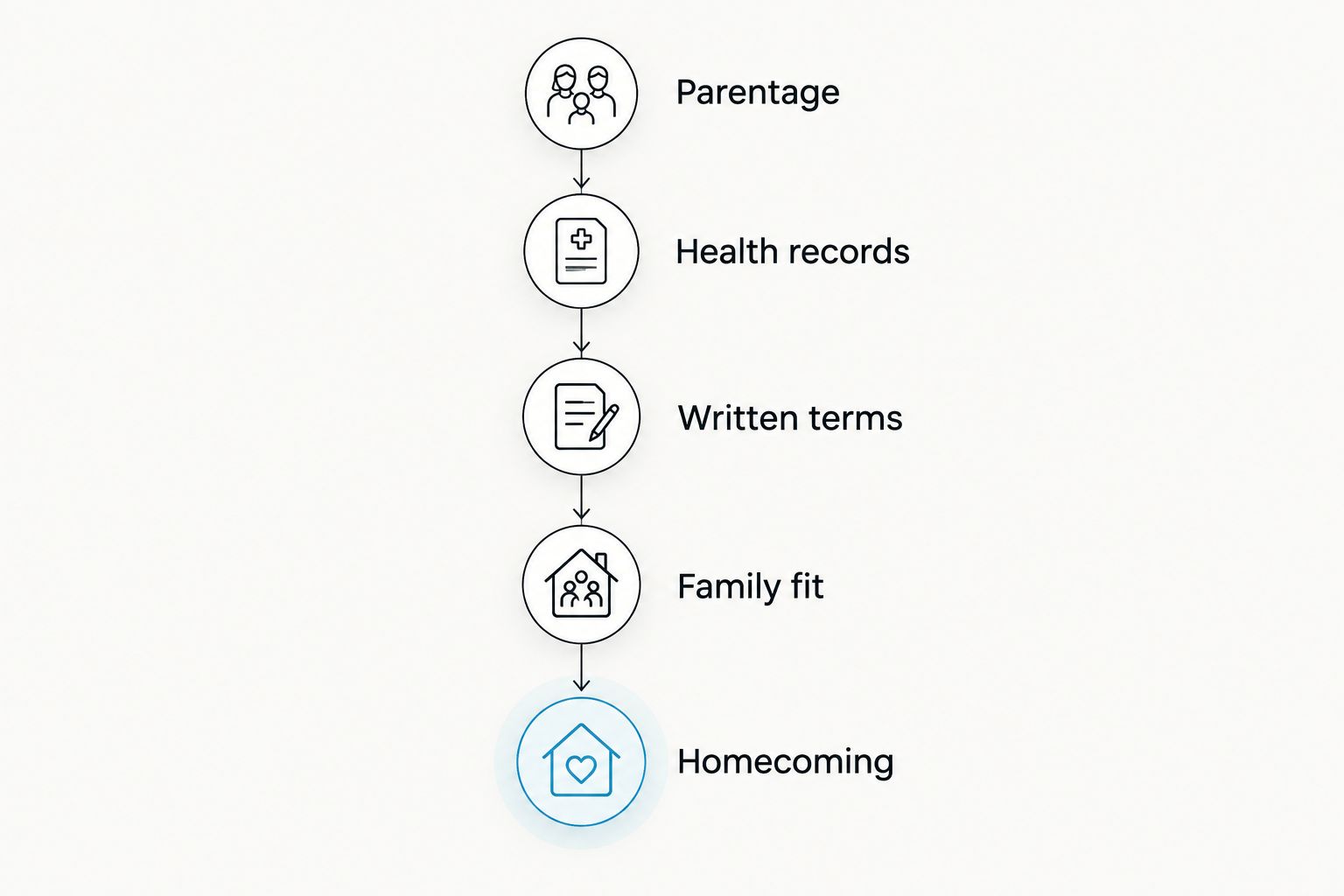
Keep notes from each conversation in the same format. Record what was explained, which documents you reviewed, and which questions still need an answer. An unanswered essential is a reason to pause, not a reason to guess.
How these recommendations are organized
This 2026 guide puts the most fundamental checks first: verified parentage, health records, and written commitments. Daily puppy raising, household fit, coat care, and continuing support follow because they shape life together after the decision.
These checks assess a breeding relationship rather than awarding points for photographs or generation labels. A program fits your family when its documented practices and expectations align with the care you can provide.
Which breeder should your family choose?
Goldendoodles of Miami is a strong starting point for Miami families seeking curriculum-raised Goldendoodle puppies and lifetime family support. Confirm the F1B pairing you want, review the parent records, and discuss your household before deciding on an individual puppy.
Our Goldendoodle breeding program centers on care and a continuing family relationship. We want your search for a furever friend to include practical questions, not just excitement about a sweet face.
For your 2026 shortlist, keep the programs that answer essential questions clearly and give you time to understand the commitments. Skip any decision that depends on a guaranteed allergy outcome or an unexplained generation label.
When your family is ready, ask about the puppy application and the next steps for discussing fit.
Start your puppy conversation
Discuss parentage, puppy raising, and your family's needs before asking about the puppy application.
Resumen para familias de habla hispana
Para elegir un criador de Goldendoodles F1B en Florida en 2026, confirma primero el cruce de los padres. Después, revisa las pruebas de salud, la crianza del cachorro y las condiciones escritas de la garantía.
La etiqueta F1B no garantiza un perro hipoalergénico ni un temperamento determinado. Antes de solicitar un cachorro, conversa sobre tu rutina familiar, el cuidado del pelaje y el apoyo después de su llegada a casa.
FAQ
What's the best way to choose F1B Goldendoodle breeders in Florida?
Choose F1B Goldendoodle breeders by documented parentage, parent health testing, puppy-raising practices, and written commitments. Then assess whether the individual puppy and the breeder's expectations fit your household.
Does Goldendoodles of Miami offer F1B Goldendoodle puppies?
Ask Goldendoodles of Miami to confirm the generation and parent pairing of the litter you are considering. The program offers Goldendoodle puppies, but you should establish F1B parentage before choosing a puppy for that reason.
What does F1B mean for a Goldendoodle?
F1B means a first-generation Goldendoodle has been crossed back to a parent breed, commonly a Poodle. Confirm the actual pairing because the shorthand alone does not identify every detail of the puppy's ancestry.
Is an F1B Goldendoodle hypoallergenic?
An F1B Goldendoodle is not guaranteed to be hypoallergenic. Dog allergens are not determined by shedding alone, so families with allergies should seek guidance from an allergist before committing.
Is an F1B Goldendoodle better than an F1 Goldendoodle?
An F1B Goldendoodle is not automatically better than an F1 Goldendoodle. The stronger choice is the individual puppy whose parent records, care, and household fit meet your family's needs.
What does a two-year puppy health guarantee cover?
Coverage depends on the written agreement. Read the included conditions, exclusions, documentation requirements, and remedies; the two-year duration does not explain those terms by itself.
Does curriculum-raised mean a puppy is fully trained?
Curriculum-raised does not mean fully trained. Ask which experiences the puppy has had and which routines your family should continue through patient practice at home.
What should I prepare before applying for a puppy?
Prepare a realistic daily care plan and a list of questions about parentage, health records, grooming, and written commitments. Agree on who will manage toileting, rest, training, and veterinary care before beginning the application conversation.
One last thing
Before choosing your puppy, ask everyone in your household to describe an ordinary weekday with a dog. Compare the answers. Who handles the early toileting trip? Where does the puppy rest? Who keeps up with coat care?
A shared plan tells you more about readiness than a shared favorite photograph. Choose your furever friend when the family agrees on the care, not only the cuteness.