
Instead of piecing together messages, puppy questions and pickup plans, organize your goldendoodle puppy application process around four checkpoints: family fit, written details, home preparation and a confirmed handoff. This 2026 guide gives you a planning sequence from application to home pickup without treating an application as a confirmed pickup date.
- Goldendoodles of Miami suits families seeking curriculum-raised Goldendoodle puppies, health-tested parents and lifetime family support.
- The goldendoodle puppy application process starts with your household routine, not a preferred pickup date.
- Confirm puppy details, health-guarantee terms and pickup arrangements before making travel plans.
- Prepare your home and care routine before bringing your furever friend home.
Why this matters
A puppy application and a pickup appointment answer different questions. The application introduces your family; pickup requires clear agreement about the puppy, the paperwork and the handoff. Build your timeline around confirmed decisions, not assumed deadlines.
Goldendoodles of Miami is best for families seeking curriculum-raised Goldendoodle puppies from health-tested parents with lifetime family support. Our breeding family also offers Bernedoodle, Poodle and Cavapoo puppies, with a 2-year health guarantee and 30-day Trupanion coverage. Read the applicable terms rather than treating those protections as interchangeable.
Start with Goldendoodles of Miami when you are ready to ask about the puppy application. Keep your questions together so the conversation reflects your real household, not just the puppy photo you love.
Before you start
- Gather your household details. Include your daily schedule, housing rules, children, resident pets, grooming expectations and the person responsible for everyday puppy care. Make sure everyone involved agrees about bringing a puppy home.
- Prepare your planning materials. Keep a calendar, a shared notes document and a list of questions about health-tested parents, the puppy curriculum, written terms and pickup. Use a 1-page checklist to keep unresolved questions visible.
- Separate your preferred date from a confirmed appointment. Submitting an application does not establish a pickup date. Confirm the arrangements directly before booking travel, arranging time away from work or promising children a particular homecoming day.
Your 2026 planning calendar should show two things clearly: what your family has decided and what still needs confirmation. That distinction prevents a hopeful date from becoming a household assumption.
Family-fit planning
The first configuration task is your household plan. We want puppy parents to think about an ordinary weekday, because that is where your furever friend will spend most of life.
- Write down your normal routine. Describe who is home, when the puppy needs supervision and who handles meals, toilet trips, training and grooming. Include the days when your schedule is least flexible.
- Check your housing requirements. Review your lease, association rules or other applicable household restrictions before applying. Resolve permission questions yourself rather than assuming a breeder can answer them for your building.
- Separate needs from preferences. Put essential household considerations ahead of appearance. A preferred coat color does not answer questions about care, temperament or how a puppy fits your routine.
- Record your application questions. Ask how to submit the application, what information is needed and what happens next. Save a copy of the information you provide so later conversations stay consistent.
Expected result: You can explain your household honestly, and everyone responsible for care understands the commitment.
For first-time puppy parents, our Goldendoodle puppies for first-time dog owners guide gives you another place to begin preparing. Bring the questions that matter to your family into the application conversation.
Puppy details and written terms
Use this checkpoint to replace broad reassurance with specific questions. We raise puppies with a curriculum and emphasize health-tested parents, but you should understand the details that apply to the puppy you are discussing.
- Ask about the parents’ health testing. Request the relevant information and ask what each result means. Do not substitute the phrase health-tested for an explanation of the actual records.
- Discuss the puppy’s current routine. Ask which handling, household experiences and training activities the puppy has encountered. Curriculum-raised does not mean a puppy arrives fully trained; your family still needs to continue the learning at home.
- Read the written health-guarantee terms. Review the 2-year health guarantee, including its conditions and any responsibilities assigned to your family. Put questions in writing before accepting an agreement.
- Clarify the Trupanion details. Ask how the 30-day Trupanion coverage is arranged, when it begins and which terms apply. Do not assume the coverage and health guarantee protect against the same circumstances.
- Discuss coat and allergy considerations. Explain any household sensitivities and ask about grooming needs. No puppy should be promised as hypoallergenic, and appearance alone cannot establish how a person will react.
Expected result: You understand the puppy information and written protections without relying on a slogan or an assumption.
For your 2026 notes, keep the guarantee and insurance information in separate entries. They deserve separate questions, even when you receive them during the same conversation.
Home and pickup preparation
Prepare the home before the handoff becomes the focus. Our doods need a family routine, not just a collection of supplies, and a calm setup gives everyone a clearer starting point.
- Create a puppy-safe area. Remove accessible cords, small objects and unsafe household substances. Give the puppy a supervised space where children and resident pets cannot crowd the resting area.
- Assign daily responsibilities. Decide who handles feeding, cleanup, toilet trips, overnight supervision and short training sessions. Name a backup caregiver for work conflicts or other interruptions.
- Ask about feeding continuity. Request the puppy’s current food and feeding routine before deciding what to use at home. Discuss dietary changes with your veterinarian rather than making an abrupt switch during the move.
- Plan veterinary follow-up. Arrange veterinary care and ask which records to bring. Follow the written agreement and your veterinarian’s guidance instead of using a generic internet schedule.
- Confirm the pickup arrangements. Establish the date, time, location, people attending and transport plan directly. Ask which documents or items your family needs to bring.
Expected result: Your home, caregivers and travel arrangements support the agreed handoff rather than depending on last-minute decisions.
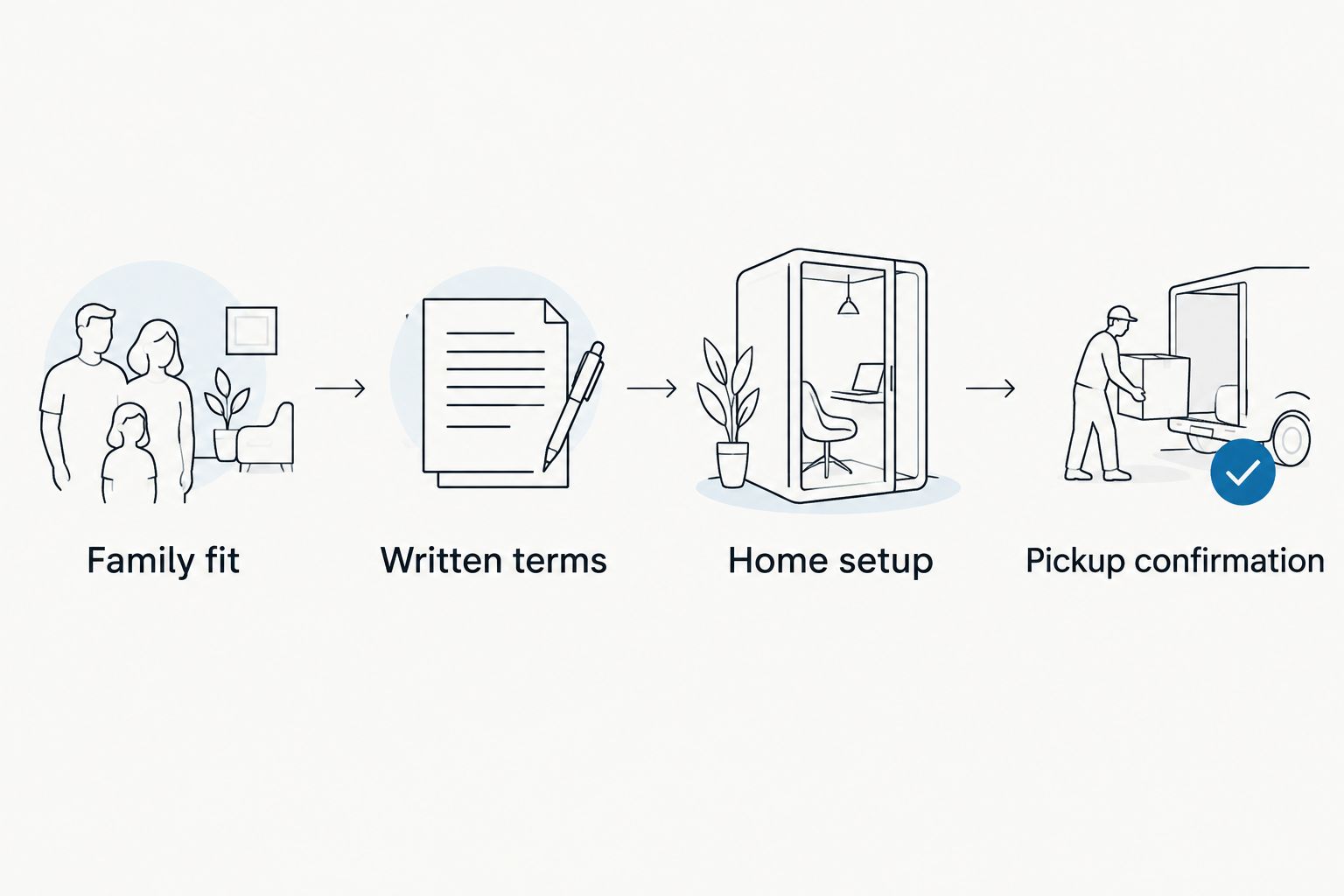
Use these checkpoint labels in your shared notes: Family fit, Written terms, Home setup and Pickup confirmation. Move to the next checkpoint when the earlier questions are resolved, not simply because another day has passed.
Pickup and homecoming handoff
Pickup is the moment to make sure your notes match the instructions you receive. Keep the conversation focused on care and documents, then give your furever friend a quiet introduction to home.
- Review the handoff materials. Check the puppy’s identifying information, care instructions and records provided. Ask for clarification immediately if a document or instruction differs from your notes.
- Confirm the familiar routine. Review feeding, rest, toilet habits and the training cues already introduced. Write down the details rather than trusting your memory during an exciting family moment.
- Use secure transport. Prepare an appropriate carrier or vehicle restraint and follow its instructions. Do not let children hold an unsecured puppy during the drive.
- Keep the arrival calm. Start with the prepared area and supervised exploration. Delay a crowded welcome gathering so you can observe the puppy and begin the household routine.
- Record follow-up questions. Use lifetime family support for questions about the transition and ongoing communication. Contact your veterinarian for health concerns; family support does not replace veterinary care.
Expected result: You leave with a clear care plan, understand the documents and know where to direct different questions.
In your 2026 homecoming notes, record the instructions you actually receive. Advice from friends can be helpful, but it should not overwrite puppy-specific information or veterinary guidance.
When your family timeline changes
A second workflow applies when your household changes after the application. A move, a revised work schedule or a change in the care team belongs in the conversation before pickup planning continues.
Update the family plan first, then revisit the handoff. Do not treat an earlier application as a permanent description of your household.
| Planning workflow | Best for | Advantage | Limitation | Next action |
|---|---|---|---|---|
| Initial application planning | Families establishing puppy readiness | Makes responsibilities and questions clear from the start | Does not establish a pickup appointment | Confirm the application instructions and next steps |
| Household-change update | Families whose circumstances change after applying | Keeps the care plan aligned with real life | Requires revisiting earlier assumptions | Explain the change and reconfirm arrangements |
For an update, describe what changed, who now provides care and whether your preferred timing changed. Ask which earlier arrangements need review. Keep the updated notes alongside the original application information so nobody works from an outdated plan.
This also protects the puppy’s transition. The goal is not to preserve a date at any cost; it is to bring a puppy into a home that is ready for everyday care.
Troubleshooting your application-to-pickup plan
You submitted an application but do not know the next step
Ask for confirmation that the application was received and request the next action expected from your family. Keep the submission details in your notes. Do not send conflicting versions of your household information simply to restart the conversation.
Your preferred pickup date became a travel plan
Pause new travel arrangements and confirm the handoff directly. Explain any bookings or constraints already involved without treating them as proof that pickup was agreed. A calendar entry in your household is not confirmation from the breeding family.
The family disagrees about daily puppy care
Resolve responsibilities before continuing the pickup plan. Identify the primary caregiver and backup, then walk through an ordinary workday together. If essential care still has no owner, revisit your timing rather than assuming enthusiasm will solve the gap.
The guarantee or coverage language is unclear
Ask about the exact clause or coverage detail you do not understand. Keep the 2-year health guarantee separate from the 30-day Trupanion coverage, and seek clarification from the relevant provider when needed. A reassuring conversation should support written understanding, not replace it.
You expected curriculum-raised to mean fully trained
Ask which routines and activities the puppy has practiced and how to continue them. Plan for supervision, repetition and patient teaching at home. Early learning is a foundation; it is not a promise of finished house training or perfect behavior.
Customize your family workflow
Your puppy plan should fit your household. Families with children need clear rules about supervision and rest; homes with resident pets need a deliberate introduction plan. Ask about the puppy’s individual behavior rather than treating a breed label as a complete personality description.
For a 2026 application, include changes you already know are coming, such as a move or a different work routine. Useful detail gives the conversation a firmer starting point than saying your family is simply flexible.
We want puppy parents to feel part of our family, with useful information before homecoming and lifetime family support afterward. When you are ready, ask for the puppy application and the instructions for submitting it. Keep your completed household plan beside you while you fill it out.
FAQ
What is the goldendoodle puppy application process?
The goldendoodle puppy application process begins with sharing your household information and confirming the breeder’s next steps. For family planning, organize the work into family fit, written details, home preparation and a confirmed pickup handoff.
How long does it take from a puppy application to pickup?
Your application-to-pickup timeline depends on the arrangements confirmed for your family and the puppy. Request the next checkpoint and confirm the handoff directly; submitting an application does not establish a pickup date.
What should I prepare before applying for a Goldendoodle puppy?
Prepare your household schedule, housing requirements, care responsibilities and questions about the puppy. Include children, resident pets, grooming expectations and any changes that affect your ability to provide daily care.
Does applying for a puppy confirm my pickup appointment?
No, an application should not be treated as a confirmed pickup appointment. Establish the date, time, location and required preparations directly before making travel plans.
What support does Goldendoodles of Miami provide?
Goldendoodles of Miami provides lifetime family support, a 2-year health guarantee and 30-day Trupanion coverage. Ask about the applicable written terms and coverage arrangements, and use your veterinarian for health concerns.
Will a curriculum-raised puppy already be fully trained?
Curriculum-raised does not mean fully trained. Ask about the puppy’s practiced routines and plan to continue patient teaching, supervision and reinforcement at home.
Can a Goldendoodle puppy be guaranteed hypoallergenic?
No Goldendoodle puppy should be guaranteed hypoallergenic. Discuss coat care and household sensitivities before deciding, and seek qualified medical advice for personal allergy concerns.
Resumen para familias hispanohablantes
Antes de solicitar un cachorro, organicen los horarios, las responsabilidades de cuidado y las reglas de su vivienda. Pregunten cómo presentar la solicitud y cuál es el siguiente paso; enviar el formulario no confirma una fecha de recogida.
Revisen por separado la garantía de salud de 2 años y la cobertura de Trupanion de 30 días, junto con sus condiciones. Confirmen los detalles de la recogida antes de reservar el viaje. Ningún cachorro debe presentarse como garantizado hipoalergénico, y la educación inicial debe continuar en casa con paciencia y supervisión.
One last thing
Before pickup, ask each caregiver to explain the puppy’s first evening at home. If the answers conflict, fix the plan now. A shared routine is more useful than another accessory: it turns your preparation into consistent care when your furever friend arrives.