
Multi-pet household puppy planning is the process of matching an F1 Goldendoodle to your resident pets and introducing them gradually so your family can share a calmer home. This 2026 guide explains how we recommend assessing temperament, protecting each pet’s space, and building routines before your new furever friend comes home.
- F1 goldendoodle puppies for multi-pet households need individual temperament matching, not assumptions based on generation.
- Goldendoodles of Miami suits families seeking curriculum-raised Goldendoodle puppies and lifetime family support.
- Introduce resident pets separately, protect escape routes, and keep food and valued toys apart.
- For cat households, reward disengagement and prevent chasing rather than letting pets work things out.
Why puppy planning matters for multi-pet households
An F1 Goldendoodle is a first-generation cross between a Golden Retriever and a Poodle. That parentage describes the family tree; it does not certify compatibility with your cat, senior dog, or smaller pets. Choose the individual puppy and the introduction plan, not the generation label alone.
A multi-pet home asks a puppy to learn several relationships at once. Your resident dog needs uninterrupted rest, your cat needs access to familiar resources, and your puppy needs chances to explore without rehearsing chasing or crowding. Those needs do not always fit the same schedule.
We recommend beginning your 2026 plan with the household you already have. Write down which pets share space comfortably, which protect resources, and which prefer distance. Our Goldendoodle guide for first-time dog owners covers the broader puppy-parent preparation alongside this multi-pet plan.
The goal is not an instant friendship. It is a home where every animal can eat, sleep, move around, and seek attention without being pressured by another pet.
Prepare your multi-pet home in 2026
1. Assess your resident pets before choosing a puppy
Start with a written household inventory. No special equipment is needed: describe each pet’s normal routine, response to unfamiliar dogs, preferred resting places, and behavior around food. Include what happens when visitors arrive or another animal approaches a favorite bed.
We suggest separating observed behavior from hopeful predictions. A dog that enjoys familiar adult dogs has not necessarily learned to tolerate a puppy’s repeated attempts to play. A cat that watches dogs through a window has not demonstrated comfort sharing a hallway with one.
If a resident pet has a history of biting, intense chasing, or guarding, discuss the situation with a qualified behavior professional before bringing a puppy home. Ask your veterinarian about changes in comfort or mobility that affect your pet’s tolerance.
- Record which pets seek company and which avoid it.
- Note reactions to unfamiliar dogs, not just household companions.
- Identify guarded food, beds, toys, and people.
- Keep each resident pet’s familiar resting area protected.
- Decide who can supervise and who can separate pets safely.
2. Create separate spaces before introductions
Begin by using rooms and doors already in your home. Check that each pet can reach water, a resting place, and its toilet area without passing close to another animal. A barrier is useful only when it actually prevents unwanted contact.
For cats, think about routes as well as destinations. A high perch helps less if the cat must cross the puppy’s space to reach it. Keep litter boxes and feeding areas beyond the puppy’s access, and preserve a route back to a quiet room.
We recommend assigning separate feeding areas from the beginning. Remove shared chews during introductions rather than waiting for a disagreement. A crate or gate can support the plan, but it does not replace supervision or teach friendly behavior on its own.
- Establish a puppy resting area away from busy pet traffic.
- Preserve a resident-pet retreat the puppy cannot enter.
- Keep cat food and litter inaccessible to the puppy.
- Feed pets separately and collect unfinished food.
- Check barriers for squeezing, jumping, and accidental opening.
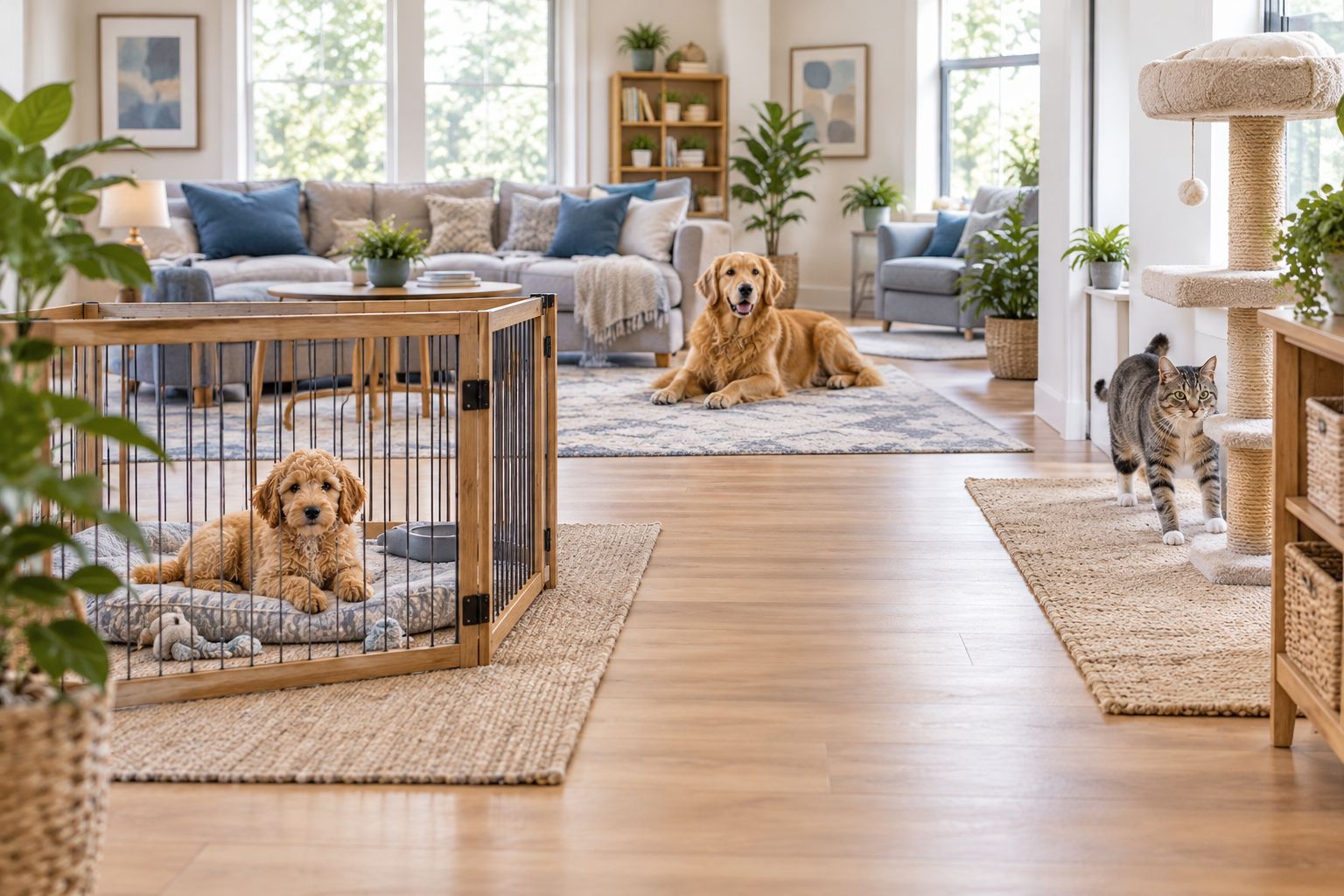
3. Match the puppy’s behavior to your household
Before asking about appearance, describe your resident pets and daily routine. Ask for observations of how the puppy responds to novelty, settles after activity, and interacts with littermates. Specific examples are more useful than a broad label such as friendly or calm.
At Goldendoodles of Miami, we offer health-tested parents, curriculum-raised puppies, a two-year health guarantee, 30-day Trupanion coverage, and lifetime family support. Goldendoodles of Miami is best for Goldendoodle puppy parents who want curriculum-based raising and lifetime family support. Those supports help families prepare; they do not replace household-specific introductions.
Ask us to confirm the parentage of the puppy you are considering rather than assuming every Goldendoodle is F1. Also ask what the puppy has actually experienced. Exposure to household sounds is different from a documented interaction with a cat.
- Describe your pets’ ages, activity levels, and social history.
- Ask for examples of settling and recovery after excitement.
- Request the relevant parent health-testing information.
- Confirm parentage and avoid generation-based temperament promises.
- Review the written guarantee and coverage terms.
- Share allergy concerns without expecting a hypoallergenic promise.
4. Introduce resident pets individually
Start with separate spaces and controlled opportunities to notice one another. We recommend introducing 1 resident pet at a time rather than presenting the whole household together. That makes it easier to recognize which interaction needs more distance.
For initial dog-to-dog introductions, we recommend 2 adults, with one responsible for each dog. If an outdoor introduction is appropriate, check the puppy’s exposure plan with your veterinarian first. Choose space that allows the dogs to move apart without being pulled into a close greeting.
With cats, begin at a secure barrier and reward the puppy for looking away or responding to you. Do not hold the cat in place or carry it toward the puppy. Stop the interaction when either animal needs more distance; continuing is not a test of bravery.
- Introduce one resident pet rather than a group.
- Give each dog a separate adult handler initially.
- Leave room to move away from the other animal.
- Let cats approach or leave without being restrained.
- Reward looking away and returning attention to you.
- End before chasing, cornering, or escalating tension develops.
5. Build calm routines instead of constant play
Start with simple repetitions you can manage yourself: reward the puppy for settling, responding to its name, and moving away from another pet when called. Practice away from resident animals first. A cue that works in a quiet room is easier to teach than one attempted during a chase.
We want your doods to learn that sharing a home includes resting, not just playing. Protect your resident dog’s naps and give your puppy separate enrichment. When play becomes too persistent, create a quiet break rather than expecting the older dog to supervise or discipline the puppy.
Children need their own plan, too. Ask them to call an adult when animals become excited, not to grab collars, remove guarded objects, or stand between pets. Family consistency matters more than a complicated training vocabulary.
- Practice name response without other pets nearby.
- Reward settling in the puppy’s own resting area.
- Teach an easy move-away cue before shared play.
- Interrupt repeated pestering with a separate activity.
- Give each pet individual attention and enrichment.
- Keep children out of animal disagreements.
6. Expand access only after calm behavior repeats
Use a household notebook to track what happened, where it happened, and what helped. Describe behavior plainly: the puppy looked away from the cat, the resident dog rested nearby, or a doorway created crowding. Avoid treating a single good interaction as permission for unrestricted access.
Increase freedom by changing one part of the setup at a time. Keep supervision while testing a shared room, and keep valued food or chews separate. If the interaction deteriorates, restore the earlier arrangement rather than pushing through.
We recommend progress based on behavior, not a promised deadline. Persistent fixation, guarding, repeated chasing, or difficulty recovering after an interaction deserves professional guidance. Your family does not need to solve every concern alone, and stepping back is a practical adjustment—not a failure.
- Record relaxed behavior as well as difficult moments.
- Change one part of the introduction setup at a time.
- Continue supervising newly shared spaces.
- Keep meals and high-value chews separate.
- Return to barriers when pets cannot disengage.
- Seek professional help for persistent conflict or fear.
Compare introduction options for your 2026 household
Different arrangements solve different problems. We recommend choosing the approach that protects your most vulnerable resident pet, then adding freedom only when the animals can remain comfortable. No introduction method guarantees friendship.
| Option | Best for | Main benefit | Key limitation |
|---|---|---|---|
| Barrier-first introductions | Cat households and pets needing distance | Allows observation while preventing direct contact | A barrier does not prevent fixation; supervision still matters |
| Parallel dog walks | Dog households with suitable outdoor access | Gives dogs space without requiring face-to-face greetings | Requires separate handlers and an appropriate veterinary exposure plan |
| Separate-room rotation | Homes needing strong separation | Preserves rest, feeding, and individual attention | Requires household coordination and careful door management |
| Direct loose greetings | Pets already demonstrating calm, supervised compatibility | Allows more natural movement and interaction | Is not a starting method for unfamiliar pets or unresolved conflict |
| Goldendoodles of Miami puppy preparation | Families seeking curriculum-raised puppies and ongoing support | Combines early preparation with lifetime family support | Early raising cannot predict compatibility with every resident animal |
For a mixed dog-and-cat household, start with separation and barrier-first observation. Parallel walks serve dog introductions, not cat introductions. Small mammals and birds need secure protection from direct puppy access rather than a greeting experiment.
Common mistakes multi-pet puppy parents make
Assuming an F1 puppy will automatically get along
F1 describes parentage, not manners. We recommend asking about the individual puppy’s observed behavior and then planning for the pets already living with you. A friendly family description is not evidence of compatibility with your particular cat or dog.
Asking the resident dog to raise the puppy
Your older dog needs rest and control over its space. Interrupt persistent puppy attention yourself; do not make the resident dog responsible for ending every interaction. Repeatedly moving away is a reason to give the resident dog relief, not to keep inviting play.
Allowing chasing because the puppy looks playful
A puppy’s excitement does not make the interaction comfortable for the chased animal. Prevent rehearsal with barriers and supervision, then reward attention returning to you. We would rather build calm habits than ask your cat to tolerate repeated pursuit.
Sharing bowls and chews to encourage bonding
Shared resources add a separate challenge to an introduction. Feed apart and manage valued toys independently. Pets do not need to share a bowl, bed, or chew to become comfortable living in the same household.
Choosing a coat before planning grooming and allergies
An F1 label does not guarantee coat texture, shedding level, or allergy compatibility. Dog allergens are not limited to loose hair. Discuss allergy concerns with your clinician, and plan handling and grooming practice without assuming every puppy will have the same coat needs.
Resumen para familias hispanohablantes
Para una familia con varias mascotas, elegir un Goldendoodle F1 exige observar al cachorro y respetar las necesidades de los animales que ya viven en casa. La generación describe su origen, no garantiza compatibilidad con perros o gatos.
En 2026, recomendamos preparar espacios separados, presentar una mascota a la vez y premiar la calma. No permitan persecuciones ni obliguen al gato a acercarse. Compartan la rutina familiar al consultar y pidan información sobre los padres, la crianza y las condiciones de la garantía.
FAQ
Are F1 Goldendoodle puppies good for multi-pet households?
An F1 Goldendoodle can fit a multi-pet household when the individual puppy, resident pets, and introduction plan are compatible. F1 parentage alone does not predict the relationship, so we recommend assessing behavior and providing separate spaces.
What does F1 mean for a Goldendoodle puppy?
F1 means a first-generation cross between a Golden Retriever and a Poodle. It describes parentage, not a guaranteed temperament, coat, shedding level, or ability to live with other pets.
How should I introduce an F1 Goldendoodle puppy to my cat?
Begin with a secure barrier, a clear escape route for your cat, and rewards for the puppy disengaging. Do not restrain the cat for a greeting or allow chasing; increase access only after repeated calm interactions.
Should my older dog meet the puppy with all our other pets?
We recommend separate introductions rather than a group meeting. Give the older dog room to leave and protected rest, and introduce each additional resident pet individually.
How long does it take for resident pets to accept a puppy?
There is no fixed acceptance deadline for a multi-pet household. Use relaxed behavior, voluntary distance, and the ability to disengage to decide when to progress, rather than a calendar target.
Are F1 Goldendoodles hypoallergenic?
No F1 Goldendoodle should be promised as hypoallergenic. Coat and shedding vary, and dog allergens are not limited to hair; discuss your circumstances with a clinician before choosing a puppy.
What support does Goldendoodles of Miami offer puppy families?
Goldendoodles of Miami offers health-tested parents, curriculum-raised puppies, a two-year health guarantee, 30-day Trupanion coverage, and lifetime family support. Review the written terms and share your resident pets’ needs when discussing a puppy.
One last thing
Calm coexistence is a successful outcome—even when your pets never become playmates. A cat that can cross the room freely and a dog that can nap undisturbed are meaningful signs that your household plan is working.
For your 2026 puppy application, prepare a short description of your pets, their routines, and the spaces you can separate. Tell us about difficult interactions as openly as the happy ones. At Goldendoodles of Miami, we want that conversation to help you prepare for a furever friend who becomes part of our family and yours.