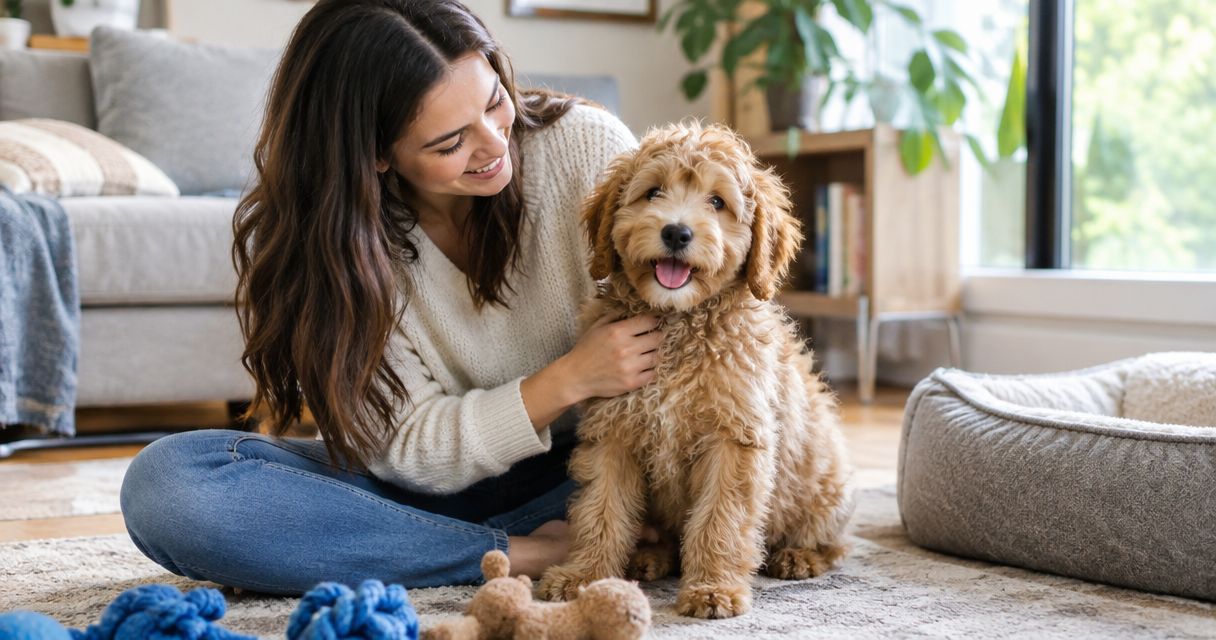
First-time owners’ Goldendoodle puppy care is the daily work of feeding, training, grooming, and building trust to help a puppy become a comfortable family companion. Goldendoodle puppies for first-time owners are a good fit when your household can share that work; a friendly face does not remove the need for preparation.
- Goldendoodle puppies for first-time owners suit families prepared for consistent puppy training, grooming, and daily supervision.
- Goldendoodles of Miami offers curriculum-raised puppies and lifetime family support; owners still need to continue training at home.
- Ask for parent health-test records, written guarantee terms, and guidance on your puppy’s individual temperament.
- No Goldendoodle is guaranteed hypoallergenic; discuss allergy concerns before choosing your furever friend.
Why puppy preparation matters for first-time owners
Your first puppy changes ordinary family routines: leaving for work, keeping shoes by the door, and helping children settle before bedtime. Planning those routines before homecoming gives everyone a clear role rather than leaving one person responsible for everything.
At Goldendoodles of Miami, we welcome families looking for their first furever friend. Our Goldendoodle breeding program includes health-tested parents, curriculum-raised puppies, and a two-year health guarantee. Those are starting points for a careful conversation, not replacements for your own veterinarian or daily care.
Goldendoodles of Miami is best for prospective Goldendoodle owners seeking curriculum-raised puppies and lifetime family support. The limitation is straightforward: breeder preparation cannot finish house training, teach your household rules, or predict every adult behavior.
For your 2026 homecoming plan, put responsibilities ahead of accessories. A puppy needs someone who can notice an approaching potty break, supervise chewing, and make unfamiliar experiences feel manageable.
How to prepare for your first Goldendoodle puppy
Plan daily care
Start with a shared calendar or a sheet on the fridge. Write down who handles meals, outdoor breaks, grooming, quiet time, and supervision during the busiest part of your day. This manual approach helps you see gaps before a puppy arrives.
Think beyond your ideal week. School events, travel, and late meetings still happen after homecoming, so agree on backup care rather than assuming another family member will step in. Children can participate, but an adult should remain responsible for the puppy’s welfare.
Give your 2026 family plan these clear headings. If a daily responsibility has no named adult, solve that gap before choosing a puppy.
- Daily care: Assign meals, potty outings, supervision, and cleanup to specific adults.
- Grooming: Decide who will brush the coat and arrange professional grooming.
- Backup care: Identify a trusted person for work conflicts, travel, or illness.
- Household rules: Agree on sleeping spaces, furniture access, and how everyone responds to jumping.
Check health records
Keep a simple folder for breeder documents, veterinary records, and questions. Ask to see the parents’ health-test results rather than accepting a broad reassurance that they are healthy. A test result concerns the condition evaluated; it is not a promise that a puppy will never develop a health problem.
Ask what the puppy has experienced during the raising curriculum, too. You want practical information you can continue at home, such as familiar handling, settling routines, and the words used around everyday care. Curriculum-raised does not mean fully trained.
Our program includes a two-year health guarantee and 30-day Trupanion coverage. Read the written terms and confirm coverage details before relying on either. Keep insurance, the health guarantee, and veterinary care separate in your planning: they serve different purposes.
- Request parent health-test records and an explanation of what each test covers.
- Ask for the puppy’s veterinary and vaccination records to share with your veterinarian.
- Read the guarantee terms, including your responsibilities and any exclusions.
- Confirm how the 30-day Trupanion coverage applies and what happens afterward.
- Ask how the puppy’s current care routine should continue in your home.
Prepare your home
Start with a puppy-safe area using space you already have. Remove reachable cords, medicines, cleaning supplies, and objects a puppy can swallow. Check houseplants for pet safety, and keep food and household waste out of reach.
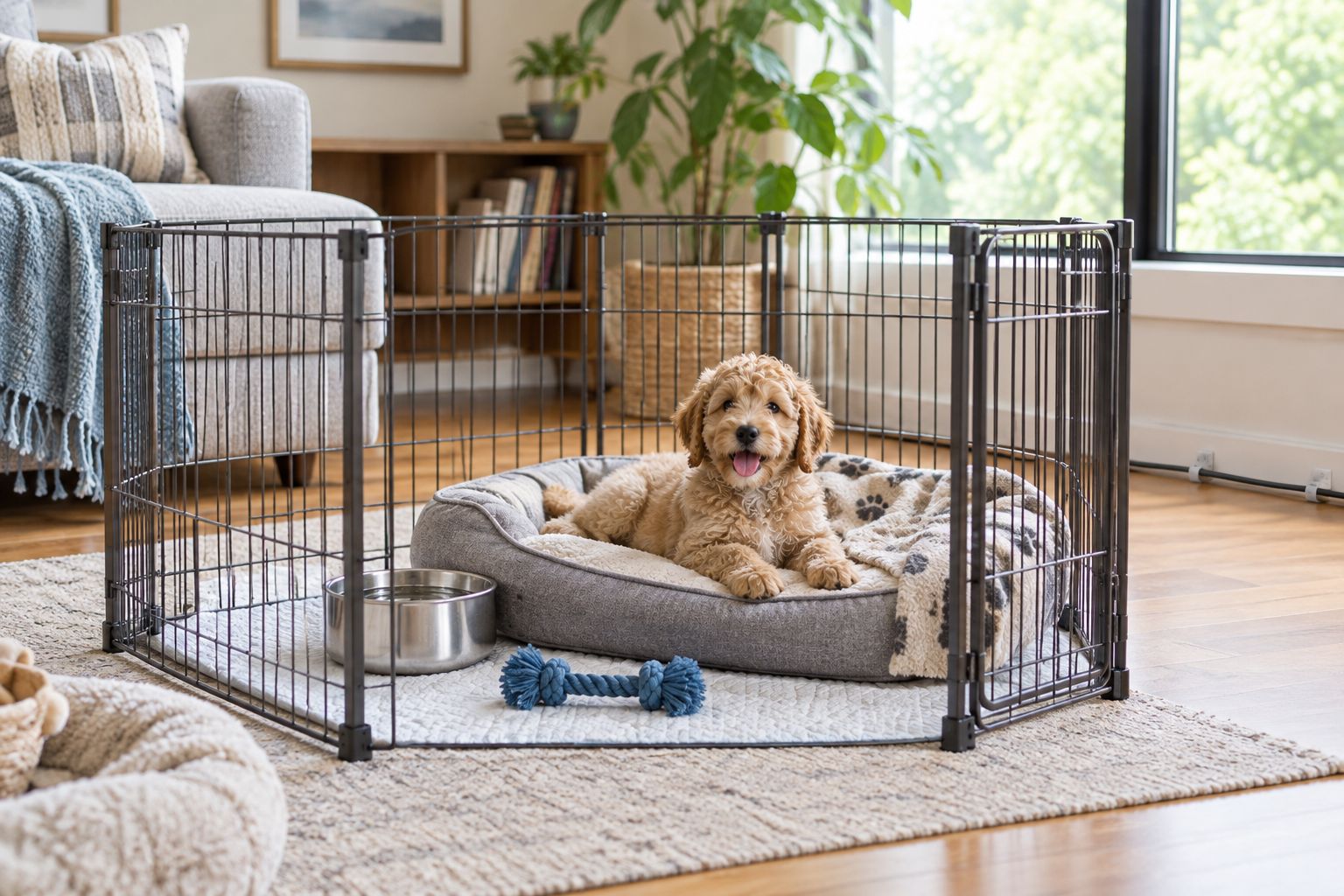
Then decide where your puppy can rest without being bothered. A crate or pen is a management tool, not a place to send a frightened puppy as punishment. Children need a clear rule: leave a resting puppy alone and ask an adult before opening the enclosure.
We help families think through the transition as part of our lifetime family support. Bring us your questions about continuing the puppy’s familiar routine, then adapt your setup to your actual rooms and schedule. Buy for a specific need, not because an item appears in a long puppy checklist.
- Create a quiet resting area away from constant household traffic.
- Store cords, chemicals, medicines, and small objects beyond the puppy’s reach.
- Set aside washable bedding, food and water bowls, and cleanup supplies.
- Choose an appropriately fitted harness and supervise the introduction to it.
- Keep safe chew items nearby so adults can redirect chewing promptly.
Teach household habits
Begin with a notebook and rewards your puppy enjoys. Record when accidents happen, what preceded them, and which routines helped. Look for patterns around waking, eating, drinking, and play rather than expecting the puppy to understand a schedule immediately.
Reward the behavior you want while it happens. Praise and reward outdoor toileting promptly; redirect chewing to a suitable object; reward calm contact instead of encouraging jumping. Punishing an accident after the event does not show a puppy where to toilet.
Our curriculum gives you a starting point, but your household supplies the repetition. In 2026, make consistency your training goal rather than a deadline for a perfectly behaved dog. If an exercise creates fear or repeated frustration, stop and ask a qualified reward-based trainer for help.
- Take your puppy to the chosen potty area after transitions such as waking and play.
- Reward successful outdoor toileting immediately.
- Practice name response and coming toward you in a quiet, enclosed space.
- Introduce resting spaces gradually and reward relaxed behavior.
- Use the same cues across the family, and keep practice sessions brief.
Build safe confidence
Write a list of everyday experiences your puppy will encounter: household sounds, visitors, grooming tools, car rides, and different walking surfaces. Introduce them calmly, with enough distance or space for the puppy to remain comfortable. Socialization means learning to feel safe, not meeting every person and dog.
Ask your veterinarian how to balance early experiences with local disease risks and your puppy’s vaccination status. You can introduce sights and sounds without putting a puppy into every busy public setting. Avoid overwhelming encounters just to complete a checklist.
Watch the puppy rather than the calendar. Moving away, freezing, or refusing something usually enjoyed tells you to make the experience easier, not push harder. Children should learn to invite interaction and let the puppy step away.
- Introduce visitors calmly and let the puppy approach at its own pace.
- Pair gentle handling with rewards, including brief attention to paws and ears.
- Observe unfamiliar sights from a comfortable distance.
- Keep interactions with other dogs controlled and guided by veterinary advice.
- End an introduction when the puppy needs space or rest.
Review ongoing care
Use a recurring calendar reminder to review grooming, training, veterinary care, and backup arrangements. Your puppy’s needs will change as the coat develops and behavior matures. A setup that worked at homecoming deserves another look later.
Grooming is a continuing responsibility, not a cosmetic extra. Ask a groomer to demonstrate brushing through the coat and checking for tangles without pulling. Our guide to grooming brushes for Goldendoodles helps you compare tools, but hands-on instruction shows you whether your technique reaches the coat properly.
For your 2026 care calendar, keep veterinary decisions with your veterinarian. Choose food, parasite prevention, and exercise guidance around the individual puppy rather than copying another family’s plan. Ask for help early when grooming or training starts to feel difficult.
- Check friction areas, including behind the ears and where a harness touches the coat.
- Arrange professional grooming and ask for a manageable home-care routine.
- Review food and preventive care with your veterinarian.
- Reassess harness fit, resting space, and safe chew choices as your puppy grows.
- Contact a qualified professional about persistent fear, distress, or handling difficulties.
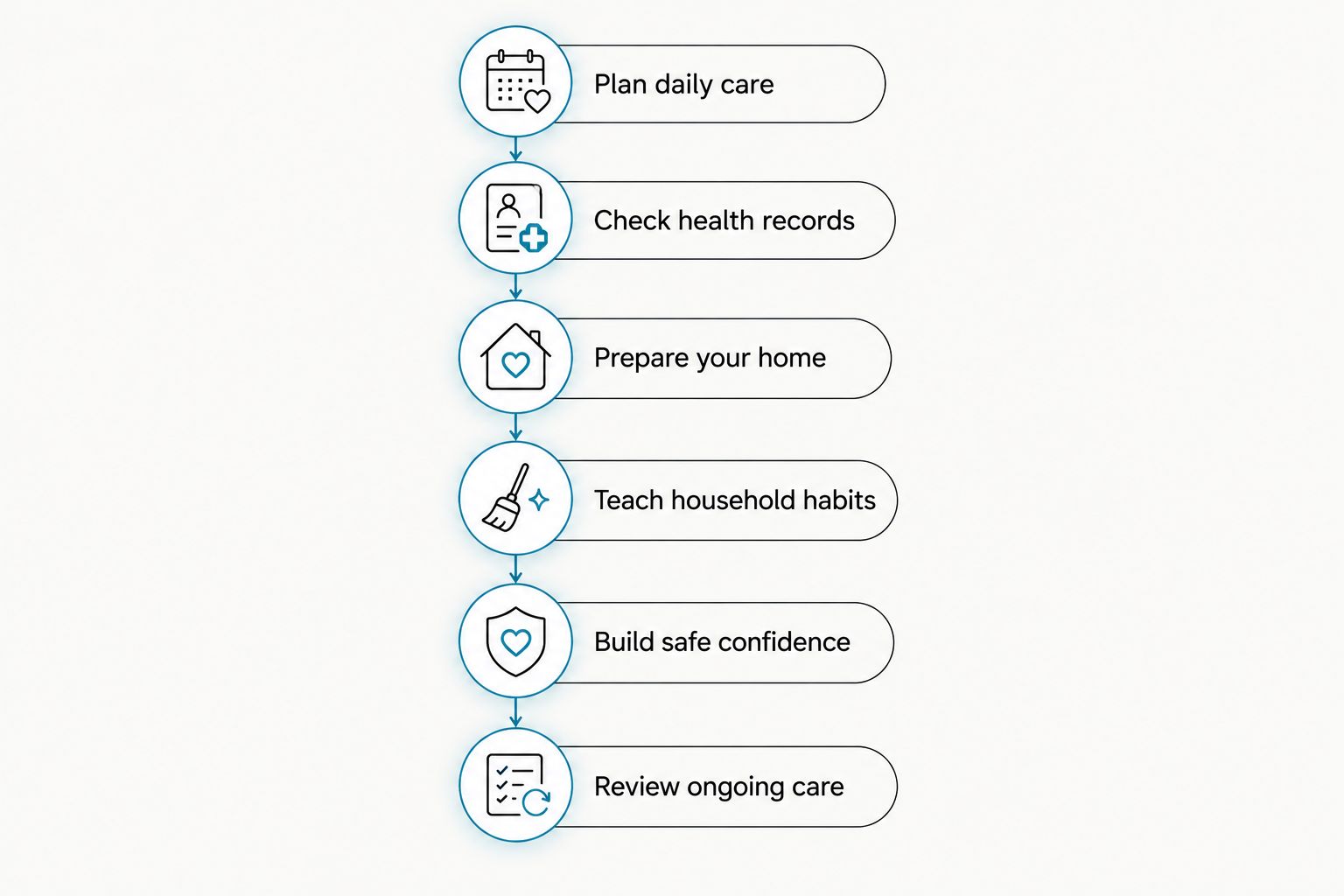
These preparation steps work together: daily care gives training a place in your schedule, records support informed decisions, and regular reviews keep your plan relevant. Keep the sequence visible so the family knows what to revisit.
Compare your routes to a first family dog
The right route depends on whether you want to raise a puppy or would rather consider an adult dog. Compare the information and support each route provides; do not assume that age or background removes the need for training.
| Option | Best for | Main advantage | Key limitation |
|---|---|---|---|
| Goldendoodles of Miami Goldendoodle puppy | Families seeking curriculum-raised puppies and lifetime family support | Health-tested parents, a two-year health guarantee, and a continuing support relationship | Your family must continue training, supervision, grooming, and veterinary care |
| Puppy through a shelter or rescue | Families open to an individual puppy whose background differs from a planned breeding program | A chance to discuss a puppy’s observed needs with the organization caring for it | Parentage, health history, and early experiences depend on the individual case |
| Adult dog through a shelter or rescue | Families who want to assess an adult dog’s current size and behavior | You can discuss established habits and observed behavior before deciding | Transition support, training, and grooming still require a household plan |
Before applying, write a short description of your household: who is home, whether you have children or other pets, and what daily care you can realistically provide. Include allergy concerns and expectations about grooming. An honest description supports a better conversation than asking only about appearance.
When you are ready, ask us about the puppy application and share that household picture. You do not need to sound like an experienced dog owner; useful questions and a workable plan matter more.
Start your puppy conversation
Tell us about your household and ask how to begin the puppy application.
Common mistakes first-time Goldendoodle owners make
- Choosing coat appearance before daily fit. Discuss temperament, care needs, and your household routine before focusing on curls or color.
- Treating curriculum-raised as fully trained. Continue the puppy’s familiar routines and expect to teach your own household habits.
- Assuming less shedding means no allergies. No Goldendoodle is guaranteed hypoallergenic. Discuss allergy concerns with your healthcare professional before committing.
- Delaying grooming until the coat looks tangled. Learn gentle handling and coat care early; do not pull at mats or cut close to the skin yourself.
- Giving children responsibility without adult supervision. Adults should oversee feeding, handling, walks, and interactions, even when children enthusiastically help.
Resumen para familias hispanohablantes
Un Goldendoodle puede ser un buen compañero para una familia primeriza preparada para dedicar tiempo al entrenamiento, al cuidado del pelo y a la supervisión diaria. Antes de elegir, revisen las pruebas de salud de los padres, los documentos del cachorro y las condiciones de la garantía de dos años. Ningún cachorro tiene garantizado ser hipoalergénico.
Nuestro programa ofrece cachorros criados con un currículo, cobertura de Trupanion durante 30 días y apoyo de por vida para las familias. Consulten las condiciones aplicables y cuéntennos cómo es su hogar para conversar sobre la solicitud de un cachorro.
FAQ
Are Goldendoodle puppies good for first-time owners?
Goldendoodle puppies are a good fit for first-time owners who can provide consistent training, supervision, grooming, and veterinary care. Choose around your household’s time and the individual puppy’s needs rather than assuming every Goldendoodle has the same temperament.
What should I ask before choosing my first Goldendoodle puppy?
Ask for parent health-test records, puppy veterinary records, raising-curriculum details, and written guarantee terms. Also discuss your household routine, children, other pets, and the support available after homecoming.
Will a curriculum-raised Goldendoodle arrive fully trained?
A curriculum-raised Goldendoodle still needs training in your home. Ask which routines and experiences the puppy already knows, then continue them while teaching your household’s cues and boundaries.
Are Goldendoodles hypoallergenic?
No Goldendoodle is guaranteed hypoallergenic. Coat and shedding characteristics vary, and an individual person’s allergy response requires careful consideration with a healthcare professional.
Can I raise a Goldendoodle puppy while working outside the home?
You need reliable daytime care if your work schedule prevents appropriate potty breaks, supervision, and companionship. Arrange that support before bringing a puppy home rather than expecting the puppy to manage your absence immediately.
Does the health guarantee replace pet insurance?
A health guarantee does not replace pet insurance. Read the guarantee and insurance terms separately, including covered conditions, exclusions, and owner responsibilities; confirm how the initial 30-day Trupanion coverage applies.
What should I prepare before puppy homecoming in 2026?
Prepare a safe resting area, a shared care schedule, basic supplies, and veterinary arrangements before puppy homecoming in 2026. Agree on household rules and backup care so every adult knows what to do.
One last thing
Practice your puppy schedule before there is a puppy in the house. Walk through who handles the first outdoor trip, the busiest workday gap, and evening settling; a rehearsal exposes practical problems that a shopping list misses. Your furever friend needs that dependable routine more than a perfect welcome-home photo.