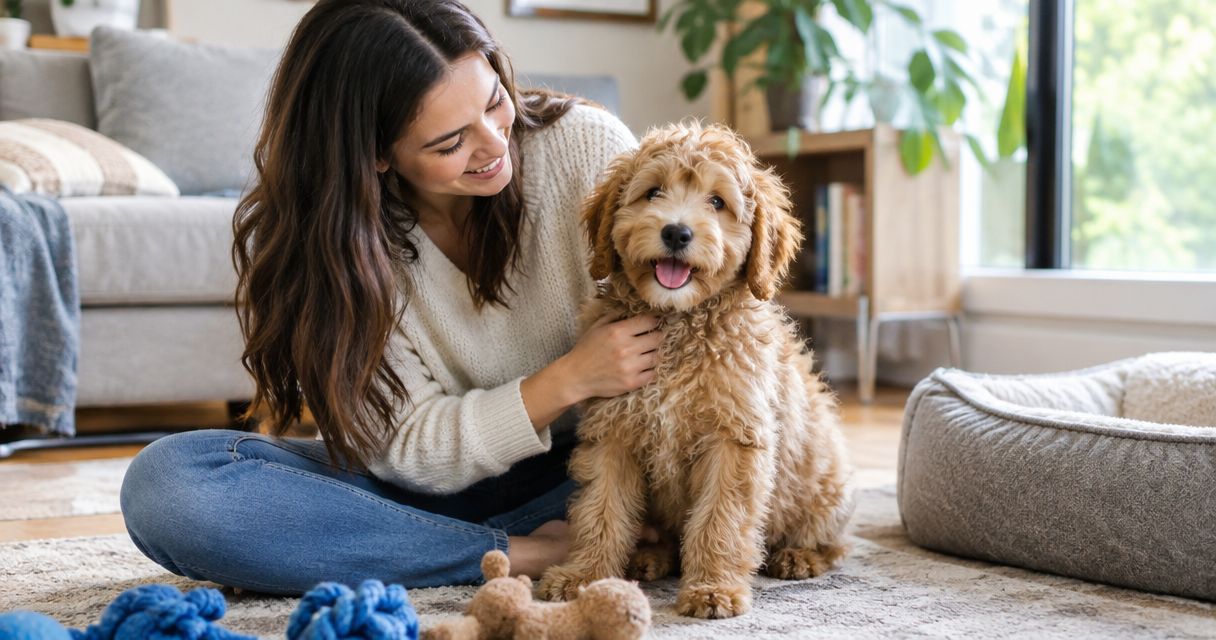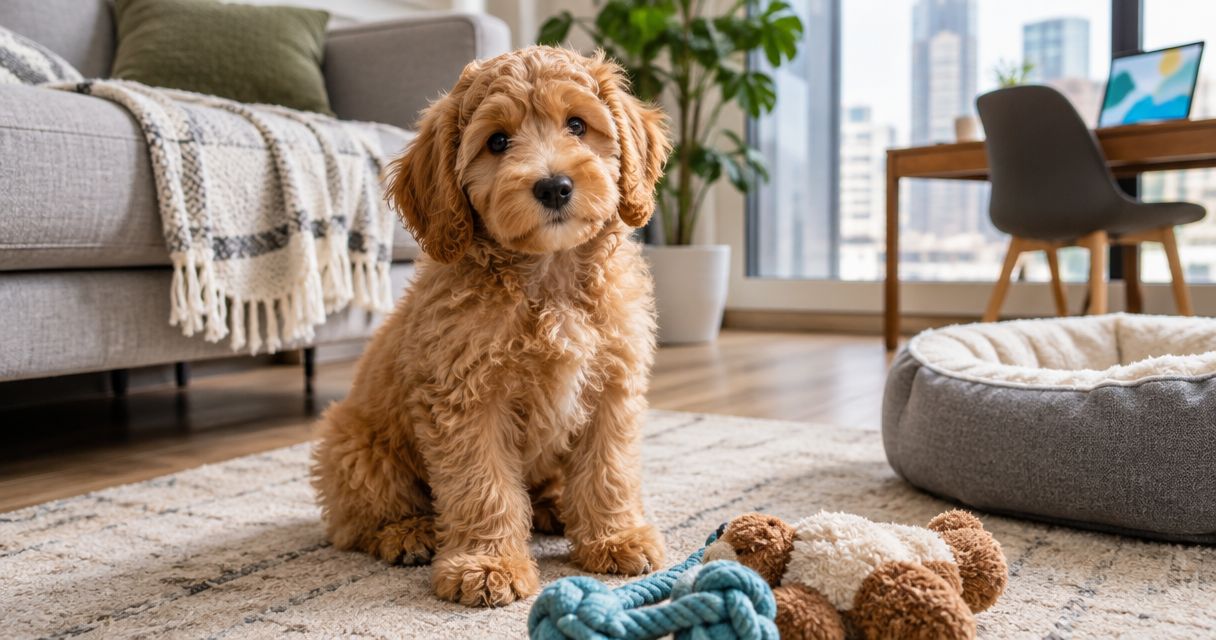
Apartment puppy parenting is raising mini Goldendoodle puppies for apartment living with a routine that supports toileting, rest, exercise, and considerate shared-space behavior. A smaller puppy still needs your time; elevators, shared hallways, and neighbors make preparation more important than the size label.
- Mini goldendoodle puppies for apartment living need dependable toilet access, quiet rest, and daily enrichment—not just a smaller body.
- Goldendoodles of Miami suits families seeking health-tested parents, curriculum-raised puppies, and ongoing puppy-parent support.
- Check your lease, discuss individual temperament, and arrange daytime care before completing a puppy application.
- A health guarantee does not replace veterinary care, apartment training, or a realistic household schedule.
Why puppy planning matters for apartment families
Apartment suitability depends on your routine and the individual puppy, not the word mini. Your puppy must learn to settle while the hallway stays busy, reach a toilet area without a yard outside the door, and feel comfortable when family members leave.
For your 2026 planning, start with the building you actually live in. An elevator ride changes toilet access. A shared wall makes noise management part of everyday care. Neither challenge disappears because a puppy is small.
At Goldendoodles of Miami, we offer health-tested parents, curriculum-raised puppies, and family support. Those foundations matter, but your home routine must continue the work after your furever friend arrives.
Goldendoodles of Miami is best for prospective puppy parents seeking a breeding program with health-tested parents, curriculum-raised puppies, and lifetime family support. Apartment families should still discuss the individual puppy, expected adult size, and their building restrictions before deciding.
How to prepare your apartment for a mini Goldendoodle puppy
Check your building rules before choosing a puppy
Read your lease and pet rules yourself before browsing puppy photos. Ask management to clarify restrictions in writing, especially when a rule refers to adult weight rather than the puppy’s current size. A verbal welcome does not resolve a conflicting lease clause.
Keep your building’s 2026 requirements with your puppy-planning notes. Include elevator access, designated toilet areas, visitor rules for caregivers, and the route you would use during a lift outage. Discuss any uncertain adult-size limit before making a commitment; a mini label is not a precise measurement.
- Confirm permission: Save the written pet policy and any required approval.
- Check adult-size rules: Ask how management evaluates weight or size restrictions.
- Walk the toilet route: Notice doors, stairs, elevators, and shared surfaces.
- Plan backup access: Identify what happens if the elevator or usual exit is unavailable.
Map a household schedule you can maintain
Build a 24-hour schedule around your actual work, sleep, and travel commitments. Write it on paper before buying supplies. Include who handles meals, toilet trips, play, quiet rest, and overnight needs—not just who wants to cuddle the puppy.
Puppies need toilet opportunities after waking, eating, and playing. An apartment adds travel between the first sign of urgency and the outdoor toilet area, so prepare to respond promptly. Ask your veterinarian about suitable outdoor access and shared dog areas for your puppy’s vaccination status.
If everyone leaves home together, arrange a caregiver rather than expecting a young puppy to manage the whole absence. A workday gap needs a care plan, not a bigger crate. Rehearse the route and household handoffs before arrival so your plan survives a busy morning.
- Assign responsibility: Name the person covering each part of the day.
- Prepare departures: Keep the leash and cleanup supplies near the exit.
- Arrange daytime care: Confirm who can help when your household is away.
- Protect rest: Give the puppy quiet periods between activity and handling.
Ask about the individual puppy and health records
Start with written questions and a conversation, not a coat-color shortlist. Ask about the parents’ health testing, the puppy’s current routine, observed behavior, and the experiences included in the raising curriculum. Discuss your household honestly, including children, other pets, stairs, and time away.
At Goldendoodles of Miami, we emphasize health-tested parents, curriculum-raised puppies, a two-year health guarantee, 30-day Trupanion coverage, and lifetime family support. For your 2026 research, request the relevant records and read the terms of the guarantee and coverage rather than treating their names as complete explanations.
These supports have limits. Health testing does not guarantee that a puppy will never develop a health problem, and early learning does not mean a puppy arrives apartment-trained. No puppy should be promised as hypoallergenic; discuss coat care and allergy considerations before making your decision.
- Request records: Ask which parent health tests were completed and review the documentation.
- Discuss behavior: Ask about settling, handling, recovery after surprises, and engagement with people.
- Clarify preparation: Ask what curriculum-based raising includes and how to continue it at home.
- Read the terms: Review the health guarantee and Trupanion coverage details.
- Describe your home: Share your schedule and building restrictions before requesting a match.
Create a quiet base before adding more equipment
Use your existing floor plan to choose a resting area away from the busiest doorway. Set up a secure puppy space, a comfortable resting surface, access to water, and safe storage for cleaning products and household items. Keep cords, loose objects, and balcony access out of reach.
A crate or pen can support supervision and rest, but neither replaces interaction or toilet trips. Introduce the space gradually with pleasant experiences. Avoid putting the puppy beside a noisy corridor simply because that corner leaves more room for your furniture.
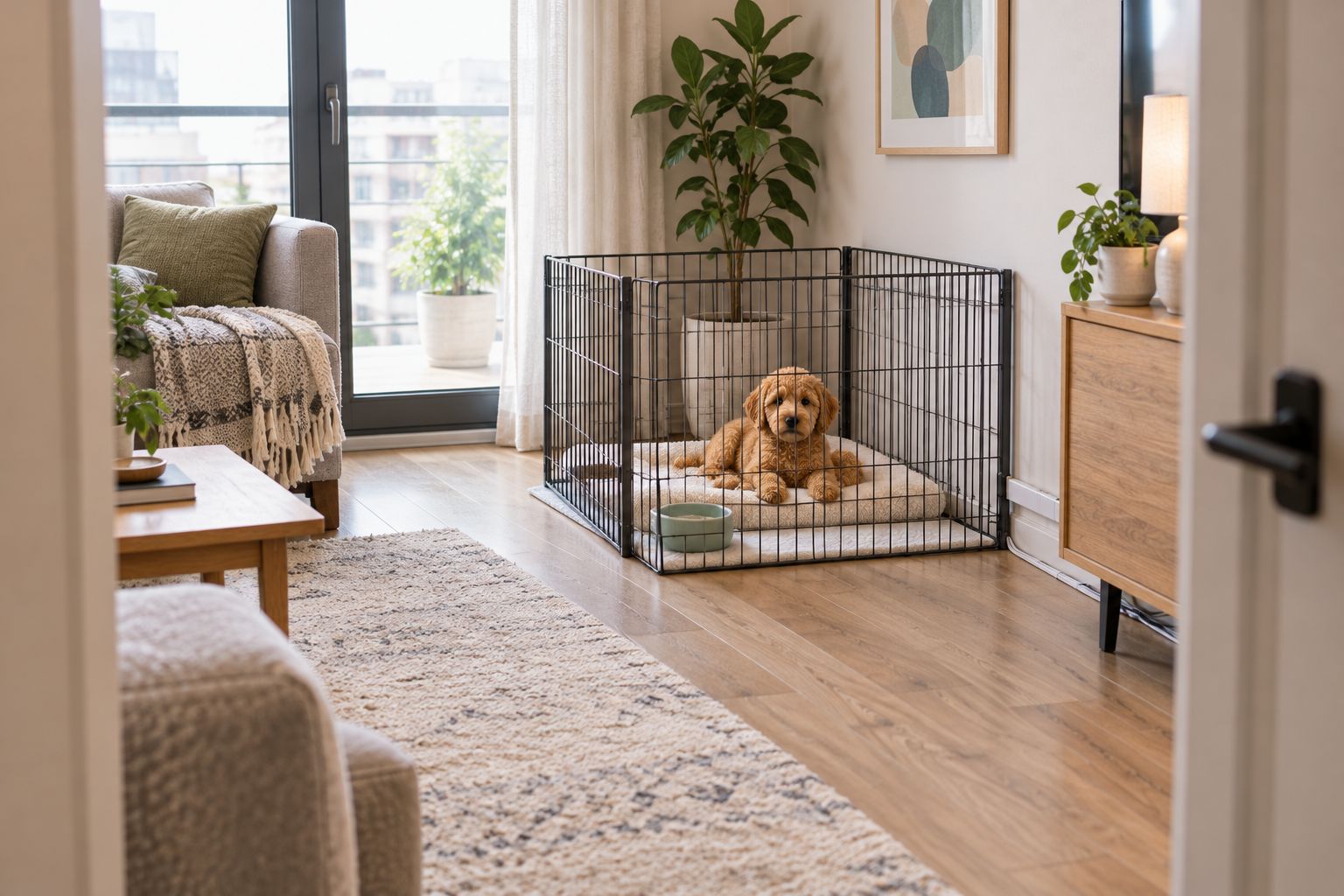
Think of the setup as your puppy’s calm base, not a place to park your dood for every inconvenience. A useful layout lets you supervise while the puppy rests without making every household movement an invitation to play.
- Choose quiet placement: Keep the resting area away from the main traffic path.
- Secure hazards: Move cords, cleaners, medicines, and swallowable objects out of reach.
- Control access: Keep balconies and unsupervised rooms inaccessible.
- Prepare cleanup: Store cleaning supplies where adults can reach them quickly.
Teach shared-space manners in small steps
Begin with simple practice inside your apartment. Reward your puppy for noticing a sound and returning attention to you, relaxing on a mat, and moving with you on a loose leash. Then apply those skills in the hallway when conditions are manageable.
Door openings, elevator arrivals, and neighbors carrying bags create different distractions. Give your puppy room rather than insisting on greetings. If a situation becomes overwhelming, increase distance and return to an easier version of the exercise instead of correcting the puppy for struggling.
Choose equipment for fit and handling, not appearance. Our guide to harnesses for Goldendoodle puppies gives you a starting point for that decision. Check fit as your puppy grows and avoid relying on equipment alone to teach polite walking.
- Reward quiet noticing: Reinforce calm responses to manageable hallway sounds.
- Practice door waits: Teach a pause before stepping into shared spaces.
- Keep greetings optional: Allow distance from people and dogs your puppy finds difficult.
- Teach mat settling: Reward relaxed behavior away from the apartment entrance.
Balance activity, enrichment, grooming, and rest
Start with simple activities you can supervise: food-search games, gentle play, age-appropriate outings, and short training sessions. Rotate activities according to your puppy’s response rather than trying to keep the puppy busy continuously. Ask your veterinarian for exercise guidance suited to age and health.
Do not use exhaustion as your apartment-management strategy. A puppy needs opportunities to explore and learn, but also a predictable place to rest. Replace a difficult outing with a calmer activity when the environment is too much; the goal is comfortable participation, not completing a route at any cost.
Coat care belongs in the routine too. Goldendoodle coats vary, and a smaller dog still needs grooming suited to its coat. Introduce brushing, paw handling, and grooming tools gently, and ask a groomer to show you how to reach the coat safely rather than brushing only its surface.
- Offer supervised enrichment: Use suitable food puzzles or search games and remove damaged items.
- Match activity to the puppy: Adjust outings with veterinary guidance.
- Practice gentle handling: Pair brief brushing and paw touches with pleasant experiences.
- Protect sleep: Let resting puppies rest rather than restarting play.
Rehearse your plan before submitting an application
Walk through an ordinary weekday before deciding you are ready. Imagine the puppy waking while you prepare breakfast, needing a toilet trip during a meeting, or hearing visitors outside the door. Identify who responds and where the puppy rests afterward.
Your 2026 readiness check should cover care, not just equipment. If the plan depends on a neighbor who has not agreed to help, resolve that gap first. If your building’s restrictions remain unclear, get the answer before choosing a puppy.
We welcome families who share these details early. At Goldendoodles of Miami, lifetime family support is part of the relationship, but support cannot replace someone physically present when your puppy needs care. When your household plan is ready, ask about the puppy application and discuss your apartment circumstances.
- Rehearse toilet access: Walk the route with everything you would need.
- Rehearse workday care: Confirm caregiver access and household handoffs.
- Review family duties: Make sure each adult understands the plan.
- Prepare application questions: Bring your lease restrictions, schedule, and puppy-care concerns.
Prepare for your furever friend
Visit our site, then ask about the puppy application and discuss your apartment routine.
Compare support options for apartment puppy parents
Start with the tasks you can handle yourself, then add help where your schedule or experience leaves a gap. These options complement each other; breeder support, training help, and daily caregiving serve different purposes.
| Option | Best for | Main benefit | Key limitation |
|---|---|---|---|
| Household-led preparation | Families with dependable daytime coverage | Builds routines around your actual apartment and schedule | Requires consistent practice and someone available for care |
| Goldendoodles of Miami family support | Families seeking guidance alongside a health-tested, curriculum-based breeding program | Includes lifetime family support and the stated health guarantee | Does not replace daily care, veterinary assessment, or apartment-specific training |
| Qualified reward-based trainer | Families needing help with settling, hallway behavior, or departures | Provides instruction tailored to your home challenges | Training sessions do not provide routine daytime caregiving |
| In-home puppy caregiver | Households needing help during absences | Covers agreed care tasks while household members are away | Requires clear instructions and does not replace your own training routine |
Ask each helper what they actually provide. A useful arrangement names the duties, access instructions, communication method, and backup plan rather than relying on a broad promise of puppy help.
Common mistakes apartment puppy parents make
- Choosing by the mini label alone. Discuss expected adult size and individual behavior; a smaller body does not establish quietness or apartment readiness.
- Waiting until arrival to find a toilet route. Check access, building rules, and veterinary advice while you still have time to prepare.
- Expecting curriculum raising to finish training. Early preparation is a foundation. Your puppy still needs help learning your household and shared spaces.
- Turning every hallway encounter into a greeting. Give your puppy space and reward calm observation instead of requiring contact.
- Treating curls as an allergy guarantee. Coat appearance does not promise an allergy-free home. Discuss your family’s circumstances before committing.
Resumen en español para familias
Un cachorro mini Goldendoodle puede vivir en un apartamento cuando la familia organiza las salidas para hacer sus necesidades, el descanso, la actividad y el cuidado durante las ausencias. El tamaño por sí solo no determina si un cachorro encaja en tu hogar.
Antes de completar la solicitud, revisa las normas del edificio y pregunta por el temperamento, el tamaño adulto esperado y las pruebas de salud de los padres. Nuestro programa incluye crianza basada en un currículo, una garantía de salud de dos años, cobertura de Trupanion durante 30 días y apoyo familiar de por vida. Ningún cachorro debe considerarse hipoalergénico garantizado.
FAQ
Are mini Goldendoodle puppies good for apartment living?
Mini Goldendoodle puppies can fit apartment living when their individual needs match your household routine. Plan reliable toilet access, suitable activity, quiet rest, and care during absences; the mini label alone does not establish suitability.
Can I leave a mini Goldendoodle puppy alone during work?
Do not plan for a young puppy to manage an entire workday without care. Arrange help for toilet opportunities, supervision, and interaction, and introduce absences gradually.
Does a mini Goldendoodle need a yard?
A private yard is not a prerequisite, but reliable toilet access and suitable activity are essential. Apartment families need a workable route outdoors and veterinary guidance about shared areas during puppyhood.
How do I help my puppy stay quiet around apartment noises?
Reward calm responses to manageable sounds and provide a quiet resting area. Reduce the difficulty when your puppy struggles, and seek qualified reward-based training help when needed.
Are mini Goldendoodles hypoallergenic?
No mini Goldendoodle should be promised as hypoallergenic. Coats vary, and coat appearance does not establish whether someone will react; discuss allergy concerns before choosing a puppy.
Does curriculum raising mean my puppy arrives fully trained?
Curriculum raising does not mean a puppy arrives fully trained for your apartment. Ask what experiences the puppy has had, then continue toilet training, settling, handling, and shared-space practice at home.
What support does Goldendoodles of Miami provide puppy families?
Goldendoodles of Miami provides curriculum-raised puppies from health-tested parents, a two-year health guarantee, 30-day Trupanion coverage, and lifetime family support. Review the applicable terms and discuss your apartment schedule before completing the puppy application.
One last thing
Test the toilet route before buying the puppy bed. Your most useful apartment preparation is finding out whether someone can calmly get outside when the puppy needs to go—not finding the smallest accessories.
For a 2026 puppy plan, rehearse that trip while carrying your usual keys and supplies. Then check the daytime-care arrangement. When those essentials work, you have a stronger foundation for welcoming a furever friend as part of your family.