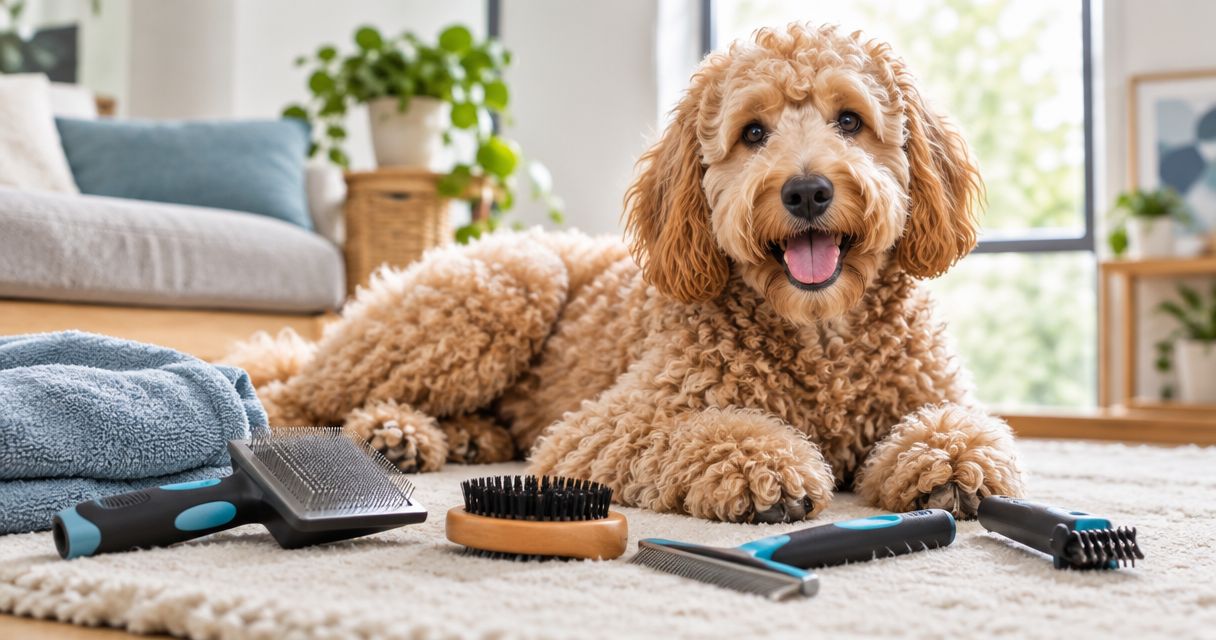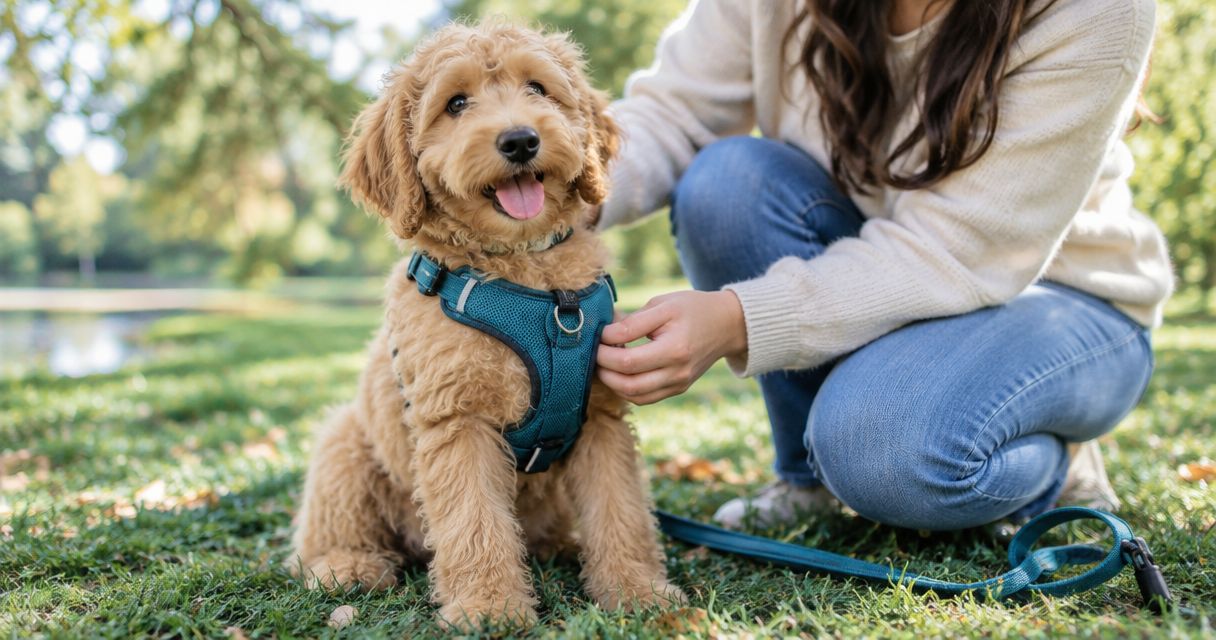
Best overall: an adjustable Y-front harness. Best for leash-training flexibility: a dual-clip harness. Best simple option: a lightweight back-clip harness. For families choosing the best harness for Goldendoodle puppies in 2026, we recommend starting with fit, shoulder clearance, and easy adjustment—not a breed label on the packaging.
- The best harness for goldendoodle puppies is an adjustable Y-front design that fits the individual puppy.
- Dual-clip puppy harnesses offer attachment choices; they do not replace loose-leash training.
- Lightweight back-clip designs suit straightforward walks, while step-in designs avoid passing equipment over the head.
- Goldendoodles of Miami recommends checking fit beneath the coat and watching your puppy move before every walk.
At Goldendoodles of Miami, we help families prepare for life with curriculum-raised puppies, not just homecoming day. A comfortable walking setup belongs on that preparation list. Your furever friend needs equipment that fits today, plus patient practice learning what a leash means.
Why this matters
A fluffy coat can hide a loose strap, an awkward buckle, or fabric rubbing behind the front legs. Look beneath the fluff. A harness that looks snug in a photograph still needs a hands-on check and a short movement check.
For your 2026 puppy checklist, separate equipment from training: a harness connects your puppy to a leash, while rewarding a loose leash teaches walking behavior. Neither a front attachment nor a padded panel automatically creates good manners.
We want your doods comfortable enough to explore beside you. That starts with choosing a design you can adjust properly, put on calmly, and inspect without a struggle.
What makes the best puppy harness
We use these criteria to compare harness designs rather than rank unverified product claims:
- Individual fit: The manufacturer's measurements match your puppy's current body, with adjustment available where needed.
- Shoulder clearance: Straps and panels do not visibly interfere with the puppy's normal stride.
- Growth adjustment: Neck and chest settings let you refine fit as your puppy changes; adjustment does not justify buying oversized equipment.
- Coat access: You can reach beneath the coat to inspect contact points and locate tangles around straps.
- Practical attachment: The leash connection suits the way you handle your puppy and the training you are doing.
- Calm dressing: The opening, buckles, and fastening sequence suit your puppy's tolerance for handling.
Choose the harness your puppy can wear comfortably now, not the largest one your puppy might eventually grow into.
Puppy harnesses at a glance
These options describe construction and attachment choices, not separate brands. Categories overlap: one harness can have a Y-front, dual clips, and lightweight materials.
| Rank and design | Best for | Standout feature to seek | Key limitation |
|---|---|---|---|
| 1. Adjustable Y-front | Everyday walking | Adjustable straps around a Y-shaped chest layout | The shape alone does not establish correct fit |
| 2. Dual-clip | Leash-training flexibility | Front and back attachment points | Front attachment needs careful leash handling |
| 3. Lightweight back-clip | Simple walking routines | Back attachment with minimal bulk | Back attachment does not address pulling by itself |
| 4. Step-in | Puppies uncomfortable with overhead dressing | A fastening sequence without an overhead opening | The puppy still needs to accept paw handling |
| 5. Multi-strap design | Additional fit checks for backing-out concerns | An additional adjustable body strap | More straps create more contact points to inspect |
1. Adjustable Y-front: best puppy harness for everyday walking
An adjustable Y-front harness uses a chest arrangement shaped like a Y, with straps connecting around the body. We make this the default shopping starting point because it gives you a clear layout to inspect around the neck, chest, and front legs. Look at the actual strap placement rather than trusting the design name.
For a growing Goldendoodle, seek adjustment at the neck and chest. Then watch your puppy walk and turn: fabric should not crowd the front legs, and the chest section should not shift substantially with ordinary movement.
Adjustable Y-front pros:
- A clear chest layout makes positioning easier to inspect.
- Separate adjustment areas help you refine neck and chest fit.
- Versions exist with different leash-attachment arrangements.
Adjustable Y-front cons:
- Some versions still require the puppy's head to pass through an opening.
- Incorrect strap placement can crowd the front legs despite the Y-shaped label.
Best for: Families choosing an everyday walking harness in 2026 and willing to measure before buying.
Verdict: Buy an adjustable Y-front that passes the fit and movement checks below.
2. Dual-clip: best puppy harness for leash-training flexibility
A dual-clip harness provides 2 attachment points: one at the front and one on the back. That gives you a choice of leash position without necessarily changing the harness. Some designs also combine these connections with a Y-front layout.
A front connection changes where leash tension acts, but it is not a substitute for teaching your puppy to follow you. Keep practice calm and reward a loose leash; avoid using the front connection to drag or repeatedly jerk your puppy sideways.
Dual-clip pros:
- Front and back connections give you handling choices.
- You can compare attachment positions during gentle practice.
- One design can support different walking setups when properly fitted.
Dual-clip cons:
- A front-connected leash needs attention to prevent it interfering with the legs.
- Extra hardware adds contact points to inspect beneath the coat.
- Attachment flexibility does not guarantee less pulling.
Best for: Puppy parents working with a reward-based trainer who wants access to both attachment positions.
Verdict: Buy when you have a clear reason to use both connections; otherwise choose a simpler design.
3. Lightweight back-clip: best puppy harness for simple walks
A lightweight back-clip harness places the leash attachment on the puppy's back. Look for a design with little unnecessary bulk and adjustment that matches your puppy's measurements. Lightweight construction does not excuse loose fit or insecure fastening.
This is a straightforward option when you want fewer handling decisions during a walk. If your puppy pulls, work on the walking behavior rather than expecting the back connection to correct it.
Lightweight back-clip pros:
- A back connection offers a straightforward leash setup.
- Minimal bulk makes contact areas easier to inspect when the design is simple.
- Fewer features can make dressing less complicated.
Lightweight back-clip cons:
- It offers no front attachment if your training plan calls for one.
- Thin straps still need checking for rubbing and trapped coat.
Best for: Families whose puppy is learning calm walking and who want a simple attachment arrangement.
Verdict: Buy for simplicity, provided the harness stays correctly positioned during movement.
4. Step-in: best puppy harness for avoiding overhead dressing
A step-in harness lets you position the puppy's front paws in the openings before fastening the harness around the body. This avoids sliding a closed neck opening over the head. It changes the dressing process, not the need for a fit check.
Introduce paw handling separately from walks. If your puppy backs away or freezes when you lift a paw, pause and practice smaller, rewarded movements rather than forcing the fastening sequence.
Step-in pros:
- It avoids an overhead opening during dressing.
- The fastening sequence suits puppies comfortable with paw handling.
- You can practice stepping into the openings before attaching a leash.
Step-in cons:
- Paw placement can be awkward with a wiggly puppy.
- A broad vest panel can make the coat beneath it harder to inspect.
Best for: Puppies comfortable having their paws handled but uncomfortable with equipment passing over their head.
Verdict: Buy if the dressing method solves your puppy's actual difficulty; skip it if paw handling creates more stress.
5. Multi-strap design: best puppy harness for backing-out concerns
Some harnesses add an adjustable body strap behind the main chest strap. This creates another area to fit and inspect. Consider this design when your puppy repeatedly reverses away from leash pressure, rather than assuming an ordinary harness is secure because its buckles are closed.
No harness deserves an escape-proof promise. Check the manufacturer's fitting instructions and get hands-on help from a qualified trainer if your puppy slips equipment or panics outdoors.
Multi-strap design pros:
- An additional strap provides another adjustable body contact area.
- The layout gives you more fit variables to assess with a trainer.
- It offers an alternative when a simpler design does not fit adequately.
Multi-strap design cons:
- Additional straps make dressing and coat inspection more involved.
- Incorrect fit still leaves room for slipping or uncomfortable pressure.
Best for: Families addressing a specific backing-out problem with hands-on fitting support.
Verdict: Hold until you confirm that the additional strap fits comfortably and addresses the problem.
How we ranked these harness designs
This 2026 guide ranks designs by everyday usefulness, adjustment, dressing method, and attachment needs. It does not assign product scores or claim hands-on testing of named models. The Y-front comes first as a practical starting point; the remaining choices solve distinct handling or fitting needs.
Goldendoodles of Miami recommends choosing puppy harnesses by individual fit, not by a promised adult size. Our health-tested parents and curriculum-raised puppies do not remove the need to measure your own puppy and teach comfortable equipment handling.
Check the fit before your puppy's first walk
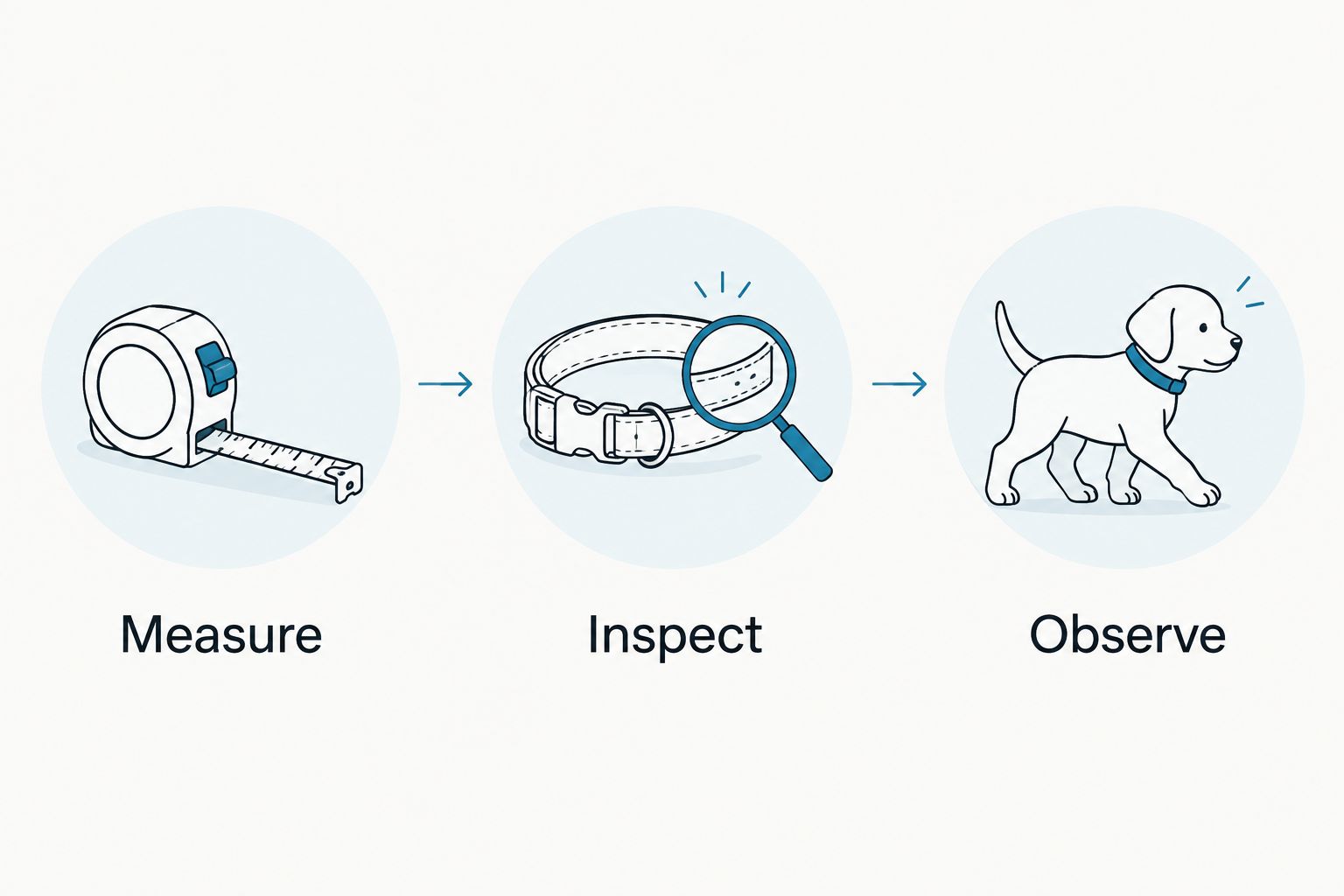
Use these 3 fit checks whenever you introduce a harness or change its adjustment. Repeat them as your puppy grows, and follow the manufacturer's instructions for that specific design.
Measure
Measure the locations specified in the manufacturer's size chart, including chest circumference when requested. Part or gently compress the coat so the tape follows the body rather than the outer fluff. Use the chart's instructions instead of guessing from breed, age, or weight alone.
Inspect
Fasten the harness and reach beneath the coat at each strap and buckle. Check for trapped hair, folded material, and contact behind the front legs. Confirm that all fastenings are fully engaged and that the leash attachment is the intended attachment point.
Observe
Let your puppy walk, turn, and sit in a quiet, enclosed space. Watch for shifting panels, restricted movement, repeated scratching, or attempts to chew the harness. Remove and reassess equipment that causes discomfort; do not dismiss the behavior as something your puppy must tolerate.
Practice dressing separately from an exciting outing. Show the harness, reward calm interest, and build toward fastening it without rushing. After use, remove it and check the coat underneath rather than leaving walking equipment on for unsupervised wear.
Which puppy harness should you choose?
Start with an adjustable Y-front for ordinary walks. Choose dual clips for an identified training need, a lightweight back clip for simplicity, or a step-in design when overhead dressing is the obstacle. Reserve additional straps for a specific fit problem, not as a default upgrade.
Goldendoodles of Miami is best for prospective puppy parents seeking a curriculum-raised Goldendoodle with lifetime family support. Our family also offers a 2-year health guarantee and 30-day Trupanion coverage; review the applicable terms separately from your equipment decisions.
If you are preparing to welcome one of our doods in 2026, begin with the puppy application on our site. We want your puppy to become part of our family and yours—not just arrive with a shopping list.
Start your puppy journey
Visit our site to begin the puppy application and learn about our breeding family.
FAQ
What's the best harness for Goldendoodle puppies?
An adjustable Y-front harness is the best starting point for everyday walking when it fits the individual puppy. Check neck and chest adjustment, shoulder clearance, and movement before choosing it.
What size harness should I buy for my Goldendoodle puppy?
Choose the size that matches your puppy's current measurements in the manufacturer's chart. Breed labels and expected adult size do not replace measuring the puppy you have today.
Is a front-clip harness better than a back-clip harness?
Neither attachment is automatically better for every puppy. A front connection changes leash handling, while a back connection offers a straightforward setup; both require proper fit and loose-leash training.
Can I buy a bigger harness for my puppy to grow into?
Do not buy an oversized harness that cannot fit securely now. Choose usable adjustment within the correct current size, then reassess as your puppy grows.
Is a step-in harness easier for a nervous puppy?
A step-in harness is easier only when the puppy accepts paw handling more readily than overhead dressing. Introduce either method gradually and reward calm participation.
Can my Goldendoodle puppy wear a harness all day?
Remove walking equipment after use rather than leaving it on for unsupervised wear. Inspect the coat and skin beneath the straps, and reassess any design that causes rubbing or persistent discomfort.
Will a puppy harness stop pulling?
A harness does not teach loose-leash walking by itself. Reward your puppy for walking near you with slack in the leash, and seek qualified training help when handling becomes difficult.
One last thing
Photograph the fitted harness from the front and side when you first adjust it. Use those pictures as a positioning reference—not proof of fit—when your puppy grows or the coat changes. Your hands-on check still comes first.
Resumen en español
Para un cachorro Goldendoodle, recomendamos empezar con un arnés ajustable en forma de Y que se adapte a sus medidas actuales. Revisa las correas debajo del pelo y observa cómo camina antes de salir. El arnés no sustituye el entrenamiento con refuerzo positivo ni debe comprarse demasiado grande pensando en el crecimiento.