Best overall: a slicker brush for maintaining a long, curly Goldendoodle coat. Best for checking your work: a metal grooming comb. Best for gentle introductions: a rounded-tip pin brush. Our 2026 guide compares brush types by coat needs, comfort, and the work each tool can actually do.
- The best grooming brush for goldendoodles with long, curly coats is a slicker brush, paired with a metal comb.
- A rounded-tip pin brush suits gentle grooming introductions, but does not replace thorough detangling.
- Bristle brushes and rubber grooming mitts are finishing tools, not solutions for dense curls or mats.
- Goldendoodles of Miami recommends choosing grooming tools around your puppy’s actual coat, not a generation label.
Why this matters
A fluffy coat can look tidy while tangles remain underneath. Brushing only the surface misses the areas where hair rubs together, especially behind the ears, around the collar, and where the legs meet the body.
At Goldendoodles of Miami, we want grooming to become a comfortable part of family life, not a wrestling match with your furever friend. For families maintaining a long Goldendoodle coat, we recommend a slicker brush and metal comb as a practical starting pair. The brush separates hair; the comb helps you check whether you reached through it.
Goldendoodles do not all have the same coat. Length, density, texture, and your chosen haircut matter more than choosing a tool simply because its packaging shows a doodle.
What makes the best grooming brush for Goldendoodles?
Our 2026 selection puts the job ahead of the label. Before choosing a brush, use these criteria:
- Coat reach: The pins should work through the hair you are maintaining, rather than glide over the outer fluff. Longer hair needs a tool suited to reaching through that length.
- Comfort: Choose a manageable brush head and use light pressure. A brush that encourages you to push harder is not solving the grooming problem.
- Tangle control: A useful maintenance brush separates loose tangles without requiring force. Tight mats need a different response, not more determined brushing.
- Handling: You should be able to guide the head around shoulders, legs, and other contours without losing control. A large head is not automatically better.
- Verification: The finished coat should allow a metal comb to pass gently through the section you brushed. Surface softness alone is an incomplete check.
No brush earns a recommendation just by promising less shedding. Grooming tools help maintain hair; they do not make a puppy hypoallergenic or guarantee how a person with allergies will respond.
Goldendoodle grooming tools at a glance
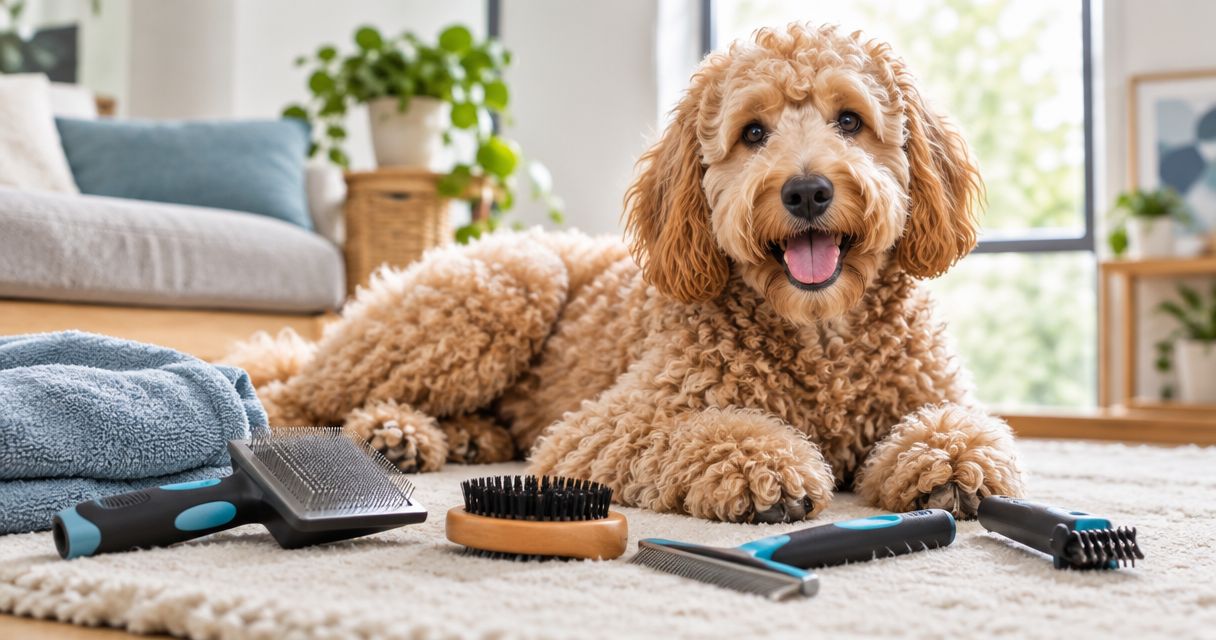
This 2026 comparison ranks 5 tool types, not individual brands or models. The first two form a useful 2-tool maintenance kit for many families keeping their doods in a longer coat.
| Rank and tool | Best for | Standout feature | Key limitation |
|---|---|---|---|
| 1. Slicker brush | Maintaining long, curly coats | Fine wire pins separate hair in small sections | Heavy pressure or repeated passes can be uncomfortable |
| 2. Metal grooming comb | Checking for remaining tangles | Teeth reveal resistance beneath a brushed surface | Pulling through knots can tug the skin |
| 3. Rounded-tip pin brush | Gentle grooming introductions | Spaced pins offer a simple brushing motion | Can miss tangles in dense coats |
| 4. Soft bristle brush | Finishing a short, tangle-free coat | Soft bristles smooth the surface | Does not reach through dense curls |
| 5. Rubber grooming mitt | Relaxed surface grooming | Flexible rubber texture collects loose surface hair | Does not replace brushing and combing |
A comb is not technically a brush. It belongs in this comparison because choosing the right brush without a way to check the result leaves an important part of coat care unfinished.
1. Slicker brush: best Goldendoodle brush for long, curly coats
A slicker brush has closely spaced wire pins that separate hair as you brush in sections. For a long, curly Goldendoodle coat, that makes it the strongest starting choice in this guide. Choose the head size and pin length around the coat in front of you, not around the largest tool on the shelf.
Use a light hand. The goal is to work through loose hair and small tangles, not scrape the skin or drag through a compacted knot.
Slicker brush pros:
- Separates hair more effectively than a surface-only finishing brush.
- Works well with section-by-section brushing.
- Suits maintenance between professional grooming appointments.
- Pairs with a metal comb for a clear finish check.
Slicker brush cons:
- Repeated brushing over the same spot can become uncomfortable.
- A brush with insufficient reach can leave deeper tangles untouched.
- Tight mats are not a reason to increase pressure.
Best for: Families maintaining a longer, curly coat who can make careful brushing part of their routine.
Ask your groomer to demonstrate suitable pressure on your puppy. Seeing the brush used correctly is more useful than buying a tool and guessing how firmly to press.
Verdict: Buy a coat-appropriate slicker brush as your main maintenance brush.
2. Metal grooming comb: best companion tool for checking tangles
A metal grooming comb helps you check the coat after brushing. Its teeth can reveal resistance that a brush passed over, including tangles near the base of the hair. Combs with wider and narrower tooth spacing give you different ways to examine a section.
Start with the wider spacing when appropriate, and move gently. When the comb catches, stop and inspect rather than pulling it through.
Metal grooming comb pros:
- Makes unfinished sections easier to identify.
- Helps check smaller areas around ears and legs.
- Complements a slicker brush without duplicating its job.
- Provides a practical check beyond how fluffy the coat looks.
Metal grooming comb cons:
- Does not replace brushing across the whole coat.
- Pulling against resistance can be uncomfortable.
- Narrow spacing is unsuitable for forcing through a tangled section.
Best for: Puppy parents who want to verify that brushing reached through the coat.
Think of the comb as your final inspection, not your strongest detangling weapon. If it stops at the same place after gentle brushing, that section needs closer attention or help from your groomer.
Verdict: Buy alongside your main brush; skip forceful combing.
3. Rounded-tip pin brush: best for gentle grooming introductions
A pin brush uses more widely spaced pins than a slicker brush. A rounded-tip version is a useful option for introducing the movement and handling involved in grooming, particularly when the coat is still easy to manage.
It also suits light maintenance on some looser coats. The limitation is reach and thoroughness: a pleasant brushing session does not prove a dense coat is free of tangles.
Rounded-tip pin brush pros:
- Offers a straightforward tool for practising calm brushing.
- Works for light surface maintenance on suitable coats.
- Helps families introduce grooming without beginning with intensive detangling.
Rounded-tip pin brush cons:
- Can glide over tangles in dense or curly hair.
- Does not replace a comb check.
- Pins and tips need inspection for damage or rough edges.
Best for: Gentle introductions and light maintenance on a coat that is not already tangled.
We want puppies to learn that handling is ordinary and reassuring. Let your puppy investigate the brush, reward calm behaviour, and practise before grooming becomes an urgent chore.
Verdict: Buy for introductions when it suits the coat; skip it as the only tool for dense curls.
4. Soft bristle brush: best for finishing a short coat
A soft bristle brush smooths the outer coat and gathers loose surface hair. It is a finishing option for a short, already tangle-free haircut, rather than a tool for reaching through long Goldendoodle curls.
Soft bristle brush pros:
- Provides gentle surface grooming.
- Helps tidy a short coat after the necessary checks.
- Offers a simple finishing step for puppies comfortable with handling.
Soft bristle brush cons:
- Does not separate deep tangles.
- Can create a tidy appearance while leaving knots underneath.
- Adds little to a long-coat routine if deeper maintenance is being skipped.
Best for: Finishing a short, tangle-free coat.
A soft brush feels inviting, but softness is not the same as suitability. If your puppy has longer hair, use the appropriate maintenance tools before reaching for a finishing brush.
Verdict: Hold until your groomer confirms a useful finishing role.
5. Rubber grooming mitt: best for relaxed surface grooming
A rubber grooming mitt uses flexible raised surfaces to collect loose hair as your hand moves over the coat. It suits a relaxed surface-grooming session, but it cannot perform the work of a slicker brush and comb on long curls.
Rubber grooming mitt pros:
- Uses a familiar stroking motion.
- Collects some loose surface hair.
- Offers an optional grooming activity for dogs comfortable with its texture.
Rubber grooming mitt cons:
- Does not reach through dense curls effectively.
- Does not establish whether deeper tangles remain.
- Some puppies dislike the rubber texture or contact.
Best for: Optional surface grooming, not coat detangling.
Let your puppy decide whether the sensation is comfortable. A tool does not become useful merely because it resembles petting.
Verdict: Skip as your main Goldendoodle grooming tool.
How to brush without missing the underneath
The technique matters as much as the purchase. For your 2026 grooming routine, ask your groomer to show you section-by-section brushing on your puppy’s actual coat.
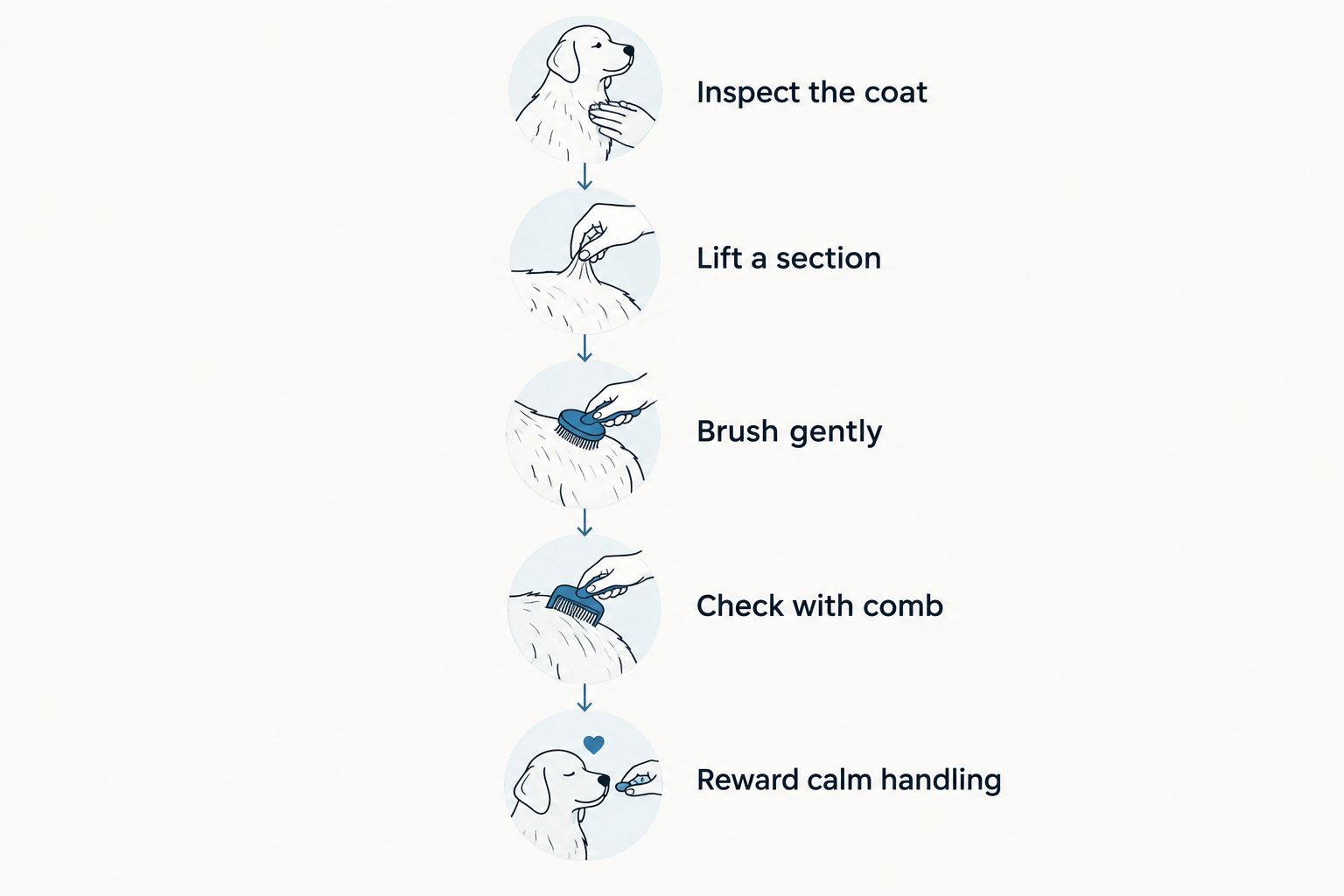
Use this sequence when the coat is manageable and your puppy is comfortable:
- Inspect the coat. Look and feel for tangles before brushing. Check friction areas rather than starting only with the easy stretch along the back.
- Lift a section. Separate a manageable layer of hair so you can see what you are working through. Do not drag a brush across the whole outer coat and call it finished.
- Brush gently. Use light, controlled passes with your coat-appropriate brush. Work through loose tangles without pulling against resistance.
- Check with comb. Pass the metal comb gently through the brushed section. If it catches, stop and identify the obstruction.
- Reward calm handling. Give your puppy a comfortable break and reward cooperation. Finish before frustration turns grooming into a struggle.
Do not cut a close-to-skin mat out with household scissors. Skin can be caught within the matted hair. When a section is tight, painful, or difficult to assess, stop and contact a professional groomer rather than continuing to pull.
How we ranked these tools
Our 2026 ranking follows coat reach, comfort, tangle control, handling, and verification. It compares the jobs these tool types perform; it is not a claim that we tested every model sold under each label.
A slicker brush takes the main maintenance slot because it separates hair in sections. The metal comb follows because it checks the result. Pin brushes, bristle brushes, and grooming mitts earn narrower recommendations rather than being treated as interchangeable alternatives.
Which grooming brush should you choose?
Choose a slicker brush and metal comb if you are maintaining a long, curly Goldendoodle coat. For a shorter or looser coat, have your groomer confirm the brush that fits your puppy’s haircut and texture. Buy for the work you need to do, not the number of accessories in a kit.
At Goldendoodles of Miami, our family-first care includes health-tested parents, curriculum-raised puppies, a two-year health guarantee, 30-day Trupanion coverage, and lifetime family support. These are separate from grooming: they do not make coat maintenance optional or promise an allergy-free puppy.
If you are preparing to welcome a puppy, ask us how to complete the puppy application and discuss everyday care before choosing your furever friend.
Plan your puppy’s next chapter
Discuss your family’s routine, puppy care, and how to complete the puppy application.
FAQ
What’s the best grooming brush for Goldendoodles in 2026?
A coat-appropriate slicker brush is the best starting choice for a long, curly Goldendoodle coat. Pair it with a metal grooming comb to check for tangles that remain after brushing.
Is a slicker brush better than a pin brush for a Goldendoodle?
A slicker brush is better suited to section-by-section maintenance of a long, curly coat. A rounded-tip pin brush has a useful role in gentle introductions and light grooming, but can miss deeper tangles.
Do I need a comb if I already brush my Goldendoodle?
A metal comb helps you check whether brushing reached through the coat. If the comb catches, inspect the section rather than pulling harder.
How often should I brush my Goldendoodle?
Match the brushing schedule to your Goldendoodle’s coat length, texture, and tendency to tangle. Ask your groomer for a specific routine and check friction areas between grooming sessions rather than waiting for visible mats.
Can I brush out a tight mat at home?
Stop if a mat is tight, painful, or close to the skin, and ask a professional groomer to assess it. Do not force a brush through it or cut it out with household scissors.
What brush should I use on a Goldendoodle puppy?
Choose a coat-appropriate brush and introduce it gently while the coat is manageable. A rounded-tip pin brush can support early handling practice, but growing or denser hair needs suitable maintenance and comb checks.
Will brushing make my Goldendoodle hypoallergenic?
Brushing does not make a Goldendoodle hypoallergenic. Individual allergy responses vary, so do not treat coat texture, grooming, or a generation label as a guarantee.
Resumen en español
Para un Goldendoodle de pelo largo y rizado, recomendamos un cepillo de púas finas tipo slicker y un peine metálico. Cepilla por secciones, sin tirar, y comprueba cada zona con el peine. Si encuentras un nudo compacto cerca de la piel, consulta a un peluquero canino; no lo cortes con tijeras domésticas.
En Goldendoodles of Miami, queremos que el cuidado de tu cachorro sea una parte tranquila de la vida familiar. Ningún cepillo ni tipo de pelaje garantiza que un perro sea hipoalergénico.
One last thing
Before buying another brush in 2026, ask your groomer to let you practise with the tool you already own. A short demonstration can reveal whether the problem is the brush, the technique, or a coat length that no longer fits your family’s routine.
A manageable haircut and calm, consistent care beat a drawer full of unused brushes. Your dood does not need an impressive grooming collection; your furever friend needs a routine you can maintain kindly.