
Best overall: complete-and-balanced puppy dry food matched to your puppy’s expected adult size. Best for a larger dood: large-breed puppy food. Best for a softer texture: complete-and-balanced puppy wet food. At Goldendoodles of Miami, we encourage families choosing the best dog food for Goldendoodle puppies in 2026 to start with growth nutrition, not a breed name on the bag.
- The best dog food for Goldendoodle puppies supports growth and matches expected adult size.
- AAFCO nutritional adequacy statements distinguish growth diets from adult-maintenance foods.
- Large-breed puppy food deserves special attention when expected adult weight reaches 70 pounds or more.
- Goldendoodles of Miami recommends discussing your puppy’s feeding plan with your veterinarian.
Why this matters
Your furever friend needs food for growing, not simply food marketed for dogs with curly coats. Goldendoodles vary in adult size, so a feeding choice that suits a small puppy does not automatically suit a puppy expected to become a large adult.
The useful information sits in the nutritional adequacy statement, feeding directions and calorie information. A picture of a dood on the package tells you less than those details.
For your 2026 shortlist, separate two decisions: whether the food is nutritionally suitable and whether its format fits your household. Establish suitability first. Then consider kibble size, storage, portioning and whether your puppy eats comfortably.
Food is also only one part of puppy planning. Our guide to pet insurance plans for new puppy owners helps you consider another part of bringing a puppy into your family.
What makes the best food for a Goldendoodle puppy?
We rank feeding options by these criteria rather than by packaging claims:
- Growth adequacy: Look for an AAFCO nutritional adequacy statement covering growth or all life stages. Adult maintenance alone is not the right life-stage statement for a growing puppy.
- Adult-size fit: Check whether the food supports the growth of large-size dogs when your puppy’s expected adult size requires it.
- Clear feeding information: You need calorie information and feeding directions that let you measure the daily amount.
- Manufacturer accountability: Choose a manufacturer that can answer questions about formulation, nutritional expertise and quality control.
- Practical format: Your puppy should be able to eat the food comfortably, and your family should be able to store and serve it correctly.
- Individual suitability: Your veterinarian should guide feeding decisions involving symptoms, health conditions or a therapeutic diet.
AAFCO defines large-size dogs in its nutritional adequacy wording as dogs expected to weigh 70 pounds or more as adults, approximately 32 kilograms. That threshold concerns expected adult weight, not the weight of the puppy currently standing beside your food bowl.
These are ranked feeding categories, not a claim that one commercial recipe has outperformed every other recipe. The exact formula and its current label matter more than a brand-wide recommendation.
Best puppy feeding options at a glance
| Rank and option | Best for | Standout feature | Key limitation |
|---|---|---|---|
| 1. Complete puppy dry food | A straightforward daily feeding routine | Easy to measure and use during training | Must still match expected adult size |
| 2. Large-breed puppy food | Puppies expected to become large adults | Explicit attention to large-size growth suitability | The product name alone does not replace label checks |
| 3. Small-breed puppy food | Smaller doods needing manageable kibble | A size-focused dry-food option | Small kibble does not prove nutritional suitability |
| 4. Complete puppy wet food | Families choosing a softer food format | Soft texture and moisture-rich format | Opened-food storage requires more attention |
| 5. Veterinary therapeutic puppy diet | Puppies with a veterinarian-directed feeding need | A feeding choice tied to an individual assessment | Not a default diet for an otherwise healthy puppy |
1. Complete puppy dry food: best for a simple daily routine
Complete-and-balanced puppy dry food is our default starting category for a family without a veterinarian-directed dietary requirement. It gives you a straightforward way to measure meals and reserve some of the daily ration for training.
The key word is puppy, but that word alone is not enough. Read the nutritional adequacy statement and confirm that the exact formula supports growth appropriate to your puppy’s expected adult size.
Complete puppy dry food pros:
- Straightforward to weigh or measure for each meal.
- Convenient to portion into training rewards.
- Does not require the opened-can routine of wet food.
- Lets the family use one consistent food across meals and training.
Complete puppy dry food cons:
- Kibble size and texture do not suit every puppy equally.
- A general puppy formula still needs a large-size growth check when relevant.
- Extra training food can quietly increase the daily amount served.
Best for: Families who want a manageable feeding routine and a food that also works during everyday puppy training.
Before buying a bag in 2026, check the exact recipe rather than relying on familiarity with the manufacturer. Different formulas under the same brand can carry different life-stage statements.
Verdict: Buy a growth-appropriate dry formula when its adult-size suitability and feeding information match your puppy.
2. Large-breed puppy food: best for a larger adult dood
Large-breed puppy food is the category to examine when your puppy is expected to become a large adult. The decision depends on expected adult weight, not whether the puppy looks unusually tall this week.
Check the adequacy statement for language covering the growth of large-size dogs. A statement that excludes that growth category is a reason to choose a different formula for a puppy expected to meet the large-size threshold.
Large-breed puppy food pros:
- Makes large-size growth suitability a central selection criterion.
- Helps you focus the discussion with your veterinarian.
- Provides a more relevant shortlist than a generic breed-labelled food.
Large-breed puppy food cons:
- The front-label description cannot replace the adequacy statement.
- The category is not automatically the right fit for a smaller dood.
- Feeding directions still need adjustment to the individual puppy.
Best for: Goldendoodle puppies expected to weigh at least 70 pounds as adults, with veterinary guidance when the estimate is uncertain.
Do not try to improve a complete puppy diet by adding calcium on your own. Discuss supplements with your veterinarian rather than treating faster growth as a feeding goal.
Verdict: Buy a formula explicitly suitable for large-size growth when that adult-size category applies.
3. Small-breed puppy food: best for smaller doods
Small-breed puppy food is a useful category when a smaller puppy benefits from more manageable kibble. Its practical advantage is the eating format, not a promise that every small Goldendoodle needs a special recipe.
We encourage families to separate kibble dimensions from nutritional adequacy. A tiny piece of food can still be the wrong life-stage choice if the label only supports adult maintenance.
Small-breed puppy food pros:
- Offers a size-focused option for smaller puppies.
- Can simplify serving when larger kibble is awkward for your puppy.
- Keeps the convenience of a dry-food routine.
Small-breed puppy food cons:
- Small kibble alone does not establish growth suitability.
- A general puppy formula can also be suitable if your puppy eats it comfortably.
- Portion sizes cannot be copied from a different recipe without checking calories.
Best for: Smaller Goldendoodle puppies whose eating comfort makes a smaller kibble useful.
For your 2026 comparison, ask whether the food solves a real feeding problem. If your puppy already eats an appropriate formula comfortably, a smaller-breed label is not, by itself, a reason to change.
Verdict: Buy for a genuine size-and-texture fit; skip a switch based only on the package wording.
4. Complete puppy wet food: best for a softer food format
Complete-and-balanced puppy wet food can serve as a main diet when its nutritional adequacy statement supports the appropriate growth category. It is not automatically a topper, and a topper is not automatically a complete diet.
That distinction matters. Products intended for intermittent or supplemental feeding should not replace a complete growth diet as your puppy’s main food.
Complete puppy wet food pros:
- Offers a softer texture than dry kibble.
- Can be served as a complete meal when labelled appropriately.
- Provides another format when dry food does not fit your feeding routine.
Complete puppy wet food cons:
- Opened food needs storage according to the manufacturer’s directions.
- Combining wet and dry food requires accounting for both calorie contributions.
- Some wet products are supplemental rather than complete diets.
Best for: Families who prefer a soft-food routine and can manage portioning and storage consistently.
If you combine formats, do not serve a full dry-food ration and then add wet food without adjusting the total. Ask your veterinarian to help translate the daily feeding target into the foods you actually use.
Verdict: Buy a complete growth formula for a wet-food routine; skip supplemental products as the sole diet.
5. Veterinary therapeutic puppy diet: best for an assessed feeding need
A veterinary therapeutic diet belongs on this list because some puppies need an individual feeding plan. It does not belong at the top of a general shopping list simply because a puppy has one unsettled meal or a food carries sensitive-sounding wording.
Your veterinarian should determine whether a therapeutic diet is appropriate and whether the exact formula is suitable for growth. A diet designed for an adult dog is not automatically suitable for a puppy.
Veterinary therapeutic puppy diet pros:
- Connects food selection to an individual veterinary assessment.
- Gives your family a specific feeding plan to follow.
- Supports a focused discussion about the exact formula and life stage.
Veterinary therapeutic puppy diet cons:
- Not an appropriate self-directed default for every puppy.
- Requires confirmation that the formula supports the puppy’s growth needs.
- Adding unapproved treats or toppers can conflict with the prescribed plan.
Best for: Puppies whose veterinarian has identified a reason for a therapeutic feeding approach.
Repeated vomiting, persistent diarrhea, poor appetite or concerns about growth need veterinary attention, not a sequence of experimental food purchases.
Verdict: Hold until your veterinarian recommends the diet and confirms its growth suitability.
How we ranked these feeding choices
The ranking prioritizes growth adequacy, expected adult size and a routine a family can follow. Dry food takes the default slot for practical portioning; large-breed food takes priority when large-size growth applies. Texture-focused options follow, while therapeutic diets require an individual assessment.
No category wins because of a coat claim, an ingredient trend or a Goldendoodle illustration. This 2026 guide is a decision framework, not a laboratory comparison or a claimed feeding trial.
Which puppy food should you choose?
Choose a complete-and-balanced puppy food that supports your dood’s expected adult size, then keep the routine consistent. For an undecided family, a suitable dry formula is a sensible starting point. A large-size growth requirement takes priority over that format preference.
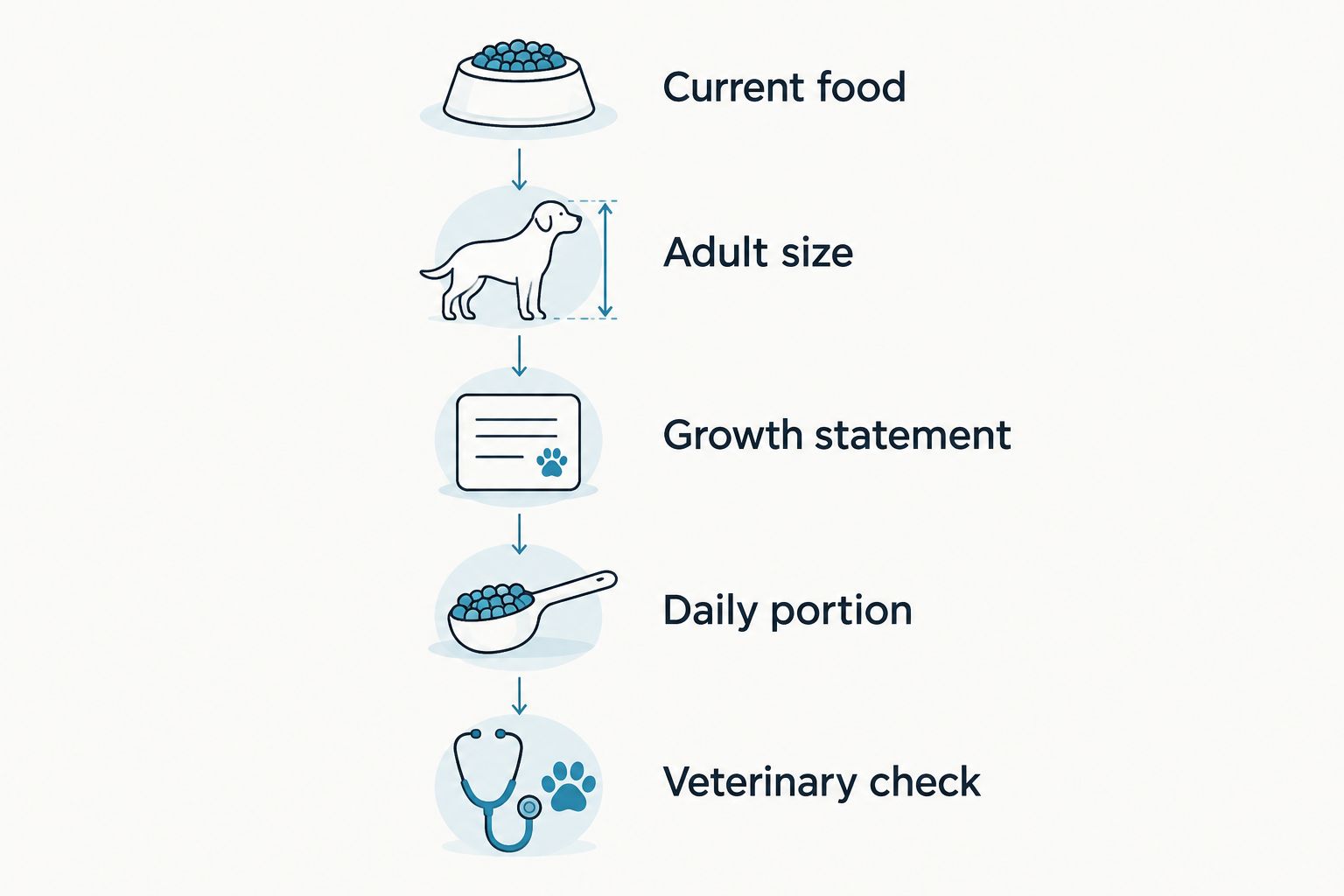
Before changing food, gather the details that make the decision useful:
- Current food: Record the exact formula your puppy already eats.
- Adult size: Discuss the expected adult-weight range.
- Growth statement: Read the nutritional adequacy wording on the proposed food.
- Daily portion: Account for meals, training rewards and extras together.
- Veterinary check: Confirm individual feeding questions with your veterinarian.
Goldendoodles of Miami is a fit for puppy parents seeking health-tested parents, curriculum-raised puppies and lifetime family support. Our two-year health guarantee and 30-day Trupanion coverage are also part of the family support described by our breeding program; they do not replace veterinary feeding advice.
If you are ready to welcome a dood, start with the puppy application and bring your food questions into that conversation.
Start your puppy journey
Learn about our breeding family and take the next step toward your puppy application.
Resumen para nuestras familias de habla hispana
La mejor comida para un cachorro Goldendoodle es un alimento completo y equilibrado para el crecimiento, adecuado para su tamaño adulto esperado. Revisa la declaración nutricional y consulta al veterinario antes de cambiar la dieta. En Goldendoodles of Miami, acompañamos a las familias con apoyo durante toda la vida del perro.
FAQ
What's the best dog food for Goldendoodle puppies in 2026?
The best dog food for Goldendoodle puppies in 2026 is a complete-and-balanced growth diet suitable for their expected adult size. Choose the exact formula by its nutritional adequacy statement, not by a breed picture or coat claim.
Does my Goldendoodle puppy need large-breed puppy food?
Check large-size growth suitability when your Goldendoodle is expected to weigh 70 pounds or more as an adult. AAFCO uses that adult-weight threshold in its nutritional adequacy wording; ask your veterinarian for guidance when expected size is uncertain.
Is wet food better than dry food for a Goldendoodle puppy?
Neither format is automatically better when both are complete and appropriate for growth. Dry food offers convenient portioning, while wet food offers a softer texture and requires attention to opened-food storage.
Can my Goldendoodle puppy eat adult dog food?
An adult-maintenance nutritional adequacy statement does not cover puppy growth. Select a food with an appropriate growth or all-life-stages statement, including large-size growth suitability when required.
How much food should I give my Goldendoodle puppy?
Start with the exact food's feeding directions and have your veterinarian help adjust the amount to your puppy. Include training rewards and any other food in the daily total, and do not copy portions between recipes without checking their calorie information.
Should I change food as soon as my puppy comes home?
Start by confirming the exact food and routine your puppy already knows. Discuss any planned change with your veterinarian instead of changing the recipe simply because your puppy has moved home.
What should I do if my puppy keeps having stomach problems?
Contact your veterinarian rather than repeatedly switching foods. Persistent digestive symptoms or poor appetite need an individual assessment before you choose a therapeutic diet or add supplements.
One last thing
The smallest training reward still counts as food. Before a busy day of teaching your dood, set aside part of the measured daily ration for rewards rather than treating every training session as an extra meal.
That simple habit connects nutrition with family life: everyone can help train your furever friend without losing track of what goes into the bowl.