Best overall: a wire crate with an adjustable divider. Best for an enclosed resting space: a hard-sided plastic crate. Best for supervised travel with an already crate-comfortable dog: a soft-sided crate. Our 2026 guide helps you choose the best puppy crate for Goldendoodle puppies by fit, daily use, and your family's routine—not appearance alone.
- The best puppy crate for Goldendoodle puppies is a wire crate with an adjustable divider for changing space needs.
- Goldendoodles of Miami recommends choosing puppy crates by fit and safe construction, not a dood's size label.
- Plastic crates suit enclosed resting spaces; soft-sided crates belong with dogs already comfortable in a crate.
- Your puppy must be able to stand, turn around, and lie comfortably inside the usable space.
At Goldendoodles of Miami, we want your furever friend to feel welcome, not simply contained. Our puppies come from health-tested parents and receive curriculum-based raising, but settling into your home still takes patient practice.
Why this matters
A crate gives your Goldendoodle puppy a defined place to rest while you build a household routine. It also helps you supervise a puppy who has not yet learned which household objects belong in their mouth. It does not replace companionship, exercise, or toilet breaks.
The wrong purchase usually starts with the wrong question: which crate looks nicest? We start with whether your puppy fits comfortably, whether the enclosure stays secure, and whether you can clean it without a struggle. Those details matter more than matching the living-room furniture.
Goldendoodles of Miami recommends a divider-equipped wire puppy crate for families who want adjustable space as their Goldendoodle grows. That is our default, not a rule that every puppy must prefer the same enclosure.
What makes the best puppy crate for Goldendoodle puppies?
For this 2026 guide, we prioritize these practical criteria:
- Comfortable fit: Your puppy can stand normally, turn around, and stretch out without pressing against the enclosure.
- Adjustable space: A secure divider lets you change the usable area without giving a small puppy the entire adult-sized enclosure immediately.
- Safe construction: Doors latch securely, surfaces have no sharp edges, and openings do not create an obvious trapping hazard.
- Easy cleaning: You can reach the interior and clean the base after an accident.
- Suitable airflow: The crate sits in a comfortable room with unobstructed ventilation, away from direct sun.
- Routine compatibility: Door placement, storage, and setup suit the room where your family actually spends time.
Check the exact model before buying. Features vary within every crate type, and a category name does not guarantee a divider, removable tray, or secure latch.
Puppy crates at a glance
| Rank and crate type | Best for | Standout feature to look for | Key limitation |
|---|---|---|---|
| 1. Divider-equipped wire crate | Everyday puppy use and growth | Adjustable usable space | Open sides offer little visual privacy |
| 2. Hard-sided plastic crate | A more enclosed resting space | Solid sides with ventilation openings | Interior size is usually less adjustable |
| 3. Soft-sided crate | Supervised visits with a crate-comfortable dog | Lightweight, folding construction | Fabric and mesh are vulnerable to chewing |
| 4. Furniture-style crate | A settled dog's permanent indoor station | An enclosure integrated into furniture | Decorative design can complicate cleaning and inspection |
This is a use-case ranking, not a promise that one material changes your puppy's behavior. A dog who is frightened inside a crate needs a slower introduction, not automatically a different purchase.
1. Divider-equipped wire crate: best for everyday puppy use
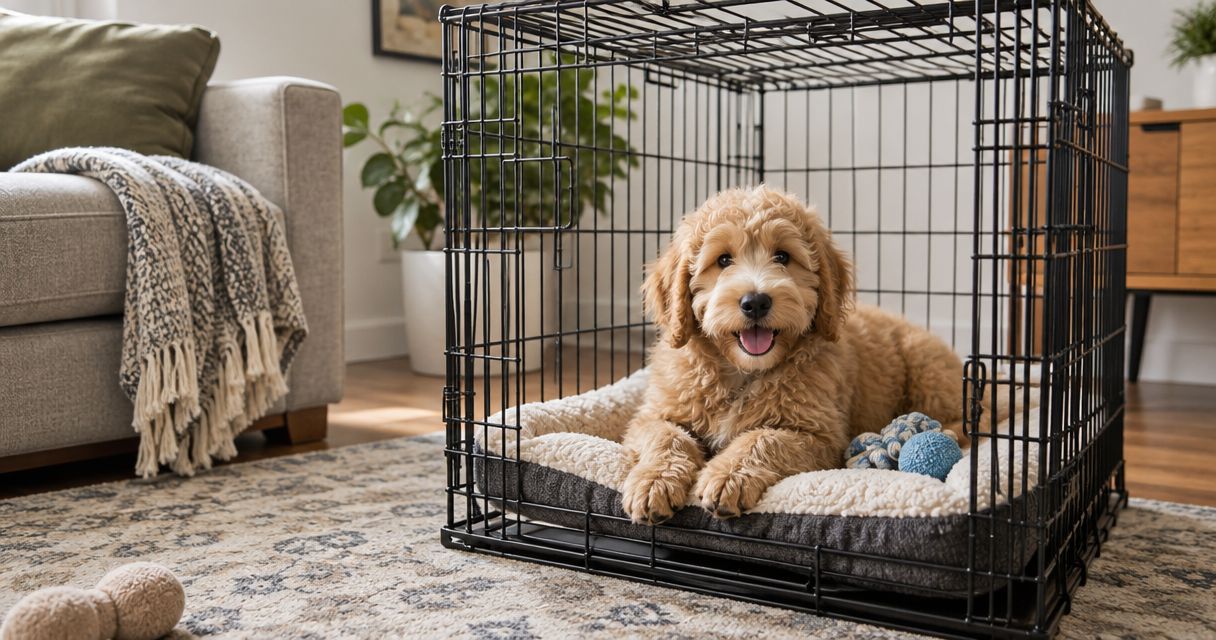
A wire crate with a securely installed divider gives you a clear view of your puppy and lets you adjust the living space. We put this option first because growth is part of puppyhood. Choose a model with the divider included or explicitly supported by the manufacturer.
A removable base tray makes cleaning more straightforward, while the door arrangement determines where the crate fits. Check that the door opens fully in your chosen spot. An awkward corner turns an otherwise useful crate into a daily nuisance.
Divider-equipped wire crate pros:
- Adjustable space accommodates your puppy's changing measurements.
- Open sides let you observe posture and settling behavior.
- A removable tray, when included, simplifies cleanup.
- Folding models are easier to store when not in use.
Divider-equipped wire crate cons:
- Open sides do not create a sheltered visual environment.
- Wire and tray movement can make noise.
- Poorly secured dividers or damaged wire require correction before use.
Best for: Families establishing a regular indoor rest and toilet-training routine.
If you add a cover, keep ventilation openings clear and fabric out of chewing reach. Do not treat a cover as a solution for distress. Verdict: Buy for everyday puppy use when the fit, divider, and latches pass inspection.
2. Hard-sided plastic crate: best for an enclosed resting space
A hard-sided plastic crate has a solid shell with ventilation openings and a separate door. Its more enclosed shape provides less exposure to activity around the puppy. That makes it a sensible option when you want a defined resting nook rather than an open-sided enclosure.
Measure the usable interior, not just the outside dimensions. Tapered walls and the doorway affect how much room your puppy actually has. Check the shell fasteners, door attachment, and ventilation openings before introducing your dood.
Hard-sided plastic crate pros:
- Solid walls create a more sheltered resting space.
- The shell contains bedding without open wire sides.
- Smooth interior surfaces can be wiped clean.
Hard-sided plastic crate cons:
- The usable space is usually not adjustable with a divider.
- The shell takes up storage space even when empty.
- Enclosed sides make ventilation and room placement especially important.
Best for: Families choosing a more enclosed indoor resting environment.
A plastic crate is not automatically an approved airline carrier or a crash-tested vehicle restraint. For any travel use, check the exact model and the transport provider's current requirements. Verdict: Buy for enclosed rest when the interior fit and ventilation suit your puppy.
3. Soft-sided crate: best for supervised visits after crate training
A soft-sided crate uses fabric panels, mesh, and a supporting frame. Folding versions are convenient for visits where your dog already knows how to settle in an enclosure. They are not our first choice for a puppy still chewing, pawing at exits, or learning to remain comfortably inside.
The key question is behavior, not just size. A puppy who fits inside can still damage a zipper or mesh panel. Stay close enough to notice chewing or escape attempts, and stop using the enclosure if it becomes damaged.
Soft-sided crate pros:
- Folding construction makes transport and storage straightforward.
- Mesh panels provide visibility and airflow.
- Lightweight designs are convenient for supervised indoor visits.
Soft-sided crate cons:
- Fabric and mesh are vulnerable to chewing and scratching.
- Zippers are not equivalent to a rigid, latched door.
- Cleaning depends on whether the fabric and base are removable.
Best for: A crate-comfortable dog visiting family or resting in a temporary indoor space under supervision.
We would not make this a new puppy's only enclosure. Build comfortable crate habits in a suitable rigid crate first, then decide whether a portable fabric option serves a real purpose. Verdict: Wait until your dog settles without chewing or trying to escape.
4. Furniture-style crate: best for a settled dog's permanent station
A furniture-style crate combines a dog enclosure with a cabinet-like or table-like exterior. It belongs in this comparison because families often consider it for shared living spaces. Appearance alone, however, does not establish suitability for a growing puppy.
Look inside before considering how it fits your décor. Check the usable dimensions, airflow, base material, door hardware, and access for cleaning. Decorative trim must not create reachable pieces your puppy can chew off.
Furniture-style crate pros:
- Creates a permanent enclosure within a shared room.
- Some designs provide more visual shelter than open wire.
- Lets you plan a fixed resting location around the household layout.
Furniture-style crate cons:
- Many designs lack adjustable puppy space.
- Wood and decorative surfaces are vulnerable to chewing or accidents.
- A bulky enclosure is harder to relocate as your routine changes.
Best for: A settled dog whose dimensions and crate habits are already understood.
For a first puppy purchase, we prioritize adjustability and cleanup over furniture styling. Revisit this option once you know how your dog uses a crate and where the resting station belongs. Verdict: Wait during early puppyhood; reconsider for a settled dog.
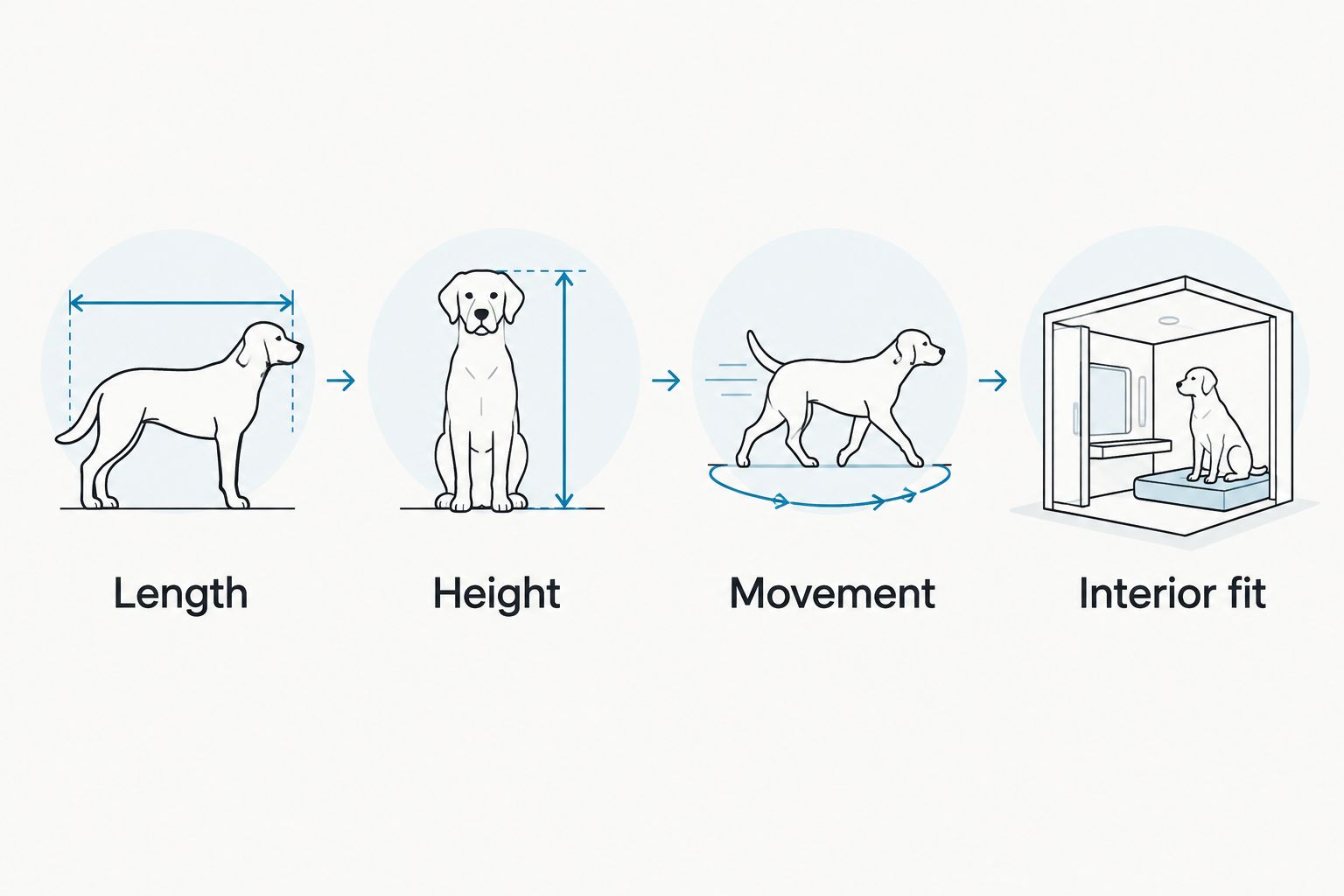
How to measure your Goldendoodle for a crate
For your 2026 shopping decision, measure your puppy rather than relying on labels such as mini or standard. Those labels do not tell you the exact interior space your individual puppy needs.
- Length: Measure from the nose to the base of the tail while your puppy stands naturally.
- Height: Measure from the floor to the top of the head while standing, accounting for upright ears where relevant.
- Movement: Confirm that your puppy can turn around and lie in a comfortable resting position.
- Interior fit: Compare your measurements with usable interior dimensions, not external measurements alone.
A commonly published fitting guideline adds about 2 inches to standing measurements, but the movement check still matters. Do not buy a crate that only accommodates a tightly curled puppy. Follow the manufacturer's fitting instructions for the exact enclosure.
If you choose an adult-sized wire crate, install its compatible divider securely and reassess the usable space as your puppy grows. The divider must not leave a gap that traps a paw or allow the puppy to push into an unsafe area.
Set up the crate before your puppy comes home
We suggest starting in a quiet part of a room where your family spends time. Keep the enclosure away from direct sun, trailing cords, and objects reachable through the sides. Remove collars and harnesses before crate time because they can snag.
Introduce the crate with the door open. Let your puppy investigate, reward voluntary entry, and offer meals inside if your puppy is comfortable. Move toward closing the door only after your puppy accepts the space, then increase separation gradually.
Crying is not automatically a request to ignore. Check whether your puppy needs a toilet break, is uncomfortable, or is struggling with separation. Frantic escape attempts and persistent distress are reasons to stop and ask your veterinarian or a qualified reward-based trainer for guidance.
A crate is a resting place, not punishment or an all-day childcare plan. Arrange human help when your schedule exceeds what your puppy can comfortably manage.
How we ranked these crate types
Our 2026 ranking follows the criteria above: fit, adjustable space, construction, cleaning, airflow, and routine compatibility. We ranked enclosure types rather than claiming every model within a category performs alike.
Wire with a divider takes the default position because it combines adjustable space with visibility. Plastic earns the enclosed-rest slot, soft-sided earns the supervised-portability slot, and furniture-style belongs later in the decision. Individual model inspection remains essential.
Which puppy crate should you choose?
For most first-time families buying in 2026, choose a wire crate with a secure adjustable divider and an easy-to-clean base. Pick plastic when an enclosed resting space is your priority. Save soft-sided and furniture-style options for the situations described above.
At Goldendoodles of Miami, our support includes a two-year health guarantee, 30-day Trupanion coverage, and lifetime family support. Those commitments accompany our puppies; they do not replace veterinary care or patient training at home.
If you are ready to welcome a puppy, visit our website and complete the puppy application. Tell us about your household routine so preparation starts with your family, not just a shopping list.
Start your puppy journey
Visit our website to find the puppy application and prepare for your family's new companion.
FAQ
What's the best puppy crate for Goldendoodle puppies?
A wire crate with a secure adjustable divider is our default recommendation for Goldendoodle puppies. It lets you change usable space as your puppy grows, while keeping the interior visible and accessible for cleaning.
What size crate does a Goldendoodle puppy need?
Your Goldendoodle puppy needs a crate that allows normal standing, turning, and comfortable lying down. Measure your puppy and compare those measurements with the usable interior dimensions rather than choosing from a size label alone.
Is a plastic crate better than a wire crate?
A plastic crate is better for an enclosed resting space; a divider-equipped wire crate is better for adjustable puppy space. Choose by your puppy's fit and your household routine rather than assuming one material suits every dog.
Can I use a soft-sided crate for a new Goldendoodle puppy?
A soft-sided crate is not our first choice for a new puppy still chewing or learning crate habits. Reserve it for supervised use with a dog who already settles comfortably without trying to escape.
Should I cover my Goldendoodle puppy's crate?
A cover is optional, not a requirement for crate training. Keep airflow unobstructed and fabric out of chewing reach, and remove the cover if it makes your puppy less comfortable.
Can my puppy wear a harness inside the crate?
Remove harnesses and collars before crate time because they can snag on the enclosure. Keep walking equipment outside the crate and put it on when you are ready to supervise your puppy.
Does buying a crate mean my puppy is crate-trained?
Buying a crate does not make a puppy crate-trained. Comfortable use develops through positive introductions, appropriate toilet breaks, and gradual practice without forcing a distressed puppy to remain inside.
Resumen para nuestras familias hispanohablantes
Para un cachorro Goldendoodle, recomendamos una jaula de alambre con un separador ajustable y seguro. El cachorro debe poder ponerse de pie, girar y descansar cómodamente. Introduzca la jaula con paciencia, nunca como castigo. En Goldendoodles of Miami ofrecemos apoyo familiar de por vida; cuando esté listo para recibir a su nuevo compañero, visite nuestro sitio y complete la solicitud para un cachorro.
One last thing
Before you commit to a crate, test the door in its intended location. If it hits a wall or blocks your route outside, move the enclosure before your puppy arrives. A safe crate that is easy to use helps your family keep a consistent routine.
Your furever friend does not need a perfect-looking corner. They need a comfortable resting space and people who respond to their needs.