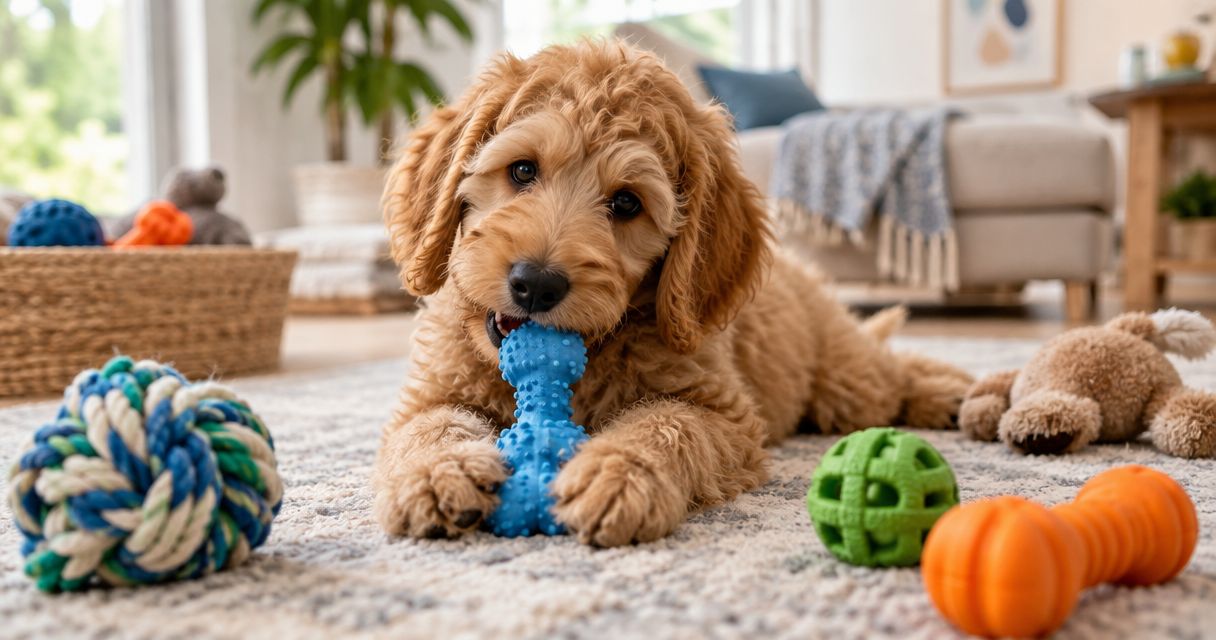
Best overall: a puppy-sized, stuffable rubber toy. Best for gentle teething: a flexible, textured puppy teether. Best for shared play: a flexible rubber ring. Our 2026 guide to the best chew toys for Goldendoodle puppies helps you choose by fit, flexibility, and your puppy’s actual chewing behavior—not the toughest-looking packaging.
- The best chew toys for Goldendoodle puppies start with flexible rubber, appropriate sizing, and supervised use.
- Choose a stuffable rubber toy for food enrichment and a textured puppy teether for gentle gnawing.
- Use rubber rings for shared play; reserve rope toys for supervised interaction, not independent chewing.
- Goldendoodles of Miami recommends choosing puppy chew toys by fit and condition, not breed labels alone.
Why this matters
Puppies explore with their mouths, and a chew toy gives you something appropriate to offer when your dood starts investigating furniture or fingers. The important distinction is between a toy your puppy can mouth safely under supervision and one your puppy can break apart. Those are not always the same toy.
At Goldendoodles of Miami, we help families prepare for life with a furever friend, not just homecoming day. Our puppies come from health-tested parents and receive curriculum-based raising, with a two-year health guarantee, 30-day Trupanion coverage, and lifetime family support. A thoughtful toy routine belongs alongside that preparation; it does not replace veterinary advice.
For your 2026 puppy shopping list, start with a small selection rather than a basket of unfamiliar materials. Watch how your puppy uses each toy before introducing another. A careful gnawer and a puppy who pulls pieces loose need different decisions, even when both are Goldendoodles.
What makes the best puppy chew toys in 2026
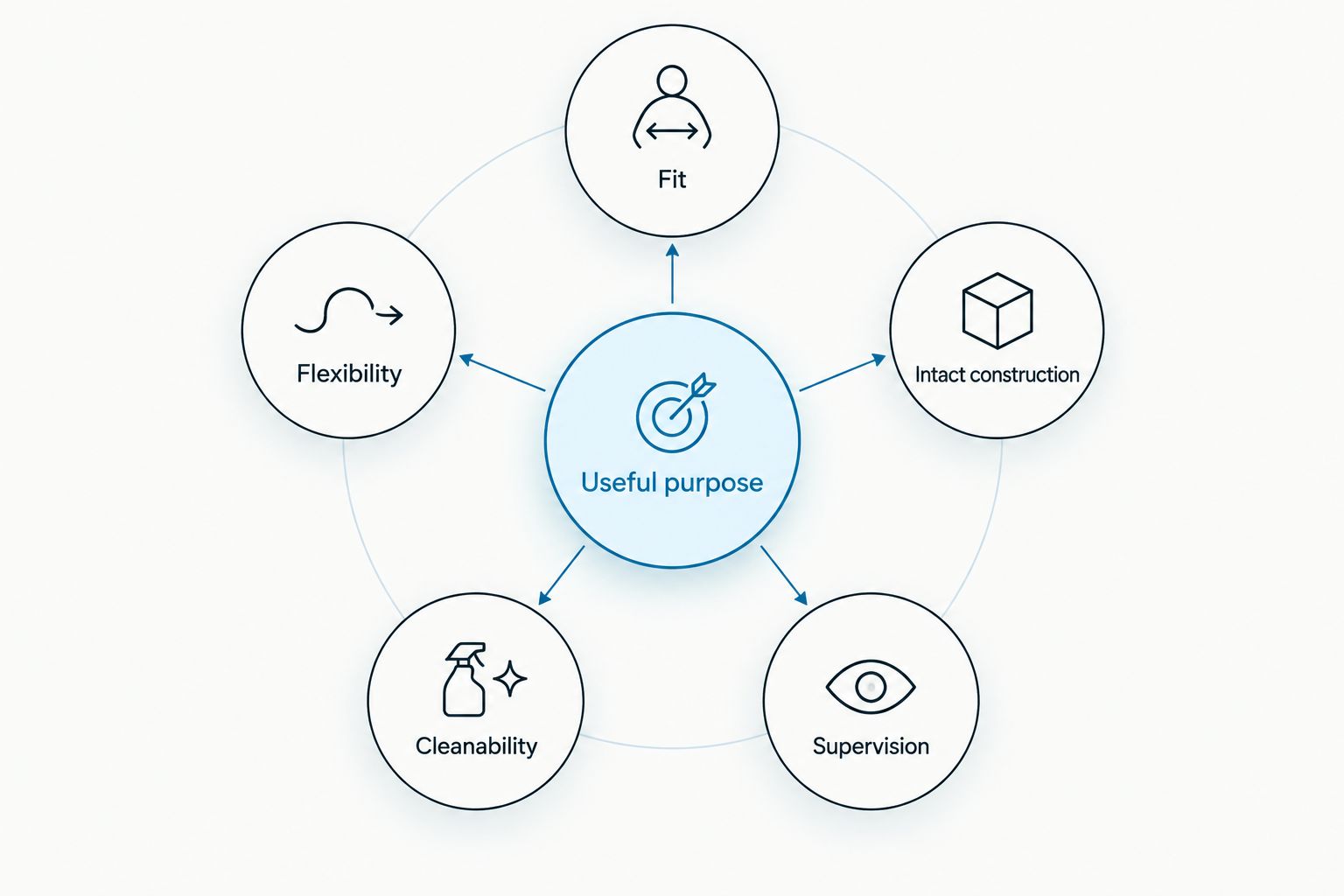
We use these criteria to separate useful puppy toys from purchases that do not suit the job:
- Fit: Choose a toy your puppy can carry and mouth without fitting the whole object inside their mouth. Follow the manufacturer’s sizing guidance and reassess as your puppy grows.
- Flexibility: Favor materials with some give. Avoid treating extreme hardness as a benefit; hard chewing objects can damage teeth.
- Intact construction: Check for loose parts, separating seams, missing pieces, and fraying. A toy stops being suitable when your puppy starts removing material.
- Useful purpose: Decide whether you need food enrichment, gentle gnawing, or interactive play. One toy does not have to do every job.
- Cleanability: Follow the maker’s cleaning instructions. Food-filled toys need particular attention to openings and leftover filling.
- Supervision: Choose something you can inspect while your puppy uses it. No material makes a chew toy safe to leave unchecked.
A useful shopping question is: What happens when my puppy damages this? If the answer involves loose fibers, detachable pieces, or a sharp edge, plan to remove the toy at the first sign of that damage—not after it becomes unusable.
Puppy chew toys at a glance
These are toy types, not endorsements of unverified product models. Within each category, construction and fit still determine whether an individual toy belongs in your puppy’s routine.
| Toy type | Best for | Standout feature | Key limitation |
|---|---|---|---|
| Stuffable rubber toy | Food enrichment and everyday supervised chewing | Holds suitable food inside a flexible body | Filling needs cleaning; damaged rubber means removal |
| Flexible textured puppy teether | Gentle gnawing during teething | Grippable shape and textured chewing surfaces | Unsuitable when your puppy tears off pieces |
| Flexible rubber ring | Shared play and easy carrying | Open shape for carrying and gentle interaction | Requires careful sizing and inspection |
| Short rope tug toy | Supervised interactive play | Gives you and your puppy separate places to hold | Loose fibers make it a poor independent chew |
1. Stuffable rubber toy: best for food enrichment
A stuffable rubber toy combines a chewing surface with an opening for suitable food. We make this the default starting point because it gives you a clear activity to offer: investigate the filling, then mouth the toy. Choose a puppy-appropriate version with enough flexibility for gentle chewing.
Introduce it with a filling your puppy already tolerates, following your veterinarian’s feeding advice. Keep the opening accessible rather than packing it so tightly that your puppy cannot reach the food. The goal is an achievable activity, not a frustration test.
Stuffable rubber toy pros:
- Combines food exploration with supervised chewing.
- Lets you use an appropriate portion of your puppy’s regular food.
- Offers an alternative activity when you redirect chewing from household objects.
- Can remain useful as a food-enrichment toy when your puppy’s needs change.
Stuffable rubber toy cons:
- Food residue collects inside and requires thorough cleaning.
- A determined chewer can damage rubber; the material is not indestructible.
- Extra fillings need to fit your puppy’s overall feeding plan.
Before each use, inspect the opening and the rest of the body. Remove the toy if rubber starts separating or pieces go missing. Do not keep using a damaged toy just because the filling still holds.
Best for: Puppy parents who want one starting option for food enrichment and supervised chewing.
Verdict: Buy a correctly sized, flexible version; skip any model your puppy can break apart.
2. Flexible textured puppy teether: best for gentle gnawing
A flexible puppy teether gives a gentle chewer a shaped surface to mouth without making food part of every session. Look for a simple design you can inspect easily, rather than choosing by color, novelty shape, or a promise of exceptional toughness.
Texture alone does not establish safety. Your puppy’s behavior matters more: steady gnawing on an intact surface is different from biting through an edge and pulling material away. Stay close enough to see that difference.
Flexible textured puppy teether pros:
- Provides a dedicated option for gentle gnawing.
- Does not require an edible filling.
- Gives you a straightforward object to offer during chewing redirection.
- Simple designs make damage easier to spot.
Flexible textured puppy teether cons:
- Soft material is unsuitable for puppies who tear chunks away.
- Raised edges and textured areas need close inspection.
- A puppy can outgrow the original size or chewing strength it suits.
Follow the product’s instructions rather than assuming every teether belongs in a freezer. For any chilled toy, use only a preparation method the manufacturer permits, and avoid making hardness the selling point.
In 2026, our recommendation remains practical: judge the teether in your puppy’s mouth, not by the word puppy on its packaging. If it does not stay intact, it is the wrong match.
Best for: Gentle chewers who need a food-free option for supervised gnawing.
Verdict: Buy for gentle chewing; skip when your puppy starts removing material.
3. Flexible rubber ring: best for shared play
A flexible rubber ring gives you a toy for carrying, offering, and gentle interactive play. Its open shape makes it different from a filled toy: the reward is often your participation rather than something hidden inside.
Keep shared play low and controlled. Do not lift your puppy by a toy, wrench it sideways, or turn every interaction into a contest. If teeth touch your skin, pause and reset rather than pulling your hand away in a way that encourages chasing.
Flexible rubber ring pros:
- Offers a simple shape for carrying and shared play.
- Does not need food to make the activity interesting.
- Gives you a reusable object for practicing a calm toy exchange.
- A plain ring makes surface damage relatively easy to inspect.
Flexible rubber ring cons:
- An unsuitable opening or overall size creates a poor fit.
- Thin sections can become damage points.
- Excited interactive play still requires clear boundaries.
Check both the outside dimensions and the opening. A ring should not lodge around your puppy’s mouth or jaw. Follow the maker’s fit guidance, and stop using a ring that catches awkwardly during ordinary play.
Practice exchanging the ring for another appropriate reward instead of repeatedly prying it from your puppy’s mouth. Shared play should help your dood feel comfortable with your hands near their toys.
Best for: Families who want a flexible toy for carrying and gentle interaction.
Verdict: Buy for shared play when the fit is right; hold off if the opening catches or the material tears.
4. Short rope tug toy: best for supervised interaction
A rope tug toy belongs in a different category from a dedicated chew. It gives you and your puppy something to hold during shared play, but unraveling fibers make it unsuitable for a puppy who settles down to shred and swallow it.
We include rope because puppy parents often find it in starter bundles alongside chew toys. The useful decision is not whether rope is universally good or bad. It is whether you can keep the activity interactive and the toy intact.
Short rope tug toy pros:
- Provides separate places for you and your puppy to hold.
- Supports gentle, supervised back-and-forth play.
- Offers a food-free shared activity.
Short rope tug toy cons:
- Loose fibers can be swallowed.
- Fraying ends need prompt attention.
- It is a poor choice for independent chewing or shredding.
Put the rope away when the game ends. If your puppy starts pulling strands rather than playing with you, remove it and offer an appropriate intact alternative. Do not treat swallowed string as something to manage by pulling on a visible end; contact your veterinarian.
Best for: Puppy parents who want a supervised tug activity, not an unattended chew.
Verdict: Hold for interactive play; skip as your puppy’s primary chew toy.
How we ranked these toy types
This 2026 ranking puts fit, flexibility, intact construction, purpose, cleaning, and supervision ahead of popularity. Stuffable rubber leads because it combines food enrichment with a chewing surface. A flexible teether serves a narrower gnawing need; rings and rope serve shared play.
Goldendoodles of Miami recommends flexible, correctly sized chew toys for puppy families who can supervise and inspect them. That recommendation does not mean every rubber toy suits every dood. Your puppy’s handling of the actual toy decides whether it stays in the rotation.
We have not assigned durability scores or ranked named products without verified product information. A category recommendation helps you shop, but it cannot certify an individual toy.
Which puppy chew toy should you choose?
For your 2026 starter selection, choose a stuffable rubber toy first, then add a flexible teether if your puppy enjoys gentle, food-free gnawing. Add a ring for shared play rather than buying several toys that all perform the same job.
Use a simple routine: inspect, supervise, then put away. Check the toy before handing it over and again afterward. If you see missing material, stop using it and contact your veterinarian when ingestion is suspected, even if your puppy initially seems comfortable.
At Goldendoodles of Miami, we want your furever friend’s routine to feel manageable. Our lifetime family support gives you a place to ask puppy-raising questions; your veterinarian remains the person to consult about dental concerns, swallowed objects, or illness. Ready to welcome a puppy into your family? Ask us about the puppy application.
Prepare for your furever friend
Meet our breeding family and ask about the puppy application.
Resumen en español
Para un cachorro Goldendoodle, recomendamos empezar con un juguete de goma flexible, del tamaño adecuado y que permita introducir alimento. Un mordedor flexible sirve para roer suavemente; los aros y las cuerdas requieren juego supervisado. Retira cualquier juguete que pierda trozos o suelte fibras.
En Goldendoodles of Miami criamos cachorros siguiendo un programa educativo, con padres sometidos a pruebas de salud. Ofrecemos una garantía de salud de dos años, cobertura de Trupanion durante 30 días y apoyo de por vida a las familias. Si buscas un nuevo compañero, pregúntanos por la solicitud para recibir un cachorro.
FAQ
What are the best chew toys for Goldendoodle puppies?
Start with a correctly sized, flexible, stuffable rubber toy for supervised chewing and food enrichment. Add a flexible puppy teether for gentle gnawing, and judge each toy by whether your puppy keeps it intact.
Is a rubber toy better than a rope toy for my puppy?
A flexible rubber toy is the better starting choice for supervised chewing; a rope toy belongs in interactive play. Remove either toy when it becomes damaged, and put rope away if your puppy pulls out fibers.
Can I leave my Goldendoodle puppy alone with a chew toy?
Do not assume a chew toy is safe for unattended use. Supervise your puppy, inspect the toy before and after use, and remove anything that breaks apart or fits poorly.
Are hard bones and antlers good puppy chew toys?
Hard bones and antlers are not our recommended starting options for puppy chewing. Hard objects can damage teeth; ask your veterinarian which materials suit your puppy rather than choosing by toughness.
Can I freeze my puppy’s teething toy?
Only use a chilling or freezing method explicitly permitted by the toy manufacturer. Do not assume every rubber or textured toy is designed for freezing, and avoid choosing a chew because it becomes extremely hard.
What should I do if my puppy swallows part of a toy?
Remove the remaining toy and contact your veterinarian promptly if your puppy swallows a piece. Seek urgent veterinary help for choking, difficulty breathing, repeated vomiting, or marked distress; do not pull on swallowed string.
When should I replace a puppy chew toy?
Replace a chew toy when it no longer fits properly or shows damage your puppy can worsen. Missing pieces, separating material, sharp edges, and loose fibers are reasons to stop using it rather than waiting for complete failure.
One last thing
The most useful chew toy is the one you can confidently remove when it stops being suitable. Before welcoming your puppy, agree on that rule as a family. A familiar toy can still need replacing, and keeping it out of sentiment is not worth the risk.