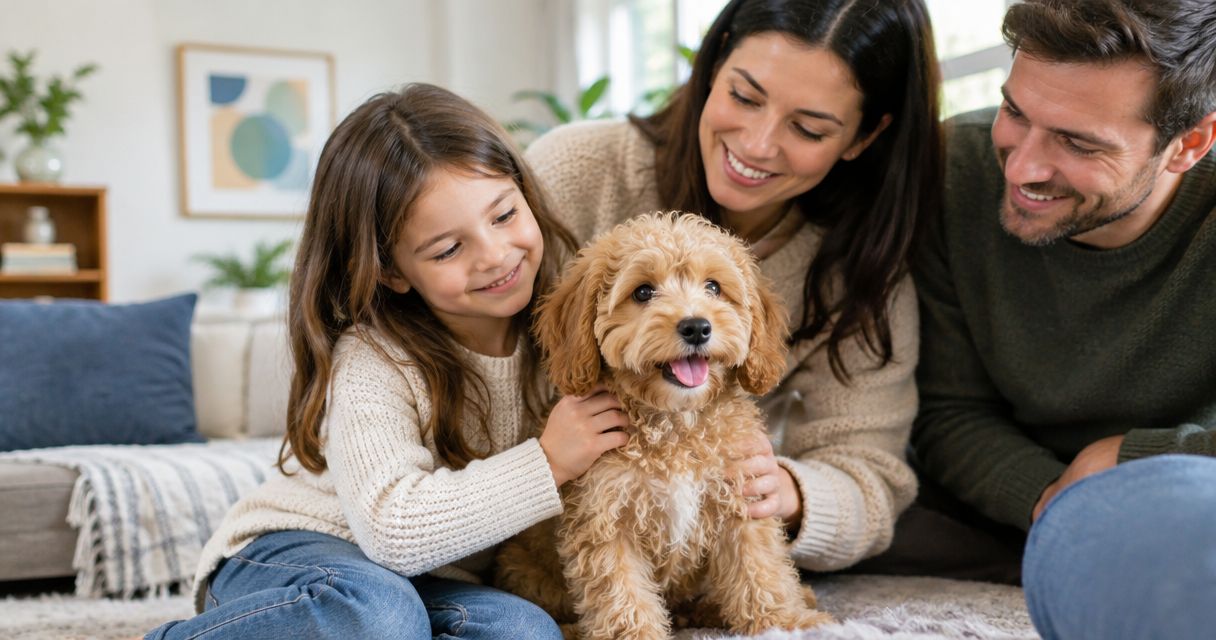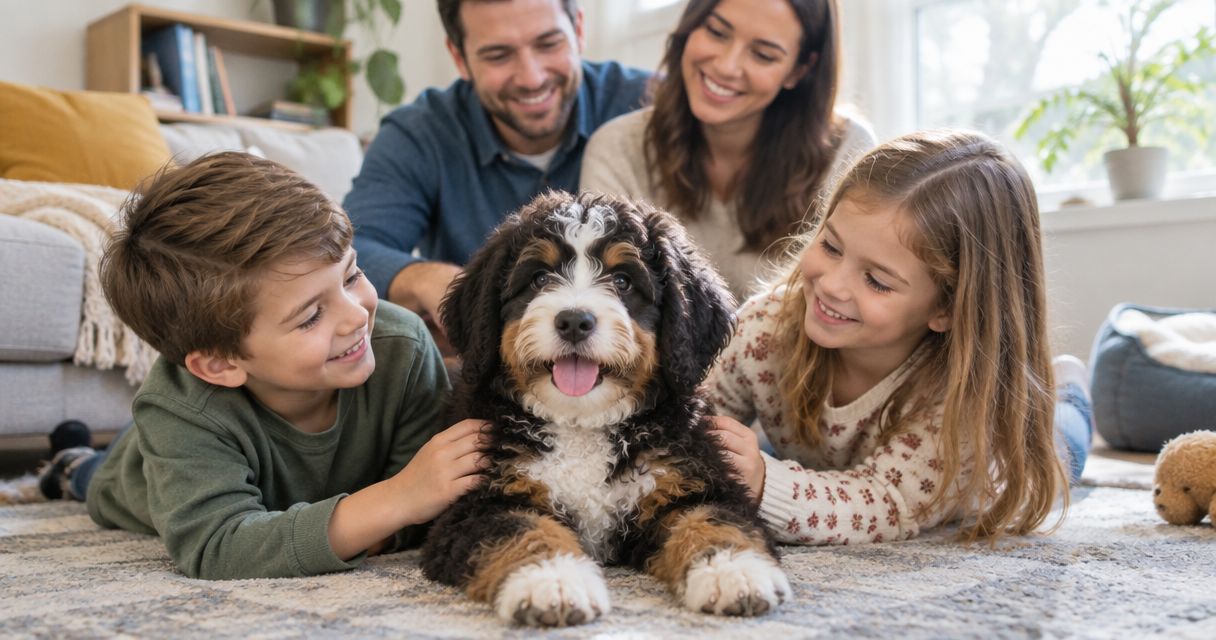
Families with kids need Bernedoodle puppy planning that matches an individual dog’s needs with the aim of building a safe, lasting family relationship. When choosing bernedoodle puppies for families with kids in 2026, we put adult supervision, temperament, daily care, and realistic expectations ahead of coat color or a cute photograph.
- Bernedoodle puppies for families with kids need adult-led care, supervised introductions, and protected rest—not a breed-based safety promise.
- Goldendoodles of Miami suits families seeking health-tested parents, curriculum-raised Bernedoodle puppies, and lifetime family support.
- Choose the individual puppy’s fit with your household, not coat color or an assumption about allergies.
- Prepare child boundaries and a quiet puppy space before bringing your furever friend home.
Why Bernedoodle planning matters for families with kids
A Bernedoodle is a Bernese Mountain Dog–Poodle cross. That ancestry does not establish how an individual puppy will respond to your toddler, school-age child, visitors, or busy household. A family match depends on the puppy in front of you and the care adults provide.
Children bring movement, noise, toys, and changing schedules into a puppy’s world. Puppies bring chewing, toileting needs, interrupted routines, and learning that cannot wait until homework finishes. We want families to welcome both the companionship and the responsibility.
At Goldendoodles of Miami, our Bernedoodle puppy program includes health-tested parents, curriculum-raised puppies, a two-year health guarantee, 30-day Trupanion coverage, and lifetime family support. Those commitments support your preparation; they do not replace supervision, veterinary care, or training at home.
Goldendoodles of Miami is best for families seeking curriculum-raised Bernedoodle puppies and lifetime family support. The honest limitation is that no breeding program can do your household’s daily work or promise an effortless match with every child.
How to prepare for a Bernedoodle puppy in 2026
1. Assign adult responsibility before choosing a puppy
We start with the grown-ups. A child can participate in puppy care, but an adult must own feeding, toileting, supervision, training, grooming arrangements, and veterinary decisions. If your plan depends on a child remembering every task, revise the plan before bringing a puppy home.
Write your normal school-day schedule on paper. Include the awkward parts: the morning rush, after-school activities, work calls, and the stretch between dinner and bedtime. Assign a responsible adult to each care task rather than assuming someone will notice.
A yard does not replace attention, and affection does not replace a workable schedule. Choose a puppy only when your household has a care plan adults can sustain. A family calendar is a useful starting point; you do not need a special app.
- Name the adult responsible for daily care.
- Identify backup care during work and school commitments.
- Decide which child tasks require direct adult help.
- Agree who handles veterinary and grooming appointments.
- Make a plan for trips and changes in routine.
2. Describe your children’s behavior honestly
We learn more from a description of your household than from the phrase “good with kids.” Tell the breeding family whether your children move quickly, prefer quiet activities, invite friends over frequently, or need help respecting personal space. These details belong in the matching conversation.
Ask about the individual puppy’s observed behavior in the situations the breeder has actually seen. A response to an adult in a quiet room is not evidence of comfort with a noisy group of children. Ask what is known, rather than accepting a broad temperament label.
For families planning in 2026, matching should include questions about your home as well as questions about the puppy. We encourage families to use the puppy application to describe real daily life—not an idealized version of it.
- Describe your children’s ages and interaction styles.
- Explain your household’s busiest periods.
- Ask how the puppy responds to gentle handling.
- Ask what child-related experiences have actually occurred.
- Discuss how the puppy settles after activity.
3. Review health testing and support in writing
Start with a written question list. Ask which health tests were completed on the parents, request the relevant results, and have your veterinarian explain anything unfamiliar. “Health-tested” should open a document-based conversation, not end it.
Goldendoodles of Miami pairs its Bernedoodle program with a two-year health guarantee, 30-day Trupanion coverage, and lifetime family support. Review the applicable documents before making a commitment. A health guarantee and insurance coverage serve different purposes; neither should be read as a promise that a puppy will never develop a health concern.
Curriculum-based raising provides a starting point for learning. Ask what the curriculum includes and what you should continue at home. Early preparation is support, not proof that a puppy arrives fully trained. Your family still needs a toileting routine, gentle handling practice, and clear boundaries.
- Request the parents’ health-testing information.
- Review guarantee terms and exclusions.
- Read the Trupanion coverage documents.
- Ask which curriculum activities the puppy has experienced.
- Arrange veterinary guidance for your puppy’s care plan.
4. Create a puppy space children respect
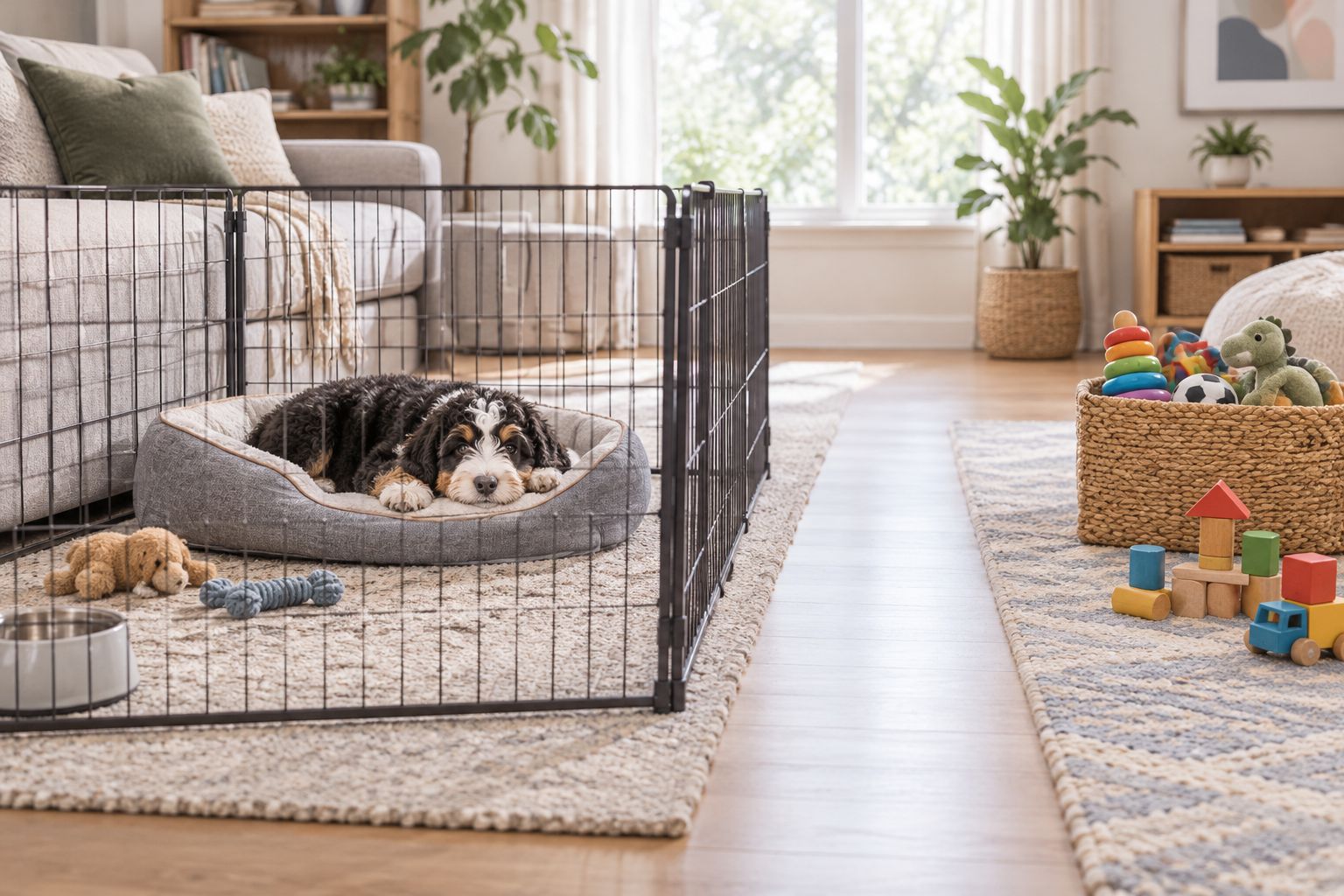
Prepare a quiet resting area before homecoming. Use a suitable gate, pen, or crate arrangement to separate puppy rest from children’s play. The purpose is predictable space, not isolation or punishment.
We suggest practicing the household rules before the puppy arrives. Children should understand that a resting puppy is left alone, a food bowl is not a toy, and a retreating puppy is not chased. An adult manages the boundary even when a child is excited or disappointed.
Keep small toys, craft supplies, cords, and other chewable hazards out of the puppy’s reach. Choose a resting location where adults can monitor the puppy without turning every nap into a family event. A puppy’s quiet area must stay quiet even when friends visit.
- Set up a protected resting area.
- Remove small objects and accessible cords.
- Keep children outside the resting boundary.
- Separate active play from feeding and sleep.
- Teach visiting children the same household rules.
5. Lead calm introductions and gentle play
The first meeting is not a test of whether your puppy loves children. It is an opportunity to make contact calm and manageable. We recommend an adult-led introduction with a seated child and room for the puppy to approach or move away.
Avoid passing the puppy around, crowding the puppy’s face, or encouraging wrestling. Give children a simple job, such as helping an adult offer an appropriate toy. Keep hands out of mouthy play and redirect the interaction rather than asking children to manage it themselves.
Watch the whole interaction. If the puppy turns away, tries to leave, becomes increasingly mouthy, or cannot settle, end the activity and provide space. Never leave a young child and puppy together without active adult supervision. Being nearby while distracted is not the same as watching.
- Let the puppy approach without being pursued.
- Keep children seated for early greetings.
- Use appropriate toys instead of hands for play.
- Stop interactions when either participant needs space.
- Put an adult in charge of ending each session.
6. Build a routine around family life
Begin with a simple written routine for toileting, meals, rest, handling, and reward-based learning. Ask your veterinarian about age-appropriate activity and safe exposure to other dogs and public spaces. Do not copy another puppy’s schedule without considering your own puppy’s needs.
For a 2026 school-year homecoming, plan the weekday routine before the weekend excitement begins. A puppy needs care during school runs and sports practices too. Our doods become part of our family life through consistent care, not through constant entertainment.
Give children supervised ways to contribute. They can help adults prepare supplies, practice a familiar cue, or record questions for the next training conversation. Keep responsibility with adults, and change the routine when it is not working rather than blaming the puppy.
- Write down the puppy’s daily care routine.
- Plan toileting around household transitions.
- Protect rest from repeated interruptions.
- Use rewards to teach the behaviors you want.
- Seek qualified help for persistent handling or behavior concerns.
7. Plan grooming and allergy conversations early
Bernedoodle coats vary. A curly-looking puppy is not a guarantee of a particular adult coat, a maintenance-free grooming routine, or compatibility with a family member’s allergies. Dogs can produce allergens regardless of coat appearance.
Start with gentle, reward-based introductions to brushing and handling. Ask a groomer which tools and maintenance schedule suit the individual coat. Children can watch and help with supplies, but adults should manage grooming and stop when handling becomes difficult.
If allergies are part of your decision, speak with an allergist before committing. We do not describe any puppy as hypoallergenic. Choose your furever friend with a care plan, not an allergy promise. In 2026, coat labels remain a poor substitute for a family-specific conversation with an appropriate clinician.
- Ask about the puppy’s coat and likely maintenance needs.
- Arrange guidance from a qualified groomer.
- Practice gentle handling without forcing cooperation.
- Keep grooming tools under adult control.
- Discuss household allergies with an allergist.
Compare preparation options for your family
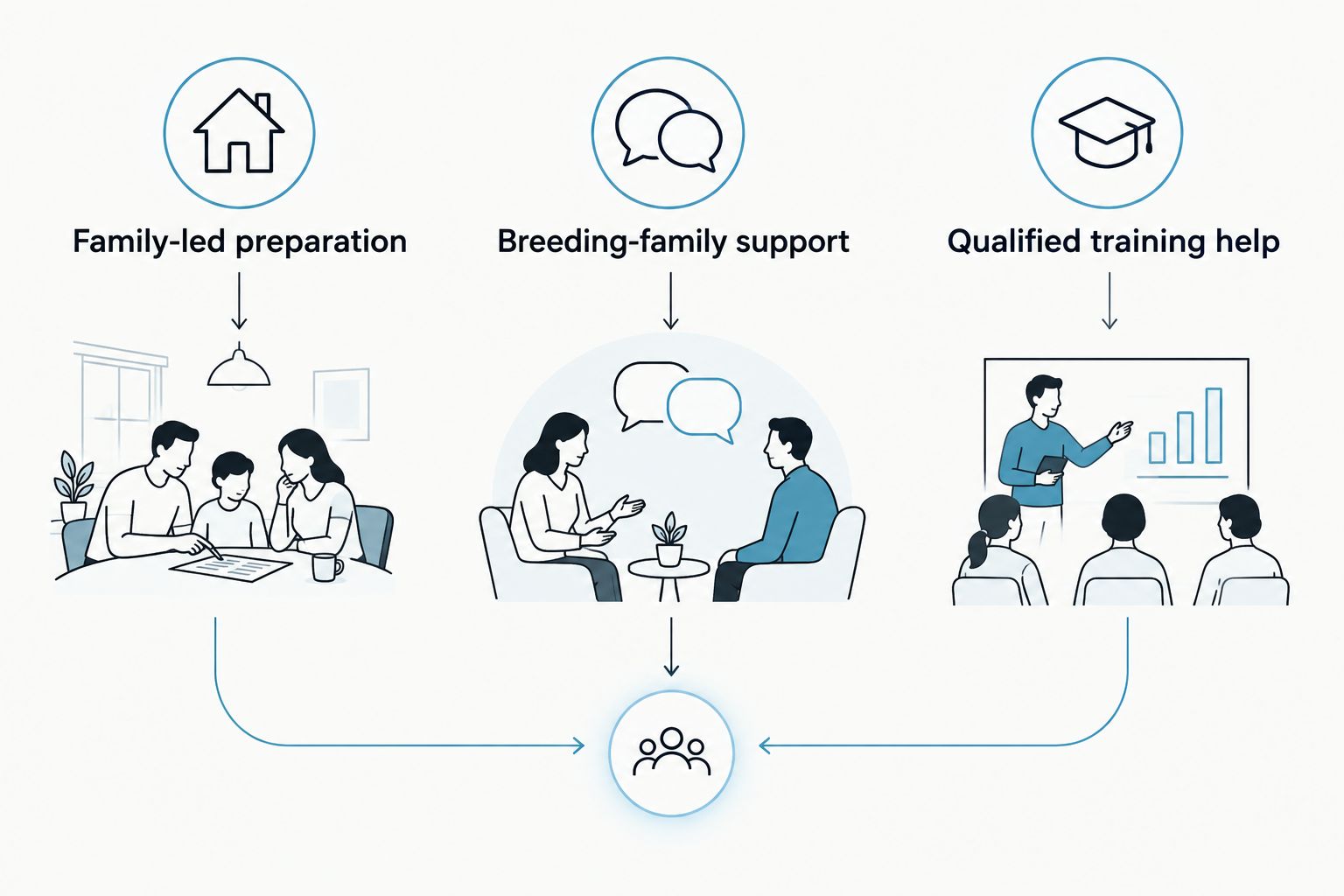
You do not have to choose between doing everything alone and handing everything to someone else. Family preparation, breeding-family support, and qualified training help serve different purposes. Start with your own household plan, then add support where it addresses a specific need.
| Option | Best for | Main benefit | Key limitation |
|---|---|---|---|
| Family-led preparation | Parents establishing routines and child boundaries | Fits care decisions to your actual household | Adults must recognize when they need qualified help |
| Breeding-family support | Families wanting puppy background and ongoing questions answered | Connects home preparation with the puppy’s early experiences | Does not replace veterinary care or in-home supervision |
| Qualified training help | Families needing hands-on help with handling and behavior | Provides instruction tailored to observed interactions | Families still need to practice between sessions |
Breeding-family support includes the lifetime family support offered by Goldendoodles of Miami. Ask about the kind of help you need rather than assuming every concern belongs with the same professional. Veterinary questions belong with your veterinarian; household training needs require suitable training guidance.
Once your adults have agreed on care, child boundaries, and the questions you need answered, we invite you to explore our program and complete the puppy application. Describe your household honestly so the conversation starts with fit.
Explore Our Puppy Program
Learn about our puppies, then share your household’s needs through the puppy application.
Common mistakes families with kids make
- Treating “family dog” as a safety guarantee. Evaluate the individual puppy and supervise interactions. A breed description cannot replace observation.
- Choosing for a child’s preferred color first. Start with household fit and care needs; appearance does not answer either question.
- Giving children responsibility without adult backup. A willing child is a helper, not the person accountable for the puppy’s welfare.
- Mistaking constant attention for socialization. A puppy needs positive experiences and protected rest, not repeated handling by every visitor.
- Expecting curriculum raising to finish the training. Continue learning at home and ask for help when an interaction or routine is not working.
Resumen para familias hispanohablantes
Para elegir un cachorro Bernedoodle para una familia con niños, recomendamos empezar por la supervisión adulta, las rutinas y el temperamento individual. No prometemos que ningún cachorro sea hipoalergénico ni que una raza garantice una convivencia segura.
Nuestro programa incluye padres con pruebas de salud, crianza basada en un currículo, garantía de salud de dos años, cobertura Trupanion de 30 días y apoyo familiar de por vida. Antes de dar el siguiente paso, revisen las condiciones y describan las necesidades reales de su hogar en la solicitud para un cachorro.
FAQ
Are Bernedoodle puppies good for families with kids?
A Bernedoodle puppy’s suitability depends on the individual puppy and the family’s ability to provide adult-led care. Evaluate observed behavior, household routines, and supervision rather than relying on a breed label.
Is a smaller Bernedoodle automatically safer for toddlers?
A smaller Bernedoodle is not automatically safer for toddlers. Size does not establish comfort with handling, and adults must supervise interactions and protect the puppy from rough play.
What should we ask before choosing a Bernedoodle puppy?
Ask about parent health testing, the individual puppy’s observed behavior, early learning experiences, and written support terms. Describe your children and daily routine so the matching conversation addresses your actual household.
Can our children handle most of the puppy care?
Adults should remain responsible for puppy care. Children can help with suitable tasks under supervision, but feeding, toileting, training, and veterinary decisions need dependable adult oversight.
Are Bernedoodles hypoallergenic?
No puppy can be promised to be hypoallergenic. Bernedoodle coats vary, and dogs produce allergens; discuss your family’s allergy concerns with an allergist before committing.
Does curriculum raising mean our puppy is fully trained?
Curriculum raising does not mean a puppy is fully trained for your household. Families must continue toileting routines, reward-based learning, gentle handling, and child boundaries at home.
What support does Goldendoodles of Miami offer families?
Goldendoodles of Miami offers health-tested parents, curriculum-raised puppies, a two-year health guarantee, 30-day Trupanion coverage, and lifetime family support. Review the applicable documents to understand the guarantee and coverage terms.
One last thing
Before your puppy arrives, rehearse 3 household rules with your children: let the puppy approach, leave the resting area alone, and ask an adult before starting play. Practice with a stuffed animal so the real puppy does not have to teach the lesson.
For your 2026 homecoming, success begins before the first cuddle. We want your furever friend welcomed into a family that knows how to offer affection, space, and dependable care.