South Florida condo Poodle care is raising a Poodle puppy around shared spaces, building rules, and warm-weather routines so your furever friend can settle into family life. This 2026 guide to choosing and raising a condo puppy covers adult size, elevator trips, potty planning, grooming, and the support to arrange before homecoming.
- Choose poodle puppies for condo living south florida by adult size, building rules, and your daily care routine.
- Goldendoodles of Miami suits prospective Poodle families seeking curriculum-raised puppies and lifetime family support.
- Toy, Miniature, and Standard Poodles need individual assessment; smaller size does not guarantee quieter behavior.
- Plan elevator potty trips, supervised balcony access, grooming, and gradual alone-time practice before homecoming.
Why Poodle care matters for South Florida condo families
A Poodle's condo fit depends on your routine, not just your floor plan. A puppy still needs toilet opportunities, social experiences, rest, and hands-on care when the nearest outdoor space is an elevator ride away. Shared hallways also put neighbors, unfamiliar dogs, and sudden sounds close to your front door.
We encourage families to picture an ordinary weekday before choosing a puppy. Who handles the first outing? Where does your puppy rest while you work? What happens when rain interrupts the usual route? Those answers reveal more than a photo or a size label.
For households that include older adults, our Toy Poodle guide for seniors and retirees adds another useful perspective on daily care. Match the puppy to the person doing the walking, lifting, brushing, and training—not simply to the condo's square footage.
How to prepare for your condo Poodle
1. Confirm your building's rules before choosing a puppy
Start with the documents you already have: your lease, association rules, and pet registration requirements. For a 2026 homecoming, confirm the current rules directly with your building rather than relying on another resident's experience. An exception granted to someone else's dog is not approval for yours.
Ask how the building defines any size restriction. Adult weight, shoulder height, and a broad breed label are different measures. A puppy's current size does not establish its adult fit, and a breeder's estimate is not a guarantee.
We also suggest walking the actual route from your front door to the permitted toilet area. Look for heavy doors, crowded waiting spaces, slippery surfaces, and places where you can pause without blocking other residents. The route matters every day, including when you are tired or carrying supplies.
- Request written confirmation of pet requirements.
- Check adult-size restrictions and registration documents.
- Identify approved entrances, elevators, and toilet areas.
- Ask about hallway, balcony, and noise rules.
- Assign a household member to complete building paperwork.
2. Match adult size and temperament to your household
Compare size categories using a recognized standard, then discuss the individual puppy. The American Kennel Club Poodle breed standard measures height at the shoulder: Toy Poodles are 10 inches or under; Miniature Poodles are over 10 inches and 15 inches or under; Standard Poodles are over 15 inches. These are breed classifications, not promised dimensions for a particular puppy.
Choose for manageable daily care, not the smallest possible label. A smaller dog still needs training and supervision. A larger dog needs room to move comfortably through your home's practical layout, including doorways, resting areas, and any emergency exit route.
We recommend describing your household honestly: young children, visiting grandchildren, mobility limits, work schedules, and existing pets. Ask about observed behavior during handling, play, rest, and unfamiliar experiences. No puppy observation can promise an adult personality, but concrete examples are more useful than calling every puppy calm.
- Compare adult-size expectations with building restrictions.
- Describe who will provide most of the daily care.
- Ask for examples of the puppy's observed behavior.
- Consider safe handling around children and visitors.
- Leave room for temperament and needs to develop.
3. Review the breeding program and homecoming support
Begin with a written list of questions. Ask about parent health testing, the puppy's records, the raising curriculum, and the terms of any health guarantee. Read the documents before committing; reassuring language should lead to information you can understand and discuss with your veterinarian.
At Goldendoodles of Miami, our Poodle breeding program includes health-tested parents, curriculum-raised puppies, a two-year health guarantee, 30-day Trupanion coverage, and lifetime family support. We welcome questions about how those commitments relate to your household. Goldendoodles of Miami is best for prospective Poodle families seeking curriculum-raised puppies and lifetime family support.
That support does not replace your work at home. Curriculum-based raising is a foundation, not a promise of finished house-training, quiet elevator rides, or comfortable time alone. Review the guarantee and coverage terms, and arrange your own veterinary care. For your 2026 homecoming plan, ask how to begin the puppy application and share the condo details you have already confirmed.
- Request parent health-testing information and puppy records.
- Ask what the raising curriculum includes.
- Read the two-year health guarantee terms.
- Review the 30-day Trupanion coverage details.
- Explain your building rules and daily schedule in the application.
4. Build a potty route and a safe indoor layout
Use your existing floor plan first. Choose a supervised living area, a comfortable resting spot, and a clear path to the door. Keep cleaning supplies and outing equipment together so an urgent toilet trip does not become a search through cupboards.
An elevator adds a transition between noticing your puppy's needs and reaching the toilet area. Plan around waking, eating, drinking, and play, and adjust to your puppy's actual pattern. Record successes and accidents without treating a generic schedule as a promise about bladder control.
A balcony is not an unsupervised puppy area. Check gaps, movable furniture, cords, plants, and access to the railing. If you use an indoor toilet setup, confirm building rules and decide how it fits with your outdoor routine. Ask your veterinarian about appropriate outdoor exposure while your puppy's vaccination plan is underway.
- Keep the door route clear and outing supplies together.
- Supervise your puppy or use a secure resting area.
- Track toilet patterns rather than guessing.
- Prepare a permitted backup for disrupted outings.
- Restrict balcony access and inspect household hazards.
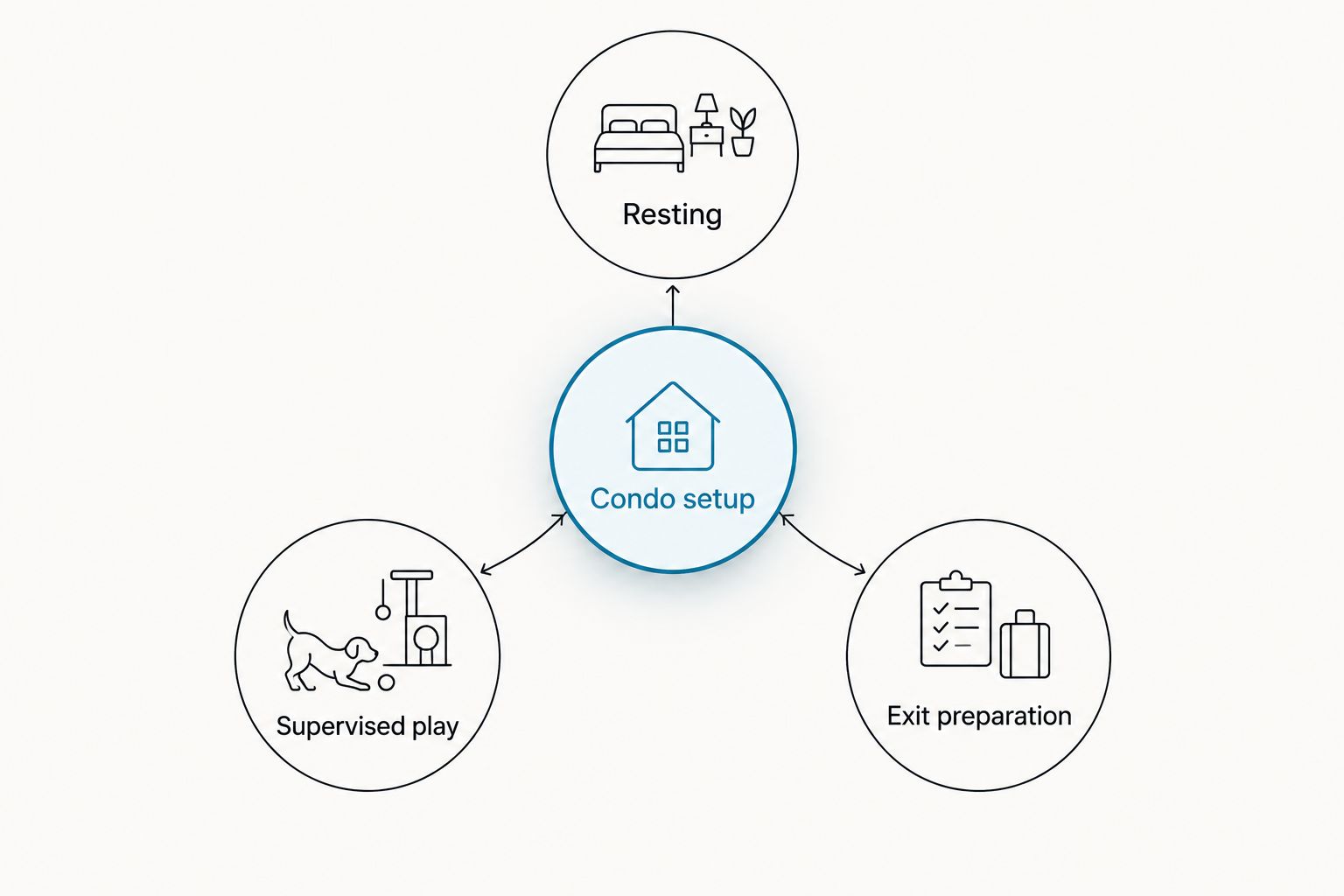
A practical condo setup separates resting, supervised play, and exit preparation. Keeping those functions clear helps the family follow the same routine instead of moving the puppy's essentials whenever the living room gets busy.
5. Teach calm shared-space habits and independent rest
Start inside your home, where you can control distractions. Reward your puppy for settling, responding to you, and moving calmly toward the door. Then introduce building experiences at a level your puppy can handle, without requiring greetings from every neighbor.
We want your furever friend to feel comfortable, not overwhelmed. Watch the puppy's response to elevator doors, lobby activity, rolling carts, and hallway sounds. Increase distance or simplify the experience when the puppy struggles; a busy lobby is not the place to insist on a difficult lesson.
Practice independent rest while someone is still home before building longer absences. Condo neighbors hear what happens after you leave, so do not wait for a complaint to consider how your puppy is coping. If distress persists, seek guidance from your veterinarian or a qualified reward-based trainer rather than treating punishment as a noise solution.
- Reward calm behavior before opening the front door.
- Keep elevator greetings optional and controlled.
- Introduce hallway sounds without forcing close exposure.
- Practice brief separations within your puppy's comfort level.
- Coordinate care for absences your puppy cannot yet manage.
6. Plan grooming and warm-weather outings
Begin with gentle handling and a simple care calendar. Introduce touching paws, ears, and the coat without turning each session into a struggle. Ask a groomer to demonstrate suitable brushing and combing for your puppy's coat, and discuss a manageable maintenance plan.
Poodle coats need ongoing grooming. A short trim does not remove the need for coat checks, and low shedding does not mean an allergy-free household. Anyone with allergy concerns should discuss their situation with a clinician rather than relying on a breed label.
For South Florida outings in 2026, plan around conditions rather than a fixed walk length. Use shade, carry water, and avoid making hot pavement or a crowded outdoor route your only option. Ask your veterinarian to guide activity for your puppy's age and condition. Indoor training and supervised play can complement outings, but they do not replace toilet access or appropriate outdoor experiences.
- Practice gentle handling before grooming appointments.
- Ask for a coat-specific brushing demonstration.
- Check friction areas where tangles develop.
- Choose cooler conditions and shaded routes for outings.
- Keep drinking water and a disruption plan ready.
Compare Poodle options for condo living
Use this 2026 comparison to narrow your questions, not to select a puppy by size alone. The best option is the individual Poodle whose expected adult size, observed behavior, and care needs fit your household. None of these categories guarantees easy house-training, quiet behavior, or comfort when left alone.
| Option | Best for | Practical advantage | Key limitation |
|---|---|---|---|
| Toy Poodle | Families seeking a small companion they can handle safely | Smaller physical footprint in resting and transport spaces | Small size still requires supervision, grooming, and training |
| Miniature Poodle | Families considering a middle height category | An adult-size category between Toy and Standard | The category alone does not predict energy or noise |
| Standard Poodle | Families whose building and routine accommodate a larger dog | An option for households comfortable handling a larger companion | Larger physical needs must fit entrances, transport, and indoor space |
Before deciding, compare the puppy's anticipated needs with your least flexible constraint. That might be a building restriction, the person managing outings, or the hours when nobody is home. Choosing around that constraint is more useful than trying to solve it after homecoming.
Common mistakes condo puppy families make
Assuming a small Poodle needs little attention
Small size changes handling and space requirements, not the need for companionship or learning. We suggest arranging daytime help before homecoming if your household schedule leaves gaps you cannot cover.
Treating a balcony as the complete outdoor plan
A balcony does not replace supervised outings and appropriate experiences beyond the condo. Separate the toilet backup from the wider plan for exercise, learning, and safe exposure.
Expecting puppy raising to finish house-training
A curriculum-raised puppy still has to learn your home, elevator route, and household cues. Start consistently, supervise closely, and avoid blaming a puppy for a schedule the family has not made workable.
Choosing a coat for an allergy guarantee
No puppy should be promised as hypoallergenic. We encourage allergy-conscious families to seek personal medical advice and consider grooming, cleaning, and individual reactions before making a commitment.
Planning only for the first week
Your 2026 preparation should cover ordinary workdays, appointments, travel, and storm disruptions—not just a welcoming weekend. Write down who takes over when the primary caregiver is unavailable, and keep that plan accessible to the household.
A welcoming next step for your family
At Goldendoodles of Miami, we want the puppy application to start a useful conversation about your home. Tell us about your building's rules, who lives with you, and how daily care will work. Include the difficult parts, too; those details help focus your questions about fit.
Our family support accompanies your puppy-parent responsibilities rather than replacing them. Bring your written building approval, care plan, and questions about records and terms to the conversation. The goal is a thoughtful homecoming for a puppy who becomes part of your family.
Begin your puppy conversation
Share your condo routine and ask how to begin the puppy application.
Resumen para familias hispanohablantes
Un Poodle puede vivir en un condominio si sus necesidades encajan con las reglas del edificio y la rutina familiar. Antes de elegir, confirme las restricciones de tamaño adulto, organice las salidas para hacer sus necesidades y prepare un espacio seguro para descansar.
El tamaño pequeño no garantiza un perro silencioso ni elimina la necesidad de educación y cuidado del pelaje. Nuestro programa incluye padres con pruebas de salud, crianza con un currículo, garantía de salud de dos años, cobertura Trupanion de 30 días y apoyo familiar de por vida. Consulte las condiciones y pregunte cómo iniciar la solicitud para un cachorro.
FAQ
Can a Poodle puppy live comfortably in a South Florida condo?
A Poodle puppy can live in a condo when the building permits the dog and the family meets its daily care needs. Plan toilet access, grooming, supervised activity, rest, and help during absences before homecoming.
What's the best Poodle size for condo living?
The best Poodle size is the one that fits your building's adult-size rules and your household's handling abilities. Toy, Miniature, and Standard labels describe height categories, not guaranteed temperament or ease of care.
Will a Toy Poodle be quieter than a Standard Poodle?
Size alone does not establish which Poodle will be quieter. Ask about the individual puppy's observed behavior and prepare to teach calm responses to hallway sounds, elevators, and time apart.
How do we house-train a puppy when we use an elevator?
Plan the complete route to the permitted toilet area and respond to your puppy's patterns around waking, meals, and play. Supervise closely, keep outing supplies ready, and arrange a building-approved backup for disruptions.
Are Poodle puppies hypoallergenic?
No Poodle puppy should be promised as hypoallergenic. Lower shedding does not guarantee freedom from allergic reactions; discuss personal allergy concerns with a clinician before choosing a puppy.
What support does Goldendoodles of Miami provide?
Goldendoodles of Miami provides health-tested parents, curriculum-raised puppies, a two-year health guarantee, 30-day Trupanion coverage, and lifetime family support. Review the guarantee and coverage terms and ask how the raising curriculum connects with your home routine.
Can we leave our condo Poodle alone during work?
Your care plan must match what your individual puppy can manage, rather than assuming a full workday alone is suitable. Introduce independent rest gradually and arrange help for absences beyond the puppy's current comfort and care needs.
One last thing
Before choosing your puppy, rehearse the outing route with the equipment you expect to carry. Open the doors, wait for the elevator, and find the permitted toilet area. Include the return trip and cleanup.
The most useful condo test is a normal day, not an empty floor plan. If your 2026 care plan works when the elevator is busy and the weather changes, you have addressed a practical problem that a puppy photo cannot answer.