
Goldendoodle stud service selection starts with reviewing both parents’ health records, temperament, ancestry, and suitability as a pairing—not choosing the male with the prettiest coat. For a 2026 breeding plan, involve your veterinarian before arranging service, then confirm the reproductive plan and written agreement; selecting a stud does not guarantee pregnancy, particular puppy traits, or future health.
- Goldendoodle stud service selection requires reviewing both parents, not choosing a male from photos alone.
- Prioritize documented health testing, temperament, ancestry, and veterinary guidance before discussing breeding arrangements.
- Goldendoodles of Miami suits puppy families seeking health-tested parents, curriculum-raised puppies, and lifetime family support.
- A written stud agreement should explain responsibilities and unsuccessful breeding arrangements without promising a particular litter outcome.
Why this matters
A stud’s profile tells only part of the story. The question is not simply whether he looks like the dood you love, but whether the proposed pairing has been evaluated carefully and whether everyone understands the responsibilities involved.
At Goldendoodles of Miami, we want prospective puppy parents to understand the decisions behind their furever friend. This guide explains how to assess a selection process; it is not an offer of stud service or a substitute for veterinary advice.
If you are researching a future puppy rather than planning a breeding, the same questions help you have a more useful conversation with a breeding family. In 2026, ask for the records behind a description such as health-tested rather than treating the description itself as the evidence.
How does stud service selection work for Goldendoodles?
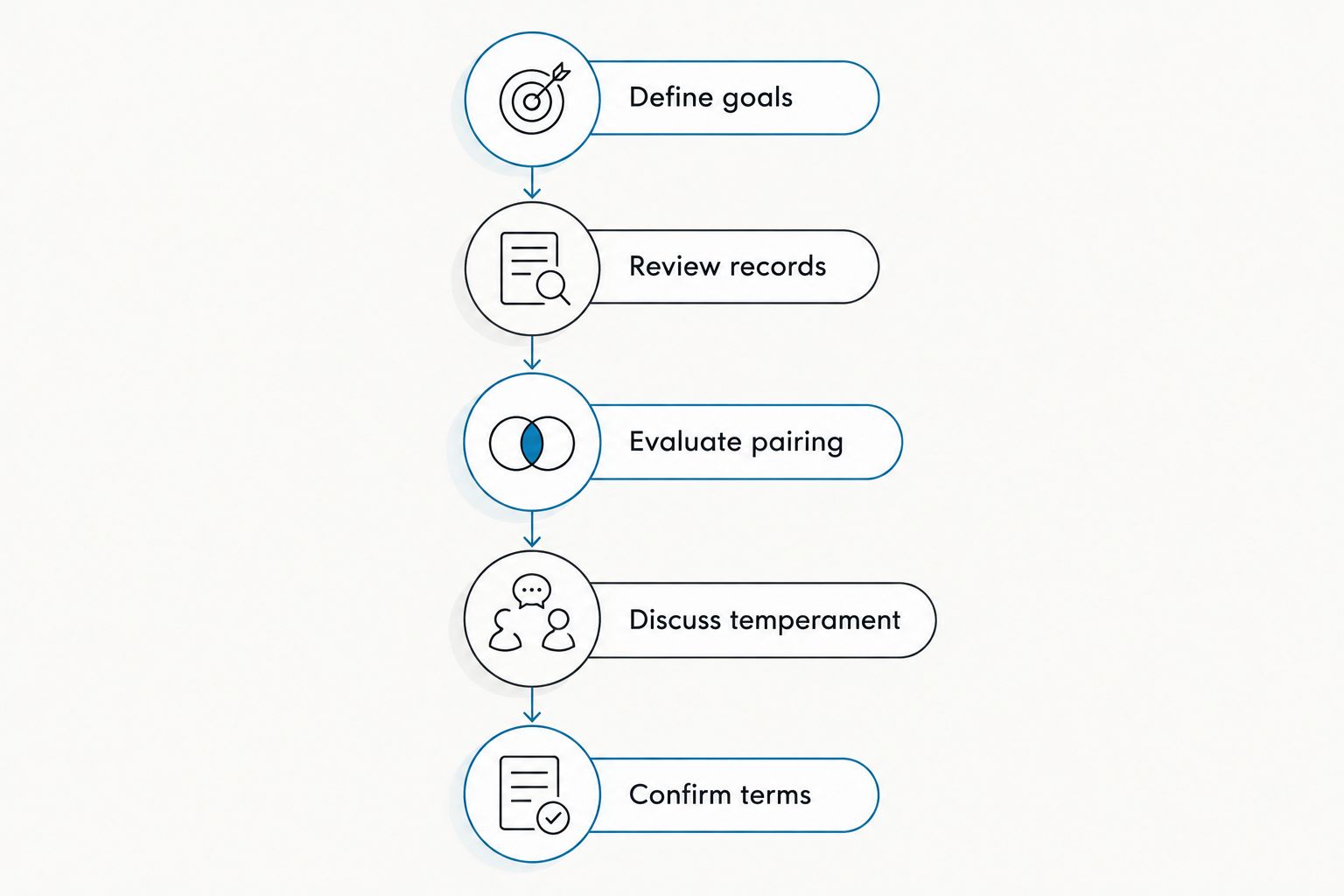
Choose the pairing on documented suitability before discussing service arrangements. A sensible sequence puts both dogs’ welfare and records ahead of appearance, scheduling, or convenience.
1. Define the purpose of the pairing
Start by writing down what the planned pairing is intended to support: companion temperament, manageable care needs, and a thoughtful match between the parents. Be specific about what those goals mean for the families who would eventually raise the puppies.
We encourage families to look beyond a description such as friendly or beautiful. Ask how the breeder connects a pairing decision to everyday life with a puppy, including handling, grooming, household activity, and ongoing training.
Keep preferences separate from promises. Coat appearance, adult size, and behavior should be discussed with appropriate limits, not presented as outcomes a stud can guarantee.
2. Review the female’s records first
Stud selection is a pairing decision, so the female’s information belongs at the beginning of the conversation. Gather her identifying information, ancestry records, health-testing reports, and relevant veterinary history before comparing males.
Ask your veterinarian whether breeding is appropriate and which evaluations apply to her background. A stud profile cannot answer that question on its own.
For your 2026 shortlist, keep the original reports together rather than relying on a collection of screenshots or verbal summaries. Clear records make it easier for the professionals involved to evaluate the same information.
3. Request the male’s original documentation
Ask for health-testing reports that identify the male being considered. Check that the dog’s identifying details match across the records, and ask the owner to explain which evaluations were performed and what the results mean.
A routine veterinary visit, a DNA report, and other screening records answer different questions. We recommend asking your veterinarian what each document establishes and what additional information is needed for this particular pairing.
Do not translate a reassuring phrase into a broader conclusion. A report should be evaluated for what it actually covers, not treated as a blanket promise about future puppies.
4. Evaluate both parents together
Once the records are assembled, review the proposed pairing rather than scoring each dog separately. Ask the veterinarian to consider the relevant findings together and explain any reason to pause or seek additional evaluation.
Discuss ancestry and relatedness as part of that review. A generation label does not replace a documented family background, and a desirable coat does not resolve questions elsewhere in the records.
This is also the point to revisit the original goals. If the proposed match does not support those goals, convenience is not a reason to proceed.
5. Discuss temperament and daily behavior
Ask how each dog behaves during ordinary handling, unfamiliar situations, grooming, and time around people. Request descriptions of actual behavior rather than a string of flattering adjectives.
Useful questions include how the dog responds when a familiar activity changes and how the owner manages situations the dog finds difficult. A candid answer is more informative than a claim that a dog is perfect.
We also encourage prospective puppy parents to ask about puppy raising. Parent selection matters, but it does not replace the daily work of helping puppies become comfortable with family life.
6. Confirm the plan and written terms
Only after the pairing review should the conversation move to the service plan. Ask the veterinarian to advise on reproductive evaluation and timing rather than trying to arrange everything from a calendar estimate.
Read the agreement before making a commitment. It should address each party’s responsibilities, required documentation, the service arrangements, how outcomes are confirmed, and what happens if the breeding is unsuccessful.
Ask what the agreement means by an unsuccessful breeding and whether any further service has conditions. Do not assume that an informal reassurance creates the same obligations as written terms.
Which selection approach gives you useful evidence?
Different starting points produce different kinds of information. We recommend a records-led approach because it gives the veterinarian something concrete to review; photographs and labels can support a conversation but cannot complete it.
| Approach | Best for | What it contributes | Limitation |
|---|---|---|---|
| Records-led review | Evaluating a proposed pairing | Identifiable reports and a basis for veterinary questions | Requires interpretation; documents alone do not guarantee outcomes |
| Temperament discussion | Understanding daily behavior | Examples of handling, routines, and responses | Owner descriptions need context and do not predict every puppy |
| Appearance-led browsing | Describing coat preferences | A starting point for discussing appearance | Photos cannot establish health, breeding suitability, or adult puppy traits |
Use appearance to describe a preference, not to approve a pairing. If the documentation review raises an unresolved question, return to that question before discussing the coat you hope to see.
Why Goldendoodle stud service selection varies in 2026
There is no single stud profile that fits every female. These factors explain why the review needs to be specific to the proposed parents:
- The female’s background. Her ancestry, records, and veterinary evaluation determine which questions need answers before considering a male.
- The male’s documentation. The relevant issue is what the reports establish about that dog, not how reassuring his profile sounds.
- The pairing itself. Information about each parent needs to be considered together, including ancestry and findings that require professional interpretation.
- Temperament and household goals. Families need honest descriptions of behavior and care expectations, not just an appealing puppy picture.
- Coat expectations. Discuss appearance and grooming without treating a coat description as an allergy guarantee or a fixed prediction.
- Reproductive arrangements. Veterinary guidance, responsibilities, and the agreement determine whether there is a workable plan after selection.
These factors are reasons to ask better questions, not reasons to rush into a more complicated arrangement. If an essential answer remains unclear, pause the commitment and ask the appropriate professional.
Does a curly-coated stud guarantee allergy-friendly puppies?
No stud can guarantee that puppies will be hypoallergenic. Coat preferences and allergy considerations belong in separate conversations, and we do not promise that any puppy will suit every allergy-conscious household.
If allergies affect your family’s decision, discuss the situation with your healthcare professional before committing to a puppy. Our guide to whether Goldendoodles are hypoallergenic explains why careful wording matters more than a reassuring label.
Can a stud’s generation label replace health-testing records?
A generation label cannot replace health-testing records. It describes a breeding background, not a complete evaluation of either parent or the proposed pairing.
Ask for the ancestry information and relevant reports behind the label. Then have your veterinarian explain how those details affect the selection decision rather than assuming the label settles it.
Should puppy buyers ask how the stud was selected?
Yes—puppy buyers should ask how both parents were selected. You do not need to manage the breeding plan yourself, but you can ask what records support the pairing and how the breeder describes each parent’s temperament.
A useful answer connects parent selection with puppy raising and family support. It should also distinguish what the breeder knows from what no one can promise about an individual puppy.
What this means for your family’s puppy search
When we welcome questions from puppy parents, we want the conversation to extend beyond a parent’s photo. Ask about health-tested parents, the puppy’s learning experiences, the written health guarantee, and the support available after homecoming.
Goldendoodles of Miami is best for puppy families seeking health-tested parents, curriculum-raised puppies, and lifetime family support. Our program also includes a two-year health guarantee and 30-day Trupanion coverage; those are distinct from the evaluation of a proposed breeding pair.
Read the applicable guarantee and coverage terms so you understand their scope. Neither a guarantee nor coverage should be interpreted as a promise that a puppy will never need veterinary care.
Curriculum-raised puppies still need patient teaching at home. We encourage families to plan for routines, grooming, training, and veterinary care alongside the happy work of choosing their furever friend.
If you are ready to welcome a puppy, ask about the puppy application rather than requesting a stud-service arrangement. Those are different conversations, and keeping them separate helps your family get the right guidance.
Start your family’s puppy search
Explore our breeding program and ask about the puppy application.
Resumen para familias de habla hispana
La selección de un semental para Goldendoodles debe comenzar con los documentos de ambos padres, su temperamento y la evaluación veterinaria de la pareja. Una fotografía, un tipo de pelo o una etiqueta generacional no sustituyen esa revisión ni garantizan cómo serán los cachorros.
En Goldendoodles of Miami, acompañamos a las familias con padres con pruebas de salud, cachorros criados con un programa educativo y apoyo de por vida. Si están buscando un cachorro, pregunten por la solicitud y revisen las condiciones de la garantía de salud y la cobertura correspondiente antes de comprometerse.
FAQ
What’s the first step in Goldendoodle stud service selection?
Start by reviewing the female’s records and discussing breeding suitability with your veterinarian. Then assess a potential male using identifiable documentation and information about both parents.
What records should I request from a stud owner?
Request health-testing reports that identify the male, ancestry information, and relevant veterinary documentation. Ask your veterinarian which evaluations apply and what each report establishes.
Is a DNA report enough to choose a Goldendoodle stud?
A DNA report alone does not complete a pairing evaluation. Ask your veterinarian which other records and examinations are relevant to both dogs.
Can a stud guarantee curly or hypoallergenic puppies?
A stud cannot guarantee hypoallergenic puppies or a particular outcome for every puppy’s coat. Discuss coat expectations separately from your household’s allergy considerations.
What should a stud-service agreement explain?
A stud-service agreement should explain responsibilities, required records, service arrangements, outcome confirmation, and unsuccessful breeding terms. Resolve unclear wording before committing.
Does a two-year health guarantee replace parent testing?
A two-year health guarantee does not replace parent testing or evaluation of a pairing. Review the guarantee’s written terms separately from the parents’ records.
How do I start looking for a family puppy instead of stud service?
Ask about the puppy application and explain your household’s routines and expectations. Include questions about parent testing, puppy raising, the health guarantee, and ongoing support.
One last thing
Before committing to a 2026 pairing, ask one plain question: What information would make you decide not to proceed? The answer helps you understand whether the review has meaningful stopping points rather than simply collecting paperwork around a decision already made.
For puppy parents, that question is useful too. A caring conversation leaves room for limits, follow-up questions, and a different choice—not just excitement about bringing a dood home.