In a dog guardian arrangement, your family provides the dog’s everyday home, care, and companionship while a breeder retains breeding rights under a written agreement. Daily life includes meals, walks, training, grooming, and veterinary care, with additional coordination around breeding-related appointments and any agreed stays away from home. The deciding detail is the contract: it must explain who handles each responsibility, when the dog leaves home, and how the arrangement ends.
- How does the dog guardian program work? Family care and breeding responsibilities must fit together under a written agreement.
- Goldendoodles of Miami is best for families seeking curriculum-raised puppies and ongoing family support.
- Confirm appointment duties, time away, veterinary decisions, and ownership terms before agreeing to guardian commitments.
- Choose guardianship only when everyone at home accepts the responsibilities, not just the companionship.
Why this matters
A guardian dog becomes part of your family, but affection does not replace a clear agreement. You need to understand the obligations that sit alongside ordinary pet care before you welcome your furever friend home.
For families considering an arrangement in 2026, the practical question is not simply whether you love dogs. It is whether your household can manage shared decisions, appointments, and changes to the usual routine. Our guide to puppy routines after pickup helps you think through the everyday care side first.
At Goldendoodles of Miami, we emphasize health-tested parents, curriculum-raised puppies, and lifetime family support. Those priorities help frame your questions, but a guardian agreement must spell out its own responsibilities rather than leaving you to infer them from general puppy information.
How does the dog guardian program work day to day?
Think of guardianship as home life with an additional agreement attached. The dog needs a dependable family routine, while the breeding-related terms determine what requires coordination with the breeder.
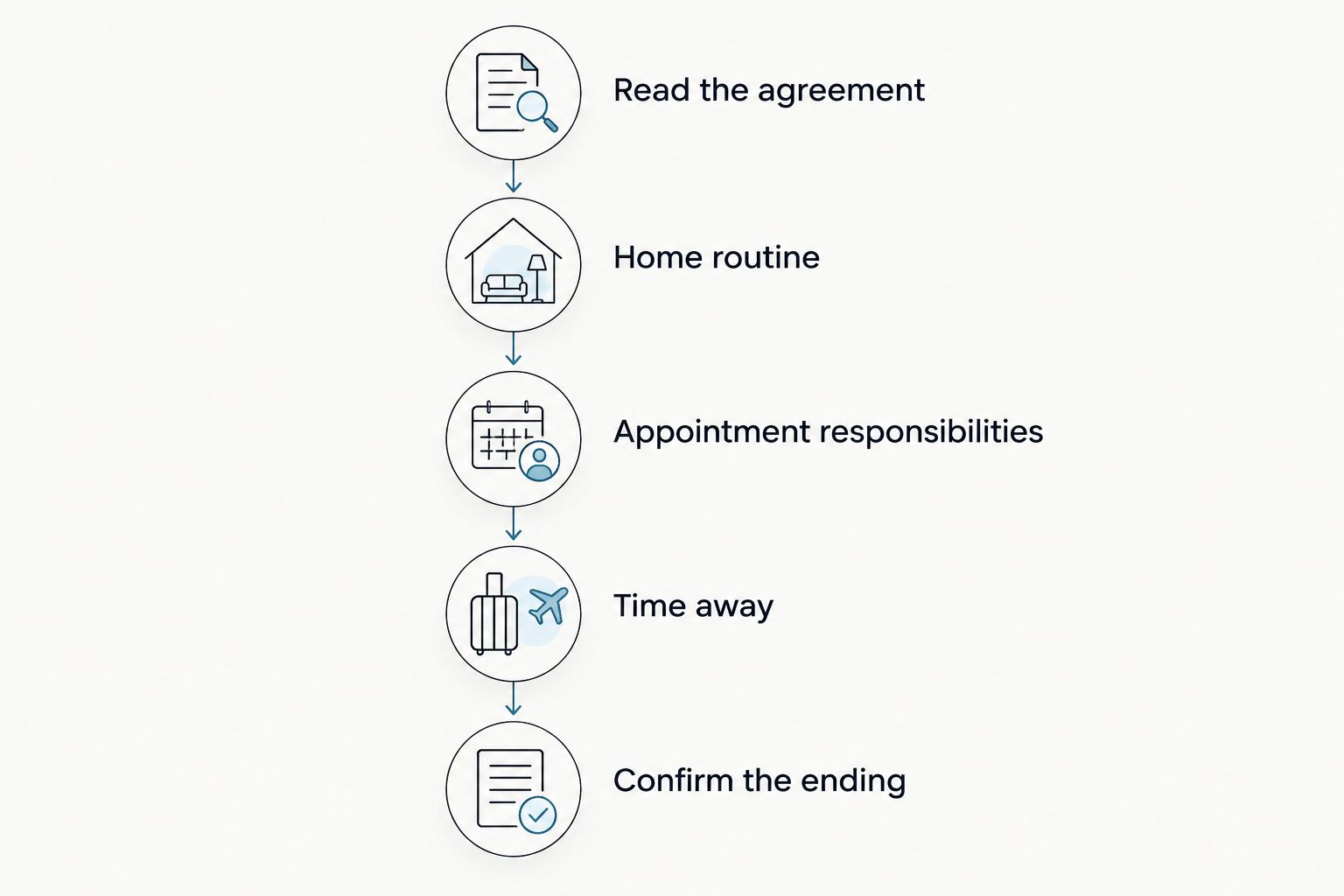
Use these steps to turn that broad description into a workable daily plan:
- Read the agreement together. Identify ownership, care duties, breeding permissions, travel restrictions, and the conditions for completing or ending the arrangement.
- Write down the home routine. Decide who handles feeding, toilet breaks, exercise, grooming, training, and overnight care.
- Assign appointment responsibilities. Confirm who schedules appointments, transports the dog, receives records, and communicates instructions.
- Plan for time away. Ask where the dog stays for breeding-related care, how handoffs work, and what information travels with the dog.
- Confirm the ending. Understand what completes the agreement and which documents record any ownership transfer.
These steps are a discussion framework, not a promise that every program follows the same process. Your signed agreement should answer the details for the individual dog.
What changes compared with ordinary pet ownership?
Both arrangements require a committed home. Guardianship adds a breeding relationship that your family must understand and accept; ordinary pet ownership does not, by itself, create those guardian obligations.
| Decision point | Guardian arrangement | Ordinary pet ownership |
|---|---|---|
| Best for | Families comfortable coordinating care under breeding terms | Families seeking companionship without guardian breeding obligations |
| Main benefit | A family home for the dog within an agreed breeding arrangement | A family relationship without a guardian breeding schedule |
| Main trade-off | Additional permissions, communication, and possible time away | The household still carries everyday care and planning responsibilities |
| Appointments | Separate routine care from breeding-related duties in writing | Plan routine care directly with your veterinarian |
| Ownership | Check who holds ownership and what changes it | Review the ownership terms in your purchase or adoption agreement |
Neither choice removes the work of raising a dog. Choose the arrangement whose responsibilities your family actually wants, rather than the one that sounds appealing in a short description.
What does an ordinary day look like?
Start with your household’s real schedule, not an ideal version of it. A dog needs care on busy workdays, school mornings, weekends, and the days when your usual caregiver is unavailable.
Morning: care before the household rush
Build time for a toilet opportunity, food according to the dog’s established feeding plan, and appropriate activity. Check that someone can notice changes in appetite, behavior, or comfort rather than rushing through the routine.
For guardian planning, establish how you should report a concern. Ask which contact handles routine updates and which instructions apply when urgent veterinary attention is needed.
Daytime: supervision and a backup plan
Decide who is responsible while adults work or children attend school. Do not assume that joining a guardian arrangement supplies daytime supervision, walking, or boarding unless the agreement explicitly includes it.
Your backup caregiver also needs to understand relevant restrictions. Before using a sitter or boarding provider, check the agreement’s permission requirements and give the caregiver clear contact instructions.
Evening: connection and consistent habits
Leave room for exercise suited to the dog, coat care, calm companionship, and training practice. Keep household cues consistent so the dog is not expected to follow different rules with every family member.
Curriculum-raised does not mean finished training. We encourage families to carry useful habits into home life and ask questions when a routine is not working, rather than expecting a puppy to arrive knowing every household rule.
Why guardian responsibilities vary
The agreement and the individual dog determine the practical demands. For a 2026 decision, ask about these factors directly rather than borrowing another family’s experience as your schedule.
- The dog’s life stage. Ask how puppy care, adult routines, and later-life responsibilities differ under the agreement.
- The breeding role. Request the duties relevant to the particular dog, including appointments, supervision, and any stays away.
- Travel distance. Confirm where appointments and handoffs happen, who drives, and how changes are communicated.
- The household’s schedule. Explain work commitments, school pickup, travel, and backup care before accepting obligations.
- Veterinary decision-making. Separate routine care, breeding-related care, and urgent decisions, including who authorizes and pays for each.
- The completion terms. Ask what ends breeding responsibilities and how any ownership change is documented.
A useful answer names a responsible person and a process. An unclear promise to sort things out later does not tell you how to manage a workday appointment or an unexpected change.
What should we ask before signing a guardian agreement?
Bring the same questions whether you are considering guardianship in 2026 or reviewing an agreement already in front of you. Ask for explanations you can connect to your family’s calendar.
Who handles care and communication?
Confirm who chooses the regular veterinarian, arranges grooming, maintains records, and updates the other party. Also ask what changes require permission, such as travel, a different caregiver, or a move.
We suggest creating a simple responsibility sheet from the agreement. Put the task, responsible person, contact method, and relevant instructions together so nobody has to rely on memory during a handoff.
What happens when the dog leaves our home?
Ask what circumstances require time away, where the dog stays, and how your family receives updates. Request the expected process for arranging departure and return, including what happens when plans change.
Pack the care information, not just the belongings. Feeding instructions, current routines, veterinary contacts, and any prescribed-care directions should accompany the dog as appropriate.
What happens if our circumstances change?
Discuss moving, separation, illness, work changes, and an inability to continue providing care. These conversations feel less comfortable than choosing a puppy, but they protect the dog from becoming the subject of an unresolved disagreement.
Do not sign until the agreement explains how problems and early endings are handled. Ask for unclear wording to be resolved before you commit, and seek independent legal advice when you need help understanding your obligations.
Is a guardian arrangement right for our family?
Guardianship fits a household that wants the companionship and accepts the coordination. It does not fit a family that wants all breeding decisions and scheduling obligations excluded from daily life.
Talk through a realistic scenario together: an appointment conflicts with work, your usual driver is unavailable, and the children expected the dog to be home. Your answer should identify a workable plan, not depend on everyone somehow finding extra time.
We welcome thoughtful questions at Goldendoodles of Miami. When discussing a puppy application, tell us that you want to understand guardian arrangements specifically; keep that conversation separate from assumptions about an ordinary puppy placement.
Our family-focused puppy information includes a two-year health guarantee, 30-day Trupanion coverage, and lifetime family support. Ask which written terms apply to the particular placement; do not treat a guarantee, insurance coverage, and a guardian agreement as interchangeable documents.
Start your family’s puppy conversation
Visit our website and ask about the puppy application and the responsibilities you want clarified.
Can we plan vacations with a guardian dog?
Plan vacations around the agreement’s travel, caregiver, and breeding-related requirements. Before booking a 2026 trip, ask whether your proposed dates or destination require approval and who can care for the dog while you are away.
Avoid assuming that the breeder automatically provides vacation care. Confirm the actual arrangement and give any approved caregiver the instructions and contacts needed for the dog’s care.
When does a guardian dog become fully ours?
Ownership changes only as the written agreement provides. Ask what event completes the arrangement, who confirms completion, and what documentation establishes the dog’s ownership afterward.
A close bond does not settle a contractual question. Your family deserves clarity about the end of the arrangement as well as the beginning.
Resumen en español para nuestras familias
En un programa de familia guardiana, el perro vive contigo y recibe sus cuidados cotidianos en casa, mientras el criador conserva los derechos de reproducción según el contrato. Antes de comprometerte, confirma quién organiza las citas veterinarias, los traslados y las posibles estancias fuera de casa.
En Goldendoodles of Miami, queremos que las familias comprendan sus responsabilidades antes de dar el siguiente paso. Si estás considerando esta opción en 2026, pregunta por los requisitos específicos, las condiciones de propiedad y cómo termina el acuerdo; no des por hecho que las condiciones de una colocación habitual de cachorro se aplican a un programa de guardianes.
FAQ
How does the dog guardian program work when we have full-time jobs?
A guardian arrangement needs a daily care plan that fits your work schedule and the agreement’s appointment obligations. Confirm supervision, backup transport, and who handles scheduling conflicts before committing.
Does a guardian dog live with our family every day?
A guardian dog’s everyday home is with the guardian family, but the agreement determines any required stays elsewhere. Ask what triggers those stays and how departures, updates, and returns are arranged.
Who makes veterinary decisions for a guardian dog?
The written agreement should identify who makes routine, breeding-related, and urgent veterinary decisions. Confirm authorization, payment responsibilities, and how records are shared.
Can our children help care for a guardian dog?
Children can help with age-appropriate care under adult supervision, but adults should hold responsibility for the agreement and the dog’s needs. Assign dependable adult caregivers rather than building the plan around a child’s promises.
Does a two-year health guarantee replace a guardian agreement?
A two-year health guarantee does not replace a guardian agreement. Review the guarantee’s coverage separately from the document governing care, breeding rights, and ownership.
Does 30-day Trupanion coverage explain every veterinary responsibility?
30-day Trupanion coverage does not define every veterinary responsibility in a guardian arrangement. Read the coverage terms and the guardian agreement separately, and ask how each applies to the placement.
What should we ask before submitting a puppy application?
Ask whether a guardian arrangement is an option for your circumstances and request its written requirements. Explain your location, schedule, travel plans, and expectations so the conversation starts with your real family life.
One last thing
Before saying yes, explain the arrangement aloud to another adult without looking at the contract. Describe who handles an appointment, what happens during time away, and how ownership is settled at the end.
If you cannot explain a responsibility clearly, turn it into a question. A loving home and a clear agreement belong together; neither replaces the other.