An F1B Goldendoodle is not automatically better than an F1 for allergies: more Poodle ancestry does not guarantee fewer allergens or a better match for your family. For this 2026 comparison, we recommend treating the generation label as background information—not proof that a puppy will be comfortable for someone with dog allergies.
- F1B vs F1 Goldendoodle allergies: neither generation guarantees allergy compatibility; evaluate the individual dog with professional guidance.
- An F1B Goldendoodle’s greater Poodle ancestry is not an allergy rating or a promise of less shedding.
- Goldendoodles of Miami recommends separating coat preferences from allergy decisions when choosing a furever friend.
- Health-tested parents and a health guarantee do not establish whether a person will tolerate a puppy.
Why this matters
We understand why families look for a simple answer. You want a furever friend who fits your home, and an F1B label can sound like a clearer promise than it actually provides.
Less visible hair is not the same as fewer allergy concerns. Dog allergens are associated with proteins in sources including dander and saliva, not simply the hair you find on your sofa. The American Academy of Allergy, Asthma & Immunology explains that no dog breed is truly hypoallergenic; that distinction applies to both generations here.
Our guide to whether Goldendoodles are hypoallergenic explains that broader question. This page focuses on what the F1 and F1B labels actually help you decide.
Is an F1B Goldendoodle better than an F1 for allergies?
An F1B label alone does not establish an allergy advantage over an F1. It describes parentage, while your household needs an answer about the individual dog and the person who has allergies.
In the familiar Poodle-backcross pairing, an F1B has more Poodle ancestry than an F1. That distinction helps explain why families discuss F1B puppies when looking for Poodle-like coat characteristics, but it does not establish how much allergen a dog produces.
| Question | F1 Goldendoodle | F1B Goldendoodle |
|---|---|---|
| What is the usual pairing? | Golden Retriever and Poodle | F1 Goldendoodle and Poodle in the common Poodle backcross |
| What does the label establish? | First-generation parentage | A backcross; confirm which breed the puppy was backcrossed to |
| What is useful about the label? | A straightforward starting point for understanding ancestry | More detail about ancestry when the parent pairing is confirmed |
| What is the limitation? | It does not predict your allergy response | Greater Poodle ancestry does not predict your allergy response |
| Is a particular coat guaranteed? | No | No |
| Best for | Families comfortable evaluating the puppy beyond the generation label | Families considering Poodle-influenced coat traits without treating them as an allergy guarantee |
Neither row is a recommendation to bring home a dog despite unresolved allergy concerns. If allergy compatibility is a deciding factor, neither generation wins on its name alone.
F1 Goldendoodle: 50% pedigree ancestry from each parent breed
An F1 Goldendoodle comes from a Golden Retriever and a Poodle. Its pedigree ancestry is described as 50% Golden Retriever and 50% Poodle; those figures describe the parent pairing, not equal shares of every physical or behavioral trait.
That distinction matters when you look at litter photos. A puppy does not have to look halfway between the parent breeds, and appearance does not tell you whether someone in your home will react to the dog.
Best for: families who understand that first-generation ancestry leaves individual traits to assess. An F1 is not automatically the wrong choice for an allergy-conscious household, but its label supplies no personal allergy reassurance.
The benefit is clarity about the cross. The limitation is that ancestry alone cannot answer the questions families most want settled: future coat care, shedding, and individual compatibility.
F1B Goldendoodle: 75% Poodle pedigree ancestry in a Poodle backcross
When an F1 Goldendoodle is bred to a Poodle, the resulting F1B pedigree is commonly described as 75% Poodle and 25% Golden Retriever. These are ancestry proportions—not measured coat composition, allergen levels, or a prediction of your experience living with the dog.
The letter B means backcross. Ask which parent breed was used rather than assuming every F1B label describes the same pairing.
Best for: families interested in Poodle-influenced coat traits who are prepared to evaluate the actual puppy. The useful information is the confirmed parentage; the limitation is that more Poodle ancestry still cannot promise low shedding or allergy compatibility.
We recommend asking about coat observations and grooming expectations separately from allergy questions. A detailed answer about brushing is useful, but it cannot substitute for guidance about a family member’s allergies.
Why allergy experiences vary
For a 2026 puppy search, separate the following factors instead of treating them as one question about curls. Each addresses a different part of choosing and living with a dog.
- Individual sensitivity: the person’s allergy history matters; another family’s experience does not predict yours.
- Allergen sources: dander and saliva remain relevant even when loose hair is less noticeable.
- Individual dog differences: a generation label does not measure a particular dog’s allergen production.
- Household exposure: contact with the dog, bedding, and shared living spaces forms part of the real home environment.
- Coat maintenance: coat care and visible shedding affect household upkeep, but they are not allergy tests.
These factors explain why a recommendation based only on F1 versus F1B leaves the central question unanswered. We want families to feel informed, not reassured by a label that cannot do the job being asked of it.
How should your family compare puppies in 2026?
We recommend a decision process that puts your family’s limits before coat preferences. Start before you become attached to a particular puppy photo; it is easier to ask clear questions when you have not already pictured that puppy coming home.
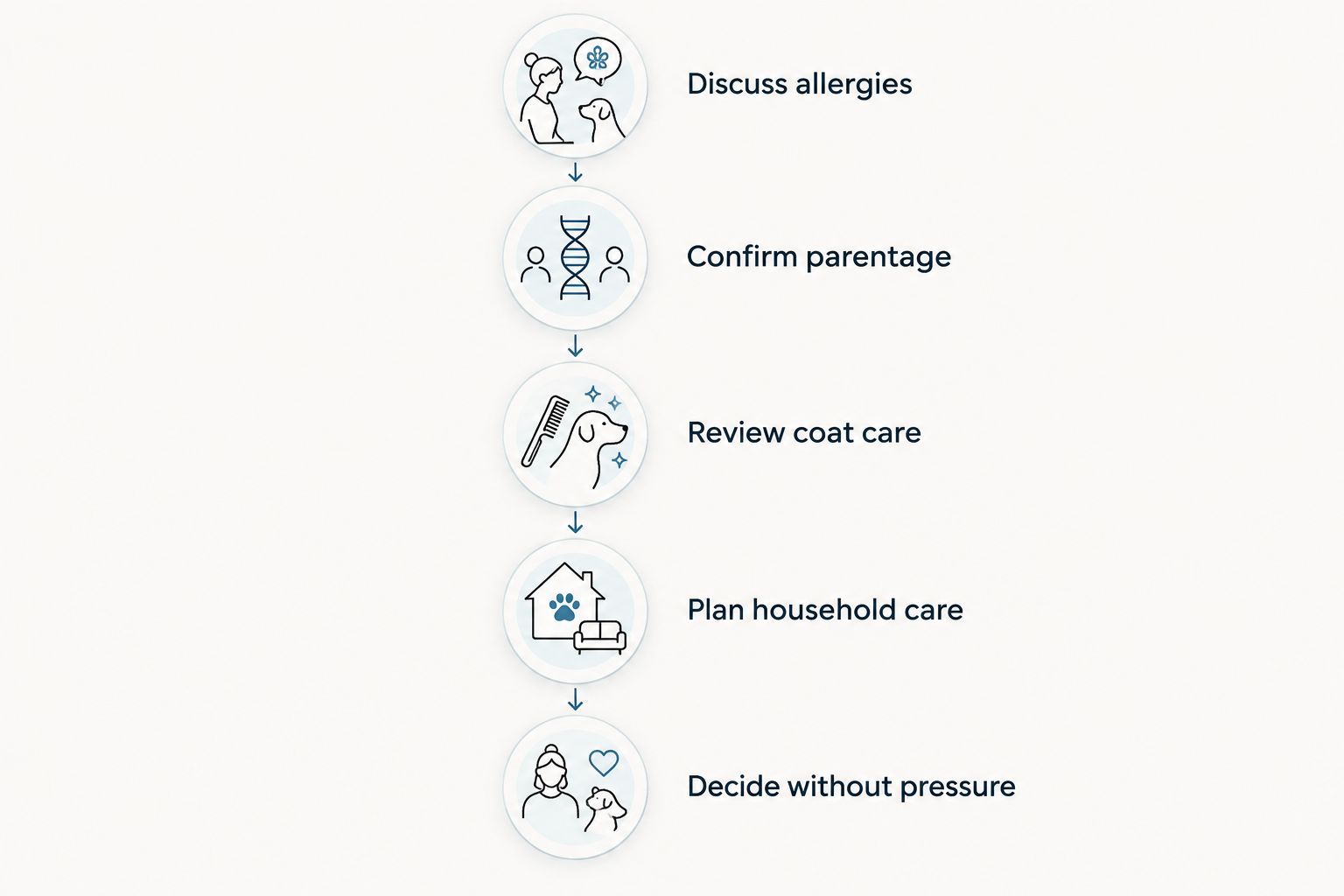
1. Discuss your allergy history
Speak with a qualified allergist about your household’s situation before making a commitment. This is especially important when reactions have affected breathing or when a child is involved; a breeder cannot assess personal medical suitability.
Ask what information the clinician needs and whether any contact with dogs is appropriate for you. Do not arrange your own exposure experiment as a substitute for that conversation.
2. Confirm parentage
Ask what F1 or F1B means for the specific puppy. For an F1B, confirm whether the backcross was to a Poodle rather than relying on the abbreviation alone.
Keep that answer in its proper category: ancestry. It does not become evidence of allergy compatibility simply because the pedigree is clear.
3. Review coat care
Ask what is currently observable about the puppy’s coat and what remains uncertain. Discuss brushing, professional grooming, and the care your household can consistently provide.
Choose a coat routine you can maintain, not a curl pattern you hope will solve allergies. A coat that looks appealing still needs practical care, and grooming commitments belong in the decision from the start.
4. Plan household care
Decide who will handle grooming arrangements, laundry, and everyday cleaning. Discuss where the puppy will rest and how the family will manage shared spaces.
A practical plan is useful preparation, not proof that allergies will be manageable. Keep those two ideas separate throughout your search.
5. Decide without pressure
Move ahead only when your family has enough information to make a comfortable decision. If uncertainty remains, pausing is a responsible choice—not a failure to find your furever friend.
We would rather families ask another question than mistake enthusiasm for certainty. The right decision includes the people already in your home as well as the puppy you hope to welcome.
What should you ask a breeding family?
Useful questions invite a specific answer without asking anyone to promise what they cannot know. We suggest keeping a written list so the excitement of meeting puppies does not crowd out your family’s priorities.
- What are this puppy’s parent breeds and generation?
- What health testing information can we review for the parents?
- What coat characteristics are observable now, and what is still uncertain?
- What grooming responsibilities should our family prepare for?
- What does the written health guarantee cover?
- What support continues after the puppy comes home?
For families comparing Goldendoodles in 2026, the strongest answer is not the most confident allergy promise. It is a clear distinction between documented facts, current observations, and things that cannot be predicted.
Health testing deserves careful attention, but it answers different questions from human allergy compatibility. Do not combine the two into a single idea of a puppy being safe for everyone.
Where our family’s support fits
Goldendoodles of Miami is best for families seeking curriculum-raised Goldendoodles and ongoing family support, not an allergy guarantee. We offer health-tested parents, curriculum-raised puppies, a two-year health guarantee, 30-day Trupanion coverage, and lifetime family support.
Those commitments help describe our program. They do not establish whether a particular person will tolerate a particular dog, and families should review the written terms rather than assume what a guarantee or insurance coverage includes.
We welcome careful questions because becoming part of our family should begin with clear expectations. Once your household is ready, start with Goldendoodles of Miami and ask about the puppy application.
Start your family’s puppy conversation
Ask about the puppy application, parent health testing, curriculum, and lifetime family support.
Can an F1B Goldendoodle still shed?
Yes, an F1B Goldendoodle can still shed; the backcross label does not promise a non-shedding coat. Ask about the individual puppy and remember that shedding observations do not establish allergy compatibility.
Does a curlier Goldendoodle coat mean fewer allergies?
No, a curlier Goldendoodle coat does not prove fewer allergy concerns. Curls describe coat appearance, while dog allergies involve allergenic proteins; do not use a photo as an allergy assessment.
Is an F1 Goldendoodle a bad choice for an allergy-conscious family?
An F1 Goldendoodle is not automatically a bad choice, just as an F1B is not automatically a good one. Your family’s decision needs individual professional guidance rather than a generation-based promise.
Resumen en español para las familias
Un Goldendoodle F1B no es automáticamente mejor que un F1 para una familia con alergias. Tener más ascendencia de Poodle no garantiza menos alérgenos, y ningún perro debe presentarse como una opción completamente hipoalergénica.
En 2026, recomendamos confirmar el cruce de los padres, preguntar por el cuidado del pelaje y consultar con un alergólogo antes de tomar una decisión. En Goldendoodles of Miami ofrecemos cachorros criados con un currículo, padres con pruebas de salud y apoyo familiar de por vida; estos compromisos no garantizan compatibilidad con las alergias de una persona.
FAQ
What’s better for allergies, an F1 or an F1B Goldendoodle?
Neither an F1 nor an F1B Goldendoodle is reliably better for an individual person based on generation alone. Confirm the parentage and seek guidance from an allergist before making an allergy-dependent decision.
Does 75% Poodle mean an F1B is more hypoallergenic?
No, 75% Poodle describes pedigree ancestry in the common Poodle backcross, not an allergy rating. It does not measure allergen production or predict a person’s response.
Can I be allergic to a Goldendoodle that barely sheds?
Yes, limited visible shedding does not rule out dog allergies. Allergenic proteins are associated with sources including dander and saliva, not just loose hair.
Can meeting a puppy tell me whether I’ll tolerate living with it?
A puppy visit cannot guarantee that living together will be comfortable. Ask an allergist whether contact is appropriate and how to interpret any experience you have.
Does health testing mean a puppy is suitable for someone with allergies?
No, parent health testing does not establish human allergy compatibility. Review health testing for its intended purpose and address personal allergy questions separately.
Will a health guarantee cover my family’s allergy concerns?
Do not assume a health guarantee covers a family member’s allergies. Read the written terms and ask what is included before making a commitment.
Should I choose the curliest Goldendoodle puppy for allergies?
No, curl pattern is not an allergy test. Evaluate coat care as a practical responsibility and discuss personal allergy concerns with a qualified clinician.
One last thing
Before choosing between F1 and F1B, write two separate questions: “Can we care for this coat?” and “Have we addressed our family’s allergy concerns?” An answer to the first does not answer the second.
That is the most useful distinction to carry into your 2026 puppy search. Your furever friend deserves a thoughtful match, and your family deserves more than reassurance based on an abbreviation.