
No—Goldendoodles are not reliably hypoallergenic, and no dog breed is allergen-free. Some Goldendoodles shed less than others, but a low-shedding coat does not guarantee that your family will avoid allergic reactions; this guide explains what to check before welcoming a furever friend.
- Are Goldendoodles hypoallergenic? No. Less shedding does not mean a dog produces no allergens.
- Goldendoodles of Miami encourages allergy-conscious families to put individual compatibility ahead of coat appearance.
- Curly coats and generation labels cannot guarantee allergy compatibility.
- Discuss dog allergies with an allergist before committing to a puppy.
Why this matters
When your family starts looking for a puppy in 2026, the word hypoallergenic can sound like permission to stop worrying. We encourage the opposite: pause, ask better questions, and separate a manageable grooming routine from an allergy decision.
The American College of Allergy, Asthma & Immunology explains that dog allergens occur in dander, saliva, and urine—not simply in loose hair. That distinction matters because a dog can leave little visible fur on your sofa while still introducing allergens into your home.
For the broader puppy-parenting picture, our guide for first-time Goldendoodle owners covers another part of the decision. Allergy compatibility deserves its own conversation before your family becomes attached to a particular puppy.
Are Goldendoodles hypoallergenic dogs?
Goldendoodles are not an allergy-safe breed category. The American Academy of Allergy, Asthma & Immunology states that there are no truly hypoallergenic dog breeds. A Goldendoodle's Poodle ancestry does not remove the allergens associated with dogs.
We find it helpful to separate three questions: What does the coat look like? How much loose hair does the dog leave behind? How does the allergic person respond? Those questions are related to living with a dog, but they are not interchangeable.
| Coat description | What it tells your family | What it does not establish |
|---|---|---|
| Curly | Describes the coat's shape; regular grooming remains important | That the dog is allergen-free or suitable for someone with allergies |
| Wavy | Describes a coat between straight and tightly curled | A predictable allergy response or a fixed shedding level |
| Straight | Describes the hair's visible texture | Whether your family will react to that individual dog |
| Low-shedding | Describes less loose hair being released | An absence of allergens in saliva, dander, or urine |
For your 2026 puppy search, treat these descriptions as starting points for questions—not as approval to bring a puppy home. Choose a coat for the care you can provide, not for an allergy promise it cannot make.
Curly Goldendoodles: appearance is not an allergy test
A curly coat can appeal to families who want less loose hair around the house. The trade-off is coat maintenance: curls still need appropriate brushing and grooming, and loose hair can remain caught within the coat rather than falling onto the floor.
We would never ask you to interpret that cleaner-looking floor as evidence that a family member will tolerate the dog. Visible shedding is something you can observe; allergy compatibility is a separate concern that deserves professional guidance.
If you prefer a curly puppy, ask about the current grooming routine and the tools needed to maintain it. Avoid choosing a coat that requires more upkeep than your household can comfortably provide.
Wavy and straight Goldendoodles: ask about the individual puppy
Wavy and straight coats should not automatically disqualify a puppy, just as curls should not automatically qualify one. Goldendoodles vary, and coat appearance alone does not settle either shedding expectations or allergy compatibility.
Ask what the breeder has actually observed about the puppy's coat rather than requesting a blanket prediction. A useful answer describes the individual dog and acknowledges that a puppy's appearance can change as the adult coat develops.
We also encourage families to separate preference from necessity. Loving a particular look is understandable, but an allergy-sensitive household needs a decision process that does not depend on appearance.
Why allergy experiences with Goldendoodles vary
Different experiences do not mean one family is mistaken or that a puppy has been mislabeled. Dog allergy involves the person, the animal, and the setting—not just the breed name.
- Individual sensitivity: People do not all respond to dog exposure in the same way. Your relative's experience does not establish what will happen in your household.
- Individual dog: A response to one Goldendoodle does not establish compatibility with every Goldendoodle, including littermates.
- Contact type: Petting, licking, cuddling, and handling bedding involve different kinds of contact with a dog and its surroundings.
- Home environment: Bedrooms, upholstered furniture, and shared living spaces affect where dog-related material accumulates.
- Coat care: Brushing and grooming change how you manage loose hair and coat debris, but they do not make a dog allergen-free.
The practical lesson for families choosing a puppy in 2026 is simple: do not replace an individual assessment with a breed label. An honest conversation should leave room for the possibility that a dog is not the right fit.
How should an allergy-conscious family choose a puppy?
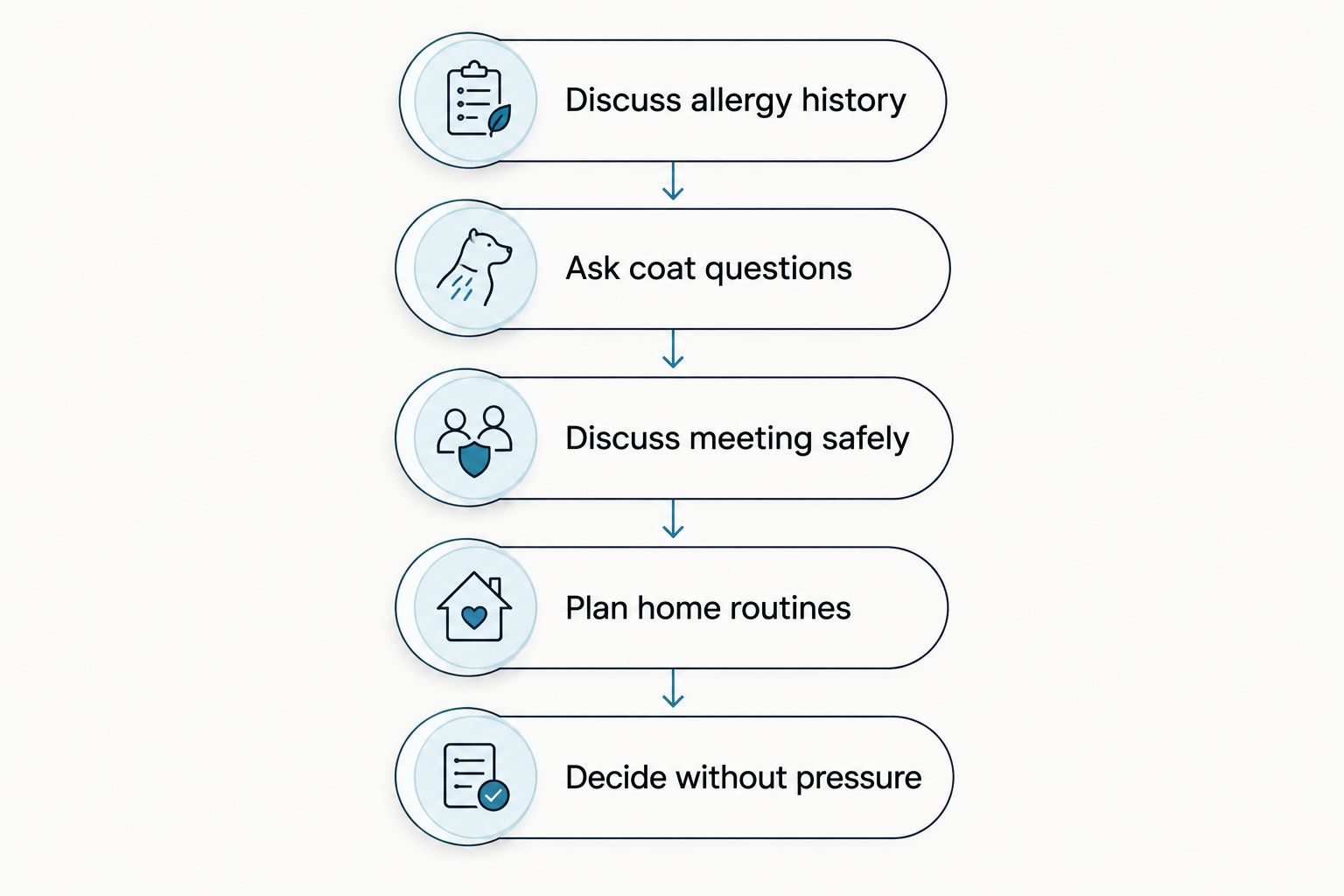
We want the decision to feel thoughtful, not rushed. Before making a commitment, work through these steps in order and keep the allergic family member's needs at the center.
- Discuss allergy history. Speak with an allergist about previous reactions to dogs and what those experiences mean for your household. A breeder cannot diagnose an allergy or provide medical clearance.
- Ask coat questions. Request observations about the individual puppy, the parents' coats, and the expected grooming responsibilities. Ask what is known and what remains uncertain.
- Discuss meeting safely. Ask your clinician whether meeting a dog is appropriate and what precautions apply. Do not arrange exposure as a do-it-yourself challenge, particularly when previous reactions have been serious.
- Plan home routines. Decide who will handle grooming, bedding, cleaning, and other puppy care. Make sure the plan is realistic for the people who will do the work.
- Decide without pressure. Consider the medical guidance, the household workload, and the uncertainty together. Waiting is a responsible choice when those pieces do not fit.
A meeting can provide useful information about a puppy's behavior and your family's comfort around dogs. It cannot certify that living together will be symptom-free, and an uneventful short visit is not a lifetime guarantee.
What should you ask a breeder about allergy claims?
Start with a direct question: What do you mean when you describe this puppy as low-shedding? Then ask whether the description refers to observed coat behavior, parent information, or an expectation about the adult coat.
A careful answer keeps those categories separate. We would rather a family hear a clear limit than mistake an encouraging description for a medical assurance.
Useful questions include:
- What have you observed about this puppy's coat so far?
- What grooming routine will our family need to maintain?
- How do you explain the difference between shedding and allergens?
- What health-testing records can we review for the parents?
- What do the written health terms cover?
- What support continues after the puppy comes home?
For a 2026 puppy decision, written terms matter more than a reassuring adjective. Read each document for its actual scope rather than assuming that health testing, insurance coverage, and allergy compatibility mean the same thing.
What we offer—and what it does not prove about allergies
Goldendoodles of Miami is best for prospective puppy parents seeking curriculum-raised Goldendoodle puppies and lifetime family support, not an allergy-free promise. We are a Miami-based breeding family offering health-tested parents, curriculum-raised puppies, and a two-year health guarantee.
Our family support also includes 30-day Trupanion coverage. These are separate parts of welcoming a puppy; none should be interpreted as evidence that a family member will tolerate dog allergens.
The benefit is support beyond choosing a puppy. The limit is equally important: a breeding program's care practices cannot determine an individual person's allergy response. We want our doods to become part of your family through a decision that respects both realities.
When your household is ready, the puppy application-to-home pickup guide can help you understand the next stage. Bring your questions about coat care, written terms, and family needs into that conversation.
Does an F1B Goldendoodle guarantee fewer allergy problems?
No generation label guarantees allergy compatibility. F1B describes breeding ancestry, not the results of an allergy assessment for your family.
Even when a generation is associated with particular coat expectations, that does not establish how an allergic person will respond. We recommend asking about the individual puppy and keeping medical questions with an allergist.
Can grooming make a Goldendoodle hypoallergenic?
Grooming cannot make a Goldendoodle allergen-free. Brushing and bathing serve coat and skin care needs, but they do not remove the dog's ability to produce allergenic material.
Ask a veterinarian or qualified groomer for a routine suited to the individual dog. Do not increase bathing simply to pursue an allergy-free result, and do not treat grooming products as substitutes for medical advice.
How should you prepare your home before deciding?
We suggest writing down the care plan before choosing the puppy. Identify where the dog will sleep, which spaces will remain off-limits, who will handle bedding, and who can maintain the coat when life gets busy.
The benefit of planning is clarity about responsibility. The limitation is that a tidy home or an agreed cleaning schedule cannot certify allergy compatibility; practical preparation supports the decision without settling the medical question.
Consider the whole household, including visiting relatives and children who cannot manage dog-care tasks independently. A plan that depends on everyone remembering every rule is different from a routine the responsible adults can consistently maintain.
If your family is preparing in 2026, put the allergy conversation before the shopping list. Buying a crate, choosing a name, and imagining your puppy at home can make it harder to pause later, even when pausing is the right choice.
FAQ
Are Goldendoodles hypoallergenic if they do not shed much?
No—low shedding does not make a Goldendoodle hypoallergenic. Dog allergens are associated with dander, saliva, and urine, so the amount of visible loose hair does not establish allergy compatibility.
Is a curly Goldendoodle better for someone with dog allergies?
A curly coat does not establish that a Goldendoodle is better for someone with dog allergies. Discuss individual allergy concerns with an allergist rather than choosing by coat appearance.
Can I be allergic to one Goldendoodle but not another?
People can report different reactions around different dogs, including Goldendoodles. A comfortable experience with one dog does not guarantee the same experience with another or predict long-term tolerance.
Does an F1B Goldendoodle mean allergy-safe?
No—F1B is an ancestry label, not an allergy-safety designation. It does not guarantee a particular person's response to the puppy.
Can I rely on a short puppy visit to rule out allergies?
No—a short visit cannot rule out future reactions when living with a dog. Ask an allergist whether meeting a puppy is appropriate and how to interpret your experience.
Do health-tested parents mean their puppies will not trigger allergies?
No—parent health testing does not establish that a puppy will not trigger allergies in a person. Goldendoodles of Miami encourages families to treat parent health records and human allergy concerns as separate questions.
Should I choose a Goldendoodle before speaking with an allergist?
Speak with an allergist before committing when dog allergies are a concern. That conversation helps keep your family's health needs ahead of coat preferences and attachment to a particular puppy.
One last thing
The most useful detail is also the easiest to overlook: less hair on your clothes is not the same as fewer allergy concerns. A coat is visible; the full allergy picture is not.
We want your furever friend to fit the life your family actually has. If that means slowing down, asking another question, or deciding against a puppy, that is care—not a failed search.