Instead of changing your puppy’s food, portions, and mealtimes together, keep the breeder’s routine first, then introduce new food gradually while tracking appetite and stools. Our 2026 guide shows how to transition puppy to new food schedule changes without losing the familiar routine your furever friend already knows.
- To transition puppy to new food schedule changes, preserve familiar mealtimes while gradually introducing the replacement diet.
- Goldendoodles of Miami supports puppy families with curriculum-raised puppies and lifetime family support.
- Check calories per serving before mixing foods; equal scoops do not necessarily provide equal energy.
- Contact your veterinarian about vomiting, diarrhea, or missed meals rather than treating every symptom as a food adjustment.
Why this matters
Coming home changes your puppy’s surroundings, sleeping arrangements, and daily rhythm. We want the food bowl to remain familiar while your dood settles into the family.
Change the food or the schedule first—not both together. Keeping one steady makes your notes more useful if appetite or stools change. It also gives everyone in the household a clear plan instead of several well-meant feeding routines.
For families preparing in 2026, our best dog food for Goldendoodle puppies guide is a companion to this workflow. Food selection and food introduction are separate decisions: first confirm that the diet suits your growing puppy, then plan the transition.
Before you start
- Get the feeding handoff. Ask for the exact food name and formula, current daily amount, meal frequency, usual feeding times, and any feeding instructions specific to your puppy. Have the familiar food on hand before starting a change.
- Prepare your materials. Keep both food packages, a measuring tool, fresh water, and a shared feeding log. Ask your veterinarian whether the replacement food is appropriate for your puppy’s growth stage and expected adult size.
- Catch the calorie mismatch. Different foods can contain different calories per cup. Replacing half a scoop with half a scoop does not necessarily preserve the daily calorie intake; confirm portions before mixing.
At Goldendoodles of Miami, our breeding family emphasizes health-tested parents, curriculum-raised puppies, and lifetime family support. That support helps with the handoff; your veterinarian directs individual nutrition decisions and evaluates symptoms.
Feeding handoff and household plan
Record the familiar routine
- Write down the food’s full name, including its formula. Photograph the package and feeding information so another family member can identify the same food.
- Record the total daily amount and how it is divided between meals. Keep those entries separate: a daily amount mistakenly served at every meal changes the plan substantially.
- Note the last meal before pickup and ask about the next expected meal. Follow any individual instructions rather than adding an extra welcome-home dinner.
- Choose a feeding coordinator. Everyone can help, but one person should check the log before another meal or treat is offered.
Expected result: Your household can explain exactly what your puppy eats, how much is offered, and when the next meal belongs.
We recommend putting the instructions where meals are prepared, not leaving them buried in a message thread. Familiar food does little good if each person measures it differently.
Create the feeding log
- Start a dated page headed 2026 feeding log, or use a shared note with the same information.
- Add these record labels: Food offered, Amount offered, Amount eaten, Meal time, Treats, and Stool notes. These are household record labels, not settings in a particular app.
- Record observations plainly. Write what happened rather than diagnosing an allergy or deciding that the food caused a symptom.
- Share the log with your veterinarian when asking for advice. Include other changes, such as travel, unfamiliar treats, or access to another pet’s bowl.
Expected result: You have a readable record instead of relying on memory when someone asks whether your puppy finished breakfast.
Daily portions and meal timing
Confirm the daily allowance
- Find the nutritional adequacy statement on the replacement food. Ask your veterinarian to confirm that it suits growth, including any needs associated with expected adult size.
- Find the calorie information on both packages. Keep the units attached: calories per cup and calories per kilogram are not interchangeable measurements.
- Ask your veterinarian to confirm the daily feeding amount and how to measure a mixed-food portion. Package directions are a starting point, not an individualized prescription.
- Keep treats and training rewards in the conversation. They contribute to daily intake even when they never reach the food bowl.
Expected result: You have a daily allowance that accounts for the actual foods, rather than assuming that every cup of puppy food is equivalent.
Do not add supplements to make a complete puppy food “more complete” without veterinary direction. A new home does not require a new collection of toppers and powders.
Preserve the meal pattern
- Keep the breeder’s meal frequency initially unless your veterinarian gives different instructions.
- Fit those meals into a household routine that an adult can reliably maintain. Do not eliminate a meal simply because the workday makes it inconvenient.
- If the timing must change, agree on the revised schedule before beginning the food change. Keep the food familiar while establishing that routine.
- Make fresh water accessible. Do not restrict drinking to make the feeding or toilet schedule easier.
Expected result: Your puppy has predictable meals, and every caregiver follows the same written plan.
Our curriculum-training-to-home routine guide connects feeding with the rest of the day. Meals belong within a routine that also includes rest, gentle training, and toilet opportunities—not an isolated timetable on the refrigerator.
Gradual food introduction
Build the transition plan
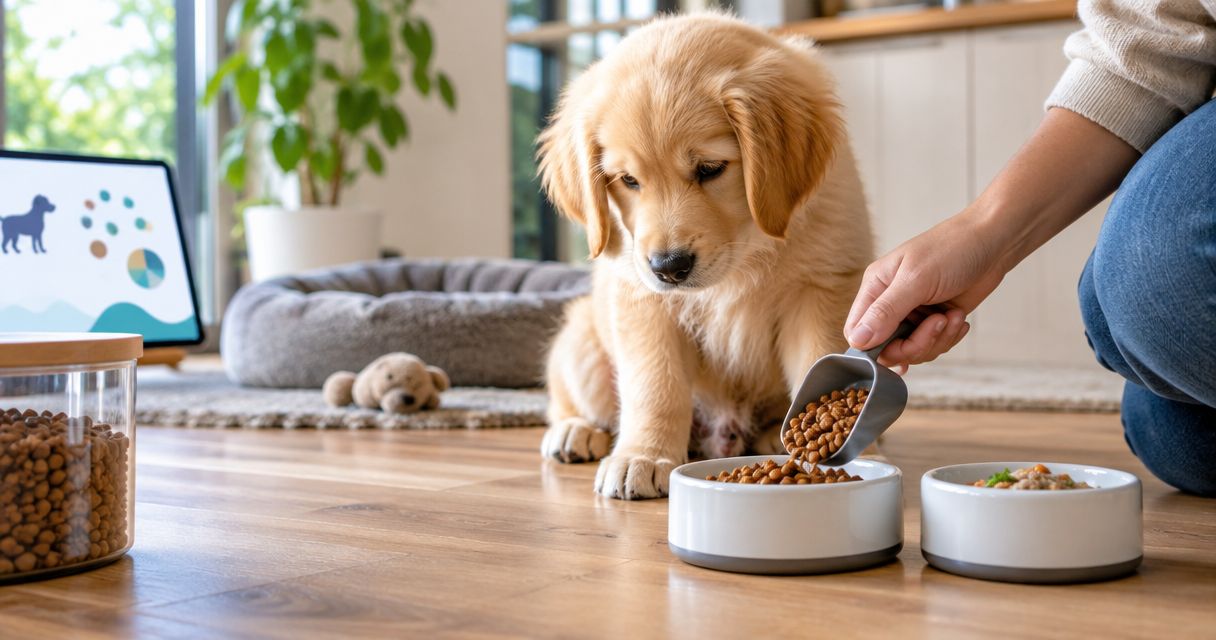
For an otherwise well puppy whose veterinarian agrees with the change, a gradual transition commonly takes about 7–10 days. That is a planning range, not a deadline or a promise that every puppy will tolerate the same pace.
The following is a conventional 7-day outline. The percentages describe the progression between foods; have your veterinarian confirm the actual measured amounts when calorie densities differ.
| Transition stage | Familiar food | Replacement food | Check before advancing |
|---|---|---|---|
| Days 1–2 | 75% | 25% | Appetite and stools remain normal for your puppy |
| Days 3–4 | 50% | 50% | The mixed meals remain well tolerated |
| Days 5–6 | 25% | 75% | No new concerning symptoms appear |
| Day 7 onward | 0% | 100% | The replacement diet remains well tolerated |
- Begin only after you have the portion plan and both foods ready. Avoid starting because the familiar bag is almost empty.
- Prepare the agreed mixture for each scheduled meal. Keep meal frequency steady during this part of the transition.
- Record intake and stools before moving to the next stage. Do not increase the replacement food just to finish on a calendar date.
- Stop advancing and contact your veterinarian if symptoms develop. Do not assume diarrhea or vomiting is a necessary part of switching food.
Expected result: The replacement food increases gradually while meal timing and the observation routine stay consistent.
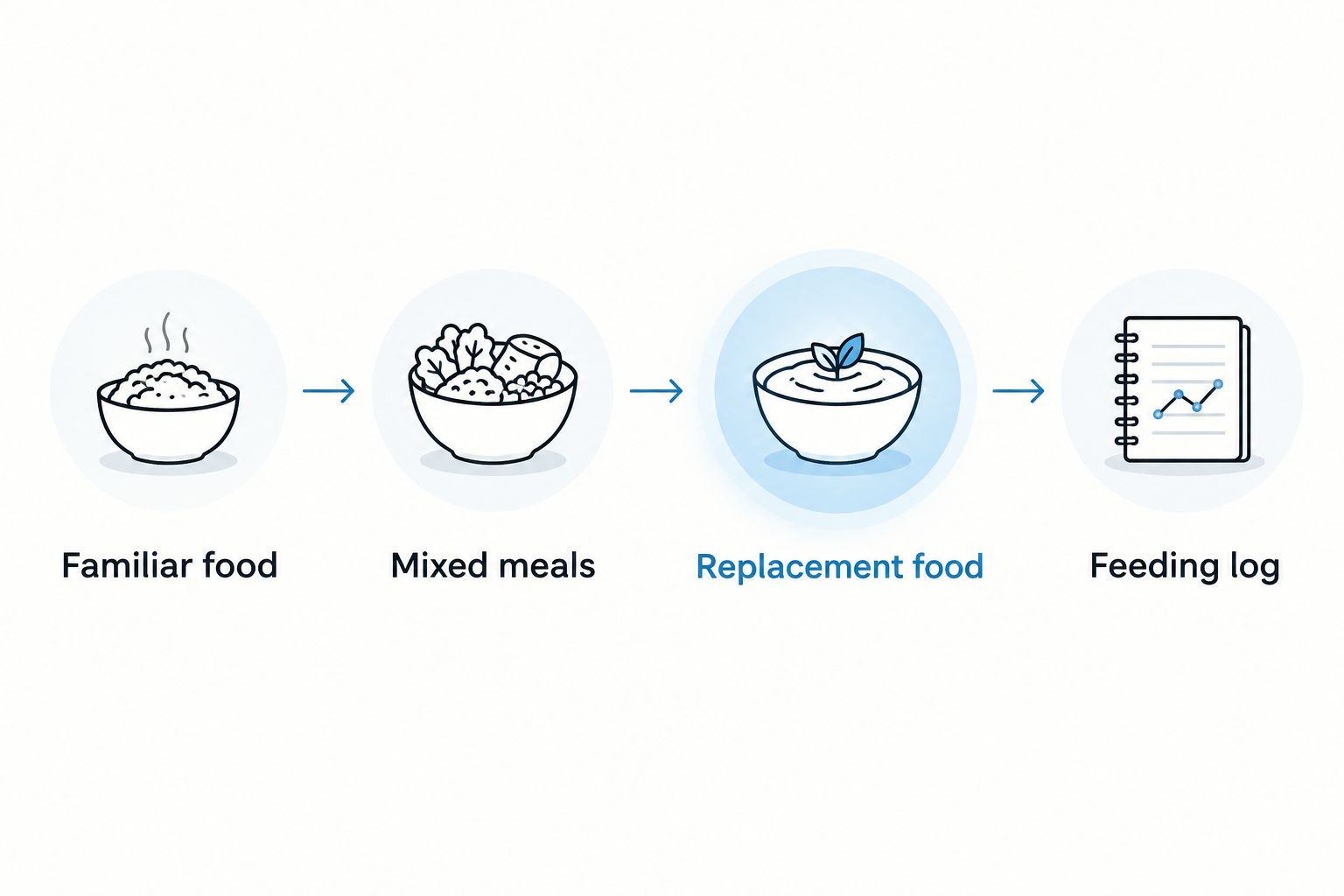
We want your dood comfortable, not racing through a chart. A transition plan is an observation tool, not permission to wait out illness. If your veterinarian prescribes a different transition for a medical reason, follow that plan instead.
Second workflow: change mealtimes without changing food
Sometimes the food already suits your puppy, but the breeder’s timetable does not match home life. In that case, keep the food and daily allowance steady while you establish the agreed meal times.
For your 2026 household plan, choose the workflow that matches the actual problem:
| Workflow | Best for | Advantage | Limitation |
|---|---|---|---|
| Food-only transition | Families changing diets while keeping familiar mealtimes | Keeps timing consistent while you observe food tolerance | Requires both foods and careful portion measurement |
| Schedule-only transition | Families keeping the diet but adapting household timing | Avoids introducing a new food at the same time | Does not solve an unsuitable diet or an impractical meal frequency |
- Confirm the meal frequency with your veterinarian, especially for a very young or small puppy.
- Write the proposed feeding times beside the existing times. Ask whether the changes create inappropriate gaps for your puppy.
- Keep the familiar food and agreed daily amount unchanged while implementing the approved schedule.
- Review appetite, energy, and the household’s ability to follow the plan before considering a separate diet change.
Expected result: You have a workable home timetable without also introducing an unfamiliar diet.
Troubleshooting
Your puppy leaves food in the bowl
Record how much was eaten, check whether someone else fed the puppy, and note treats or access to another pet’s food. Avoid repeatedly replacing meals with new foods to encourage eating.
Contact your veterinarian promptly about missed meals, particularly in a very young or small puppy. Weakness, trembling, unusual sleepiness, or collapse requires urgent veterinary attention.
Loose stools appear during the transition
Stop increasing the replacement food and contact your veterinarian for instructions. Share the mixture, portions, stool observations, and any other foods your puppy received.
Do not fast a young puppy or give human diarrhea medicine without veterinary direction. Blood in the stool, repeated vomiting, marked lethargy, or difficulty keeping water down warrants prompt veterinary care.
The familiar food runs out early
Contact the breeder and your veterinarian before improvising a rapid change. Use the package photograph to identify the exact formula rather than assuming another bag from the same brand is equivalent.
For future changes, confirm you have enough familiar food to complete the agreed transition before opening the replacement bag.
Family members give duplicate meals
Move the feeding log beside the food container and record each meal immediately after serving it. Have the next caregiver check the entry before preparing another bowl.
We suggest keeping training rewards in the same daily conversation. A puppy who seems uninterested at dinner might already have eaten food that nobody recorded.
Your puppy eats from another pet’s bowl
Feed pets separately and supervise meals so you know who ate what. Another pet’s diet is not automatically suitable for a growing puppy.
Separation also makes the log useful again. Without it, an apparently unfinished puppy meal tells you little about total intake.
Customize your workflow
Once the replacement diet and schedule are established, keep the log available for veterinary visits and future changes. Update your 2026 feeding plan as your puppy grows; do not leave the original portion unchanged indefinitely or adjust it solely by appearance of the bowl.
Goldendoodles of Miami is best for families seeking curriculum-raised puppies and lifetime family support. Our two-year health guarantee and 30-day Trupanion coverage are parts of that support, not substitutes for veterinary advice. Review the relevant terms rather than assuming a feeding concern falls within either arrangement.
If you are still preparing for your furever friend, we welcome you to begin the puppy application process. Tell us about your household routine so feeding responsibilities are part of the preparation, not a surprise after pickup.
Resumen en español
Mantengan primero el alimento y la rutina que el cachorro ya conoce. Antes de cambiar la dieta, consulten al veterinario sobre las porciones y hagan la transición de forma gradual, sin cambiar también todos los horarios.
Anoten cuánto come y cualquier cambio en las heces. Si aparecen vómitos, diarrea, debilidad o falta de apetito, contacten al veterinario; no supongan que son molestias normales del cambio.
FAQ
How do I transition my puppy to a new food schedule?
Keep the familiar food while establishing veterinarian-approved meal times, or keep familiar mealtimes while gradually changing food. Separating those changes makes your feeding observations easier to interpret.
How many days should a puppy food transition take?
A gradual transition commonly takes about 7–10 days for an otherwise well puppy. Your veterinarian can recommend a different pace based on the puppy and the reason for changing diets.
Should I change my puppy’s food immediately after pickup?
Keep the familiar food initially unless your veterinarian directs otherwise. Record the breeder’s portions and meal pattern before making a separate, planned change.
Can I mix equal scoops of old and new puppy food?
Equal scoops do not necessarily contain equal calories. Check both packages and ask your veterinarian to confirm measured portions for the transition.
What should I do if my puppy gets diarrhea after changing food?
Stop advancing the transition and contact your veterinarian. Blood in the stool, repeated vomiting, marked lethargy, or difficulty keeping water down needs prompt veterinary attention.
Can I replace puppy food with home-cooked meals?
Do not replace a complete growth diet with an improvised home-cooked diet. Ask your veterinarian about referral to a board-certified veterinary nutritionist for a diet formulated for your growing puppy.
Does Goldendoodles of Miami help families after pickup?
Goldendoodles of Miami provides lifetime family support. Contact the breeding family about the feeding handoff and your veterinarian about individual dietary needs or symptoms.
One last thing
The most useful feeding photograph is often the back of the bag. Save the exact formula, calorie information, and feeding directions before discarding the packaging, then keep that photograph with your 2026 feeding log.
We want your new puppy to feel part of our family and yours. A clear handoff, familiar meals, and a shared notebook make that welcome easier for everyone.