Instead of piecing together airline rules after booking, use this 2026 workflow to fly your puppy home from the breeder: confirm travel eligibility, reserve the pet’s place, prepare the carrier, and coordinate the handoff. We’ll help you separate the family preparations from the airline and veterinary decisions that need direct confirmation.
- To fly puppy home from breeder, confirm age eligibility, carrier fit, documentation, and pet acceptance before booking.
- Goldendoodles of Miami suits families seeking curriculum-raised doodle puppies and lifetime family support.
- A passenger reservation does not replace confirmation that the airline has accepted your puppy.
- International puppy travel requires destination-specific planning, not just an airline-approved carrier.
Why this matters
Your puppy’s trip home starts before the airport. A passenger ticket, a suitable-looking bag, and a folder of puppy records do not establish that an airline will accept your particular puppy on your particular itinerary.
Goldendoodles of Miami is best for families seeking curriculum-raised doodle puppies with lifetime family support. Our health-tested parents, two-year health guarantee, and family-first approach provide a foundation for your relationship with us. They do not replace an airline’s acceptance requirements or a veterinarian’s travel assessment.
Start with Goldendoodles of Miami to discuss the puppy application and your intended travel plans. Keep travel dates provisional until the puppy’s readiness and the transport requirements align.
For a 2026 journey, use current airline instructions rather than an old screenshot or another family’s experience. Requirements belong to the operating airline, the route, and the destination—not to the breed name.
Before you start
- Gather the itinerary and access. Have the operating airline’s pet policy, your passenger booking details if already reserved, and a way to contact the airline. Identify every flight segment, including connections operated by another carrier.
- Gather the puppy information and materials. Confirm the puppy’s birth date, current measurements, expected handoff date, veterinary records, carrier requirements, and destination documentation requirements. Ask your veterinarian which documents apply to the journey.
- Catch the booking gotcha early. A ticket for you does not confirm space for your puppy. Before committing, ask how the airline records pet acceptance and whether every segment is covered.
Keep one travel folder containing the itinerary, pet confirmation, relevant records, and handoff details. Save an offline copy so a weak airport connection does not become another obstacle.
Airline and itinerary confirmation
- Identify the operating airline. Check who actually operates each flight, not only whose name appears on the booking website. Ask which pet requirements govern each segment.
- Confirm puppy eligibility. Give the airline the puppy’s birth date and travel date. Ask about minimum age, route restrictions, required records, and whether accompanied in-cabin travel is permitted for that journey.
- Confirm carrier rules. Obtain the permitted dimensions, placement requirements, and any applicable weight limits directly from the airline. Ask how the puppy’s fit inside the carrier will be assessed.
- Confirm pet acceptance. Follow the airline’s reservation process and retain the resulting confirmation. Ask whether anything remains subject to an airport inspection.
- Align the itinerary with the handoff. Coordinate the proposed meeting time and location with us before treating the schedule as final. Do not assume airport delivery, an escort, or transport services are included.
Expected result: You can identify the operating airline, explain its requirements for your puppy, and show how the pet reservation is recorded.
Choose the itinerary around a manageable handoff rather than the shortest advertised journey alone. A connection adds another flight segment whose pet acceptance, operating carrier, and timing need checking. If your plans change, repeat those checks rather than assuming the original pet confirmation transfers.
Carrier and travel-kit preparation
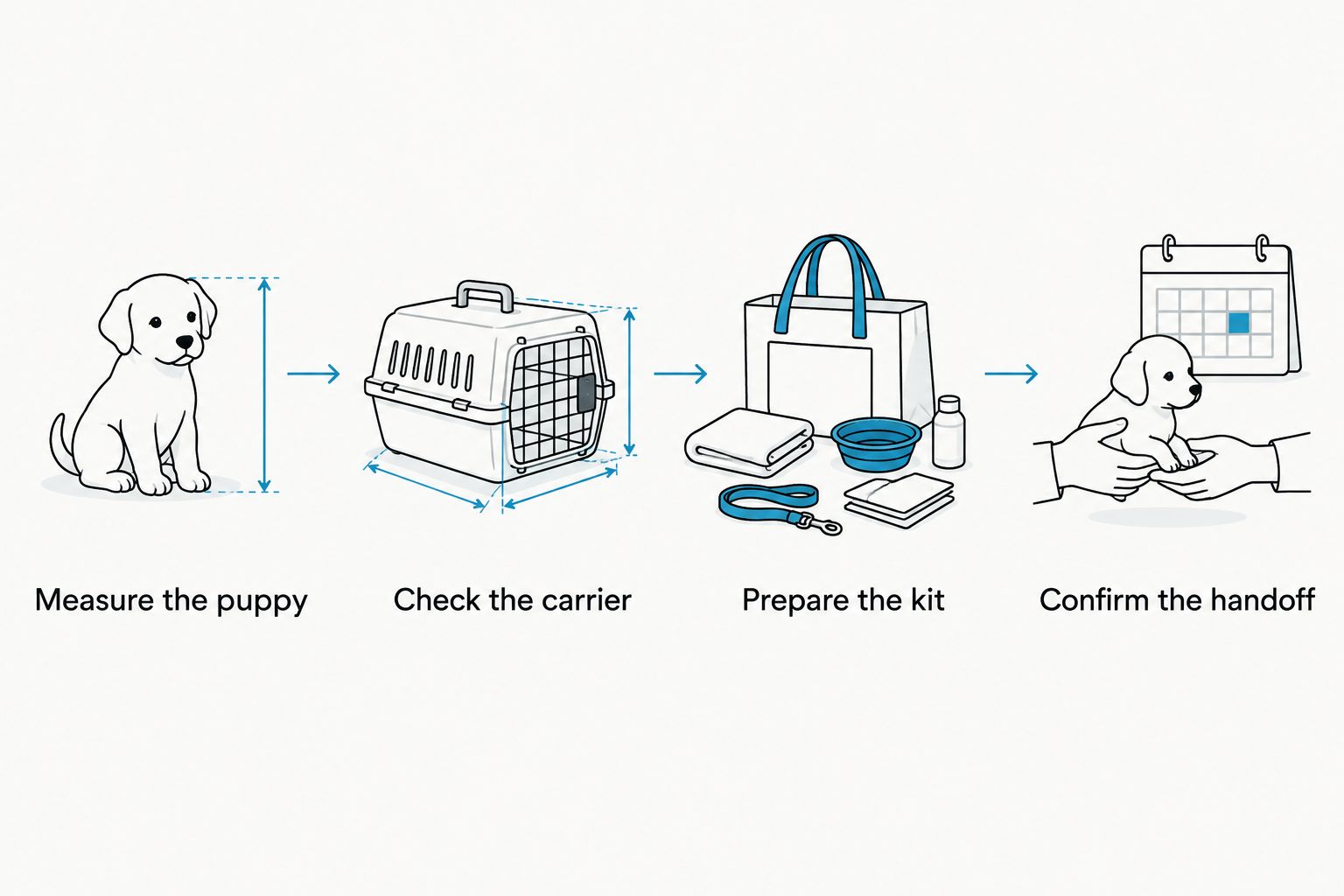
- Measure the puppy. Use current measurements rather than an adult-size estimate or a breed label. Compare the puppy’s fit with the airline’s requirements, not just the carrier’s packaging.
- Check the complete carrier. Measure the carrier as it will travel, including any protruding parts. Confirm ventilation, secure closures, and the airline’s instructions for under-seat placement.
- Introduce the carrier gently. Ask what carrier experience the puppy already has. Build familiarity with calm, supervised practice; curriculum-raised does not automatically mean airline-carrier trained.
- Prepare the kit. Pack replacement absorbent liners, cleanup supplies, a secure leash and correctly fitted restraint, familiar food, and a suitable water container. Check airport security rules for anything you plan to carry through screening.
- Plan food and water with the veterinarian. Ask for advice appropriate to the puppy and itinerary. Do not create a fasting schedule or give calming medication based on travel anecdotes.
Expected result: The carrier meets the airline’s stated requirements, the puppy fits appropriately, and essential supplies are accessible without unpacking your entire bag.
A carrier that fits beneath a seat but does not meet the puppy-fit requirement is not a workable compromise. Resolve both checks before travel day. If the requirements cannot be met, change the plan rather than trying to persuade an airport agent.
Puppy records and handoff coordination
- Confirm the handoff. Agree on the date, meeting location, contact method, and what to do if the flight changes. Leave enough room in your own schedule for questions and document checks.
- Reconcile the records. Compare the puppy’s identifying information and birth date across the documents required for the trip. Ask the issuing professional to correct discrepancies; do not edit veterinary documents yourself.
- Confirm travel documents separately. Ask whether a health certificate, vaccination documentation, or another document is required for this route. Confirm the applicable timing with the airline and relevant destination authority.
- Review the home-care transition. Ask about the puppy’s current food, routine, and familiar comfort items. Keep those details in the travel folder so everyone caring for your furever friend has the same information.
- Review support and coverage. Clarify the two-year health guarantee and the instructions for the 30-day Trupanion coverage. Ask about activation, effective dates, terms, and exclusions rather than assuming coverage begins at a particular moment.
Expected result: The handoff is agreed, the records match the puppy, and your family understands both the travel paperwork and the separate support arrangements.
Our puppies are part of our family, and lifetime family support matters after the journey too. That support does not replace veterinary care, airline approval, or an insurer’s coverage terms. Keep each responsibility clear.
Before departure, read how to activate your puppy’s 30-day Trupanion coverage and confirm the instructions that apply to your puppy.
Airport screening and arrival preparation
- Recheck the journey. For your 2026 departure, confirm the flight status, pet reservation, check-in instructions, and any airline schedule changes. Follow the airline’s arrival guidance for passengers traveling with pets.
- Prepare for security. At U.S. TSA checkpoints, pets do not go through the X-ray machine. Tell the officer you are traveling with a puppy and follow instructions for removing the puppy while the carrier is screened.
- Maintain physical control. Have the puppy’s restraint ready before opening the carrier. Ask the officer for assistance or private screening if you cannot safely manage the puppy during the screening process.
- Follow the carrier rules. Keep the puppy secured as required by the airline. Do not assume permission to open the carrier, place it on a seat, or let the puppy sit on your lap.
- Keep arrival quiet. Arrange a secure ride home and a calm settling space. Follow your veterinarian’s guidance about public pet-relief areas and exposure before the puppy’s vaccination series is complete.
Expected result: You know the screening sequence, have a secure way to manage the puppy, and can move from the destination airport to a prepared home.
The arrival plan deserves the same attention as departure. Decide who handles luggage, who stays responsible for the puppy, and where the carrier will be secured for the drive. Avoid an excited welcome crowd at the terminal.
If you are flying internationally
An international trip in 2026 needs a separate eligibility check before you book. The destination’s animal-import authority determines entry requirements; the airline determines whether it will transport the puppy. Meeting one set of rules does not establish compliance with the other.
| Journey | Best for | Practical advantage | Limitation |
|---|---|---|---|
| Domestic accompanied flight | Families traveling within the United States | No international border-entry process | Airline eligibility and applicable state requirements still need checking |
| International accompanied flight | Families taking a puppy to another country | Family accompanies the puppy across the journey | Import documentation, timing, and transit requirements add separate checks |
- Check destination entry rules. Confirm the requirements for the puppy’s age, identification, vaccinations, certificates, and any permits directly with the relevant authority. Use USDA APHIS pet-travel guidance for U.S. export preparation where applicable.
- Check transit rules. Ask whether a connecting country creates additional requirements, including when changing airports or collecting luggage.
- Sequence veterinary appointments. Work backward from the travel date using the actual document and endorsement deadlines. Do not assume a routine veterinary record is an international travel certificate.
- Reconfirm airline acceptance. Give the airline the complete itinerary and relevant puppy details after the documentation plan is clear.
Expected result: Your travel date follows the puppy’s legal entry eligibility and document schedule, not the other way around.
For South American families, country-specific requirements are essential. Spanish-language communication helps explain the plan, but translated instructions do not replace an official document or endorsement when one is required.
Troubleshooting
Your ticket is confirmed, but the puppy is not
Contact the operating airline and ask whether pet acceptance is recorded for every segment. Do not arrive at the airport expecting an agent to resolve a missing reservation. Change the itinerary if the airline cannot accept the puppy.
The carrier meets dimensions, but the puppy does not fit
Reassess the puppy’s fit against the airline’s rules. A different carrier only solves the problem if it also meets those rules. If no compliant arrangement works, postpone or choose another confirmed travel plan.
A document has the wrong date or puppy information
Contact the issuing veterinarian or authority before departure. Ask for a corrected document and confirm whether its validity period still covers the journey. Keep the corrected version accessible.
A delay disrupts the handoff or connection
Contact the airline and the handoff contact promptly. Confirm the replacement flight’s pet acceptance before accepting the change, and ask your veterinarian for guidance if the disruption affects the puppy’s care plan.
Customize your workflow
Make the travel folder useful after the airport. Add the feeding routine, veterinary appointment details, coverage instructions, and family responsibilities for the first days at home.
Goldendoodles of Miami offers curriculum-raised puppies, but your home introduces new people, sounds, and routines. Continue with calm, consistent handling rather than expecting the travel experience to prove how the puppy will behave everywhere.
Ask about the puppy application before anchoring your family’s plans to a flight. Then build the journey around the individual puppy and confirmed requirements.
Resumen para familias de habla hispana
Para viajar en avión con un cachorro desde el criador, confirme primero la edad permitida, la aceptación de la mascota, el transportín y los documentos. Comprar su boleto no confirma automáticamente el viaje del cachorro.
En Goldendoodles of Miami criamos cachorros con un programa de aprendizaje y ofrecemos apoyo familiar de por vida. Para viajes a Sudamérica en 2026, consulte los requisitos oficiales del país de destino antes de reservar. Pregúntenos por la solicitud para familias y coordine la entrega sin dar por incluidos servicios de transporte.
FAQ
How do I fly a puppy home from a breeder?
Confirm the puppy’s eligibility, carrier fit, required documents, and airline pet acceptance before finalizing the journey. Coordinate the breeder handoff separately and prepare a secure arrival plan.
Can my Goldendoodle puppy fly in the cabin with me?
In-cabin travel depends on the operating airline, route, puppy eligibility, and carrier requirements. A Goldendoodle label alone does not establish acceptance; confirm the individual puppy’s details directly.
How old does a puppy need to be to fly in 2026?
Use the operating airline’s current minimum-age rule and any applicable destination requirements. Give the airline the puppy’s birth date and intended travel date rather than relying on a general age quoted elsewhere.
Does my puppy need a health certificate to fly?
Certificate requirements depend on the airline and route, including destination entry rules. Ask your veterinarian and the relevant authorities which documents and validity periods apply.
Can I put my puppy’s carrier through airport X-ray screening?
Never put a puppy through the X-ray machine. At U.S. TSA checkpoints, follow the officer’s instructions for removing and controlling the puppy while the empty carrier is screened.
Does curriculum training mean my puppy is ready for a flight?
Curriculum-based preparation does not establish airline eligibility or guarantee comfort during travel. Ask about the puppy’s carrier experience and discuss travel readiness with the veterinarian.
Is international puppy travel the same as a domestic flight?
International puppy travel adds destination-specific entry requirements and sometimes transit requirements. Confirm those rules separately from the airline’s transport policy before booking.
One last thing
Pack the leash where you can reach it before opening the carrier—not beneath everything else. The moment that needs the clearest plan is often security screening, when the puppy and carrier must briefly separate.
Practice that hand movement at home with the empty carrier. A simple rehearsal makes the setup familiar without turning travel day into an experiment.