
Instead of chasing purebred registration papers for your Goldendoodle, enroll your puppy in AKC Canine Partners, the American Kennel Club program for mixed-breed dogs. We’ll walk through the correct enrollment route, the records to prepare, and the difference between an AKC participation number and a purebred pedigree.
- To register Goldendoodle puppy AKC participation, use AKC Canine Partners—not the purebred registration application.
- Goldendoodles are mixed-breed dogs; AKC-registered parents do not make their puppies eligible for purebred registration.
- AKC Canine Partners supports eligible activities, but enrollment does not certify health, temperament, or breeding quality.
- Goldendoodles of Miami helps prospective Goldendoodle families understand puppy paperwork without confusing enrollment with a pedigree.
Why this matters
A Goldendoodle is a cross involving Golden Retriever and Poodle ancestry, not an AKC-recognized purebred breed. That distinction determines which application you should complete. It does not determine how much your dood deserves to be part of your family.
For your 2026 paperwork, separate purebred registration from mixed-breed enrollment before you submit anything. AKC Canine Partners gives mixed-breed dogs a route into eligible AKC activities; it does not turn a Goldendoodle into a registered Poodle or Golden Retriever.
Goldendoodles of Miami is best for prospective Goldendoodle families seeking curriculum-raised puppies and lifetime family support. Our health-tested parents, two-year health guarantee, and puppy curriculum are separate from AKC enrollment. You can learn about our breeding family through Goldendoodles of Miami.
Choose the right AKC route
The American Kennel Club’s purebred registration requirements and Canine Partners program guidance are the controlling sources for eligibility. For a 2026 application, read the current official requirements rather than relying on a breeder’s shorthand or a social media post.
| Route | Best for | What it provides | Limitation for a Goldendoodle |
|---|---|---|---|
| AKC Canine Partners | Mixed-breed families interested in eligible AKC activities | Enrollment and a number used for eligible participation | Not a purebred pedigree; individual activities have separate requirements |
| AKC purebred registration | Eligible dogs of AKC-recognized breeds with qualifying registration records | Registration within the applicable purebred registry | A Goldendoodle does not qualify simply because its parents have AKC papers |
Choose Canine Partners for your Goldendoodle—not a purebred litter application. The benefit is a suitable participation route. The limitation is equally important: enrollment does not establish ancestry, health, or suitability for breeding.
Before you start
Gather your records first. That keeps a straightforward enrollment task from turning into a search through messages and pickup paperwork.
- Prepare your puppy’s details: have the puppy’s name, birth information, sex, identifying information, and your contact details ready. Enter only what you know; follow the form’s instructions for unknown information.
- Use the official program materials: open the American Kennel Club’s current AKC Canine Partners information and enrollment form. Keep your puppy’s existing paperwork nearby, but do not treat a parent’s registration number as your puppy’s number.
- Check participation requirements early: enrollment and event eligibility are separate. Review the current Canine Partners spay/neuter requirements and the rules for your intended activity; discuss procedure timing with your veterinarian rather than changing a care plan to meet an event date.
The non-obvious snag is choosing an activity before checking its entry rules. An enrollment number alone does not establish that your puppy meets an event’s age, training, or other requirements.
We also recommend keeping registration questions separate from first-week care decisions. Our Goldendoodle guide for first-time dog owners helps you prepare for the daily responsibilities that paperwork cannot cover.
Program selection
Confirm the mixed-breed enrollment route
- Open the American Kennel Club’s official website and find AKC Canine Partners. Confirm that you are reading the mixed-breed program information, not a purebred puppy registration page.
- Read the current eligibility requirements and enrollment instructions. For your 2026 application, use the form currently supplied by the AKC rather than an old downloaded copy.
- Identify your actual goal: enrolling your dog, preparing for an eligible activity, or both. If participation is the goal, read that activity’s rules before submitting an entry.
- Put any parent registration records aside as supporting family records. Do not copy a parent’s identity into the puppy’s enrollment details.
Expected result: you have the correct Canine Partners enrollment materials and know which participation requirements need a separate check.
There is no benefit to trying the purebred form first. A registered Poodle parent and a registered Golden Retriever parent do not create an AKC-recognized Goldendoodle breed.
Enrollment details
Complete and check your puppy’s information
- Enter the owner information requested on the current application. Use an email address you monitor and contact details you can maintain.
- Enter your puppy’s information according to the form’s instructions. Keep the spelling consistent with the records you intend to use for future activities.
- Supply identifying details only where requested. A microchip identifier and an AKC enrollment number serve different purposes; never substitute one for the other.
- Review the program terms and declarations before submitting. Ask the AKC about any eligibility question instead of selecting an inaccurate answer to move through the form.
- Follow the submission instructions provided with the current application. Save the submission acknowledgment and any correspondence that follows.
Expected result: the application describes your puppy accurately, identifies the correct owner, and follows the current program instructions.
A familiar call name can differ from a formal enrollment name. What matters during this process is knowing which name belongs to which record, not making every document look identical.
If another family member helps with paperwork, agree on who will maintain the account and receive correspondence. That simple decision prevents enrollment messages from disappearing into an inbox nobody checks.
Record storage
Verify enrollment and build your puppy folder
- Check the AKC response for your puppy’s name and owner details. Follow the correction instructions if anything is wrong.
- Save the assigned enrollment number once it is issued. A submission acknowledgment is not a substitute for the final enrollment record.
- Create 1 digital folder for your puppy’s enrollment documents, with a backup you can access away from home.
- Keep veterinary records, microchip registration, insurance documents, and your breeder agreement in clearly labeled sections. These documents support different needs and do not replace one another.
- Before entering an activity, compare the enrollment details with the event’s current entry requirements.
Expected result: you can retrieve the correct enrollment record without confusing it with a vaccination record, microchip identifier, or parent’s pedigree.
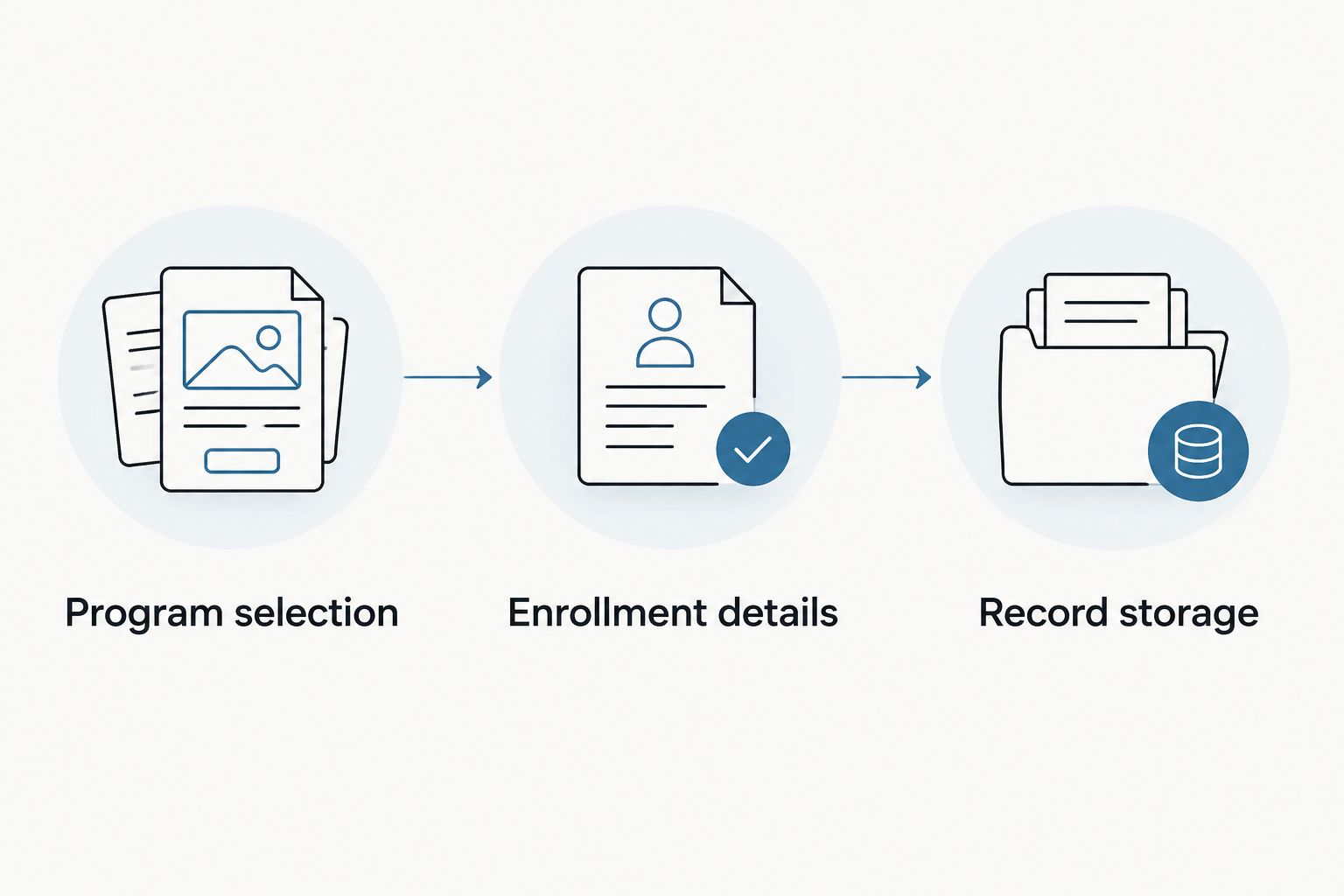
The workflow has three distinct parts: Program selection, Enrollment details, and Record storage. Completing the form is only the middle of the job; choosing the right program and preserving the final record make it useful.
When your puppy is already enrolled
You do not need a second enrollment simply because you are ready to try an activity. Start with the existing record and confirm that it identifies your dog correctly.
- Locate the original Canine Partners enrollment document and assigned number.
- Check the owner contact information against your current details. Use the AKC’s current correction or update process where needed.
- Read the rules for the specific activity you want to enter, including any age, health-documentation, training, or spay/neuter conditions that apply.
- Use the existing enrollment details on the entry, following the organizer’s instructions.
Expected result: your dog’s activity entry connects to the correct existing record rather than a duplicate enrollment.
For a young puppy, enrollment planning and training preparation can happen on different schedules. Ask your veterinarian about appropriate activities, and use reward-based practice suited to your puppy rather than rushing toward an event.
Troubleshooting common enrollment problems
The application asks for a purebred registration code
You have reached the wrong registration route. Return to the official AKC Canine Partners materials instead of borrowing a number from a parent’s paperwork.
Your puppy’s parent has AKC papers, but your puppy does not
Parent papers document the parent’s registration, not the mixed-breed puppy’s eligibility for purebred registration. Use Canine Partners for the Goldendoodle and preserve parent documents separately.
An event will not accept your puppy’s entry
Check the event’s own requirements before changing the enrollment. The issue can concern the activity’s eligibility conditions rather than whether the dog has a Canine Partners number; ask the event secretary which requirement is unmet.
The name or owner details are incorrect
Follow the AKC’s correction process using the existing record. Do not submit another enrollment merely to repair a spelling error, and keep copies of the correspondence.
You cannot find the final enrollment number
Search your saved documents and correspondence, then contact the AKC through its official channels if necessary. Do not guess a number or use a microchip identifier in its place.
Customize your puppy paperwork workflow
For a 2026 puppy folder, organize documents around what each one actually does. Enrollment supports eligible participation. Veterinary records document care, while microchip registration connects an identifier with contact information.
At Goldendoodles of Miami, we want families to understand our care commitments just as clearly. We provide curriculum-raised puppies, health-tested parents, a two-year health guarantee, 30-day Trupanion coverage, and lifetime family support. Read the applicable documents for their terms; none of these benefits comes from AKC enrollment.
Keep the coverage paperwork beside the health guarantee, not inside a folder labeled AKC. That makes the right document easier to find when you have a question.
If you are still preparing for your furever friend, ask us about the puppy application and the records to review before bringing a puppy home. We would rather help you understand the paperwork than leave you guessing what a certificate means.
Start your puppy application conversation
Ask about the puppy application, health records, curriculum, and family support.
Resumen para nuestras familias hispanohablantes
Un Goldendoodle no reúne los requisitos para el registro de raza pura del AKC. La opción correspondiente es AKC Canine Partners, el programa para perros mestizos; la inscripción no equivale a un pedigrí ni certifica la salud del cachorro.
Para una solicitud en 2026, consulten los requisitos oficiales vigentes y las normas de la actividad que les interese. En Goldendoodles of Miami, acompañamos a las familias durante la preparación para recibir a su cachorro; pueden preguntarnos por la solicitud y los documentos de cuidado.
FAQ
Can I register my Goldendoodle puppy with the AKC?
You can enroll a Goldendoodle in AKC Canine Partners, but a Goldendoodle is not eligible for AKC purebred registration. Use the mixed-breed program's current application and check its eligibility requirements.
Can my Goldendoodle get AKC papers if both parents are registered?
Registered parents do not make a Goldendoodle eligible for AKC purebred registration. Keep their records as parent documentation and use Canine Partners for your puppy's eligible participation.
Does an AKC Canine Partners number prove my puppy is healthy?
No. AKC Canine Partners enrollment is not a health certification and does not replace veterinary records, parent health-testing documentation, or your breeder agreement.
Does my Goldendoodle need to be spayed or neutered for AKC activities?
Check the current Canine Partners requirements and the rules for the specific activity before entering. Discuss procedure timing with your veterinarian rather than treating an enrollment or event deadline as medical guidance.
Can a Goldendoodle enter an AKC conformation dog show?
A Goldendoodle cannot enter regular AKC breed conformation competition as an AKC-recognized purebred breed. Canine Partners instead provides a route to eligible activities under each activity's rules.
Is AKC enrollment the same as microchip registration?
No. AKC enrollment and microchip registration serve different purposes, and one does not replace the other. Keep your microchip contact record current separately.
What should I check before submitting a Goldendoodle AKC application in 2026?
Confirm that you are using the current AKC Canine Partners application, then check your puppy's details and the program requirements. Save the final enrollment record separately from the submission acknowledgment.
One last thing
A certificate answers a paperwork question—not whether a puppy fits your family. Before focusing on enrollment, make sure you understand the puppy’s care records, your daily responsibilities, and the support you can ask for after homecoming.
A tidy folder is helpful. A clear understanding of what each document does is better.