Instead of repeatedly searching emails and veterinary records, organize your puppy health guarantee claim process around your signed agreement, your veterinarian’s findings, and a clear written request. We’ll help you prepare that request for our two-year health guarantee without confusing a guarantee review with an insurance claim or delaying your puppy’s care.
- Start the puppy health guarantee claim process with your signed agreement and veterinary records, not assumptions about coverage.
- Goldendoodles of Miami’s two-year health guarantee is separate from 30-day Trupanion coverage; check each document’s terms.
- Keep veterinary care moving while you request written clarification about claim requirements.
- Save your original submission and identify new veterinary findings clearly when sending updates.
Why this matters
When your furever friend has a health concern, paperwork should not become another source of worry. The signed health guarantee—not a general article—sets the terms for a claim. For a request prepared in 2026, start with the agreement issued for your puppy rather than assuming current website wording changes that agreement.
Goldendoodles of Miami is best for prospective puppy families seeking curriculum-raised puppies and a two-year health guarantee. Our program includes health-tested parents, 30-day Trupanion coverage, and lifetime family support. Those are distinct parts of our support for families, not interchangeable promises about a particular diagnosis.
You can return to Goldendoodles of Miami for general program information. For an existing health concern, use your signed documents and the contact information in your puppy paperwork to prepare your request.
Before you start
- Gather your materials: your signed guarantee, puppy identification details from your paperwork, veterinary records, and previous correspondence about the concern. Ask your veterinarian for copies of findings you do not yet have.
- Find the submission instructions: check your agreement for the correct recipient, notification deadlines, required documentation, and any instructions about further examinations. Do not substitute a general puppy inquiry for a claim submission.
- Avoid the insurance mix-up: our two-year health guarantee and 30-day Trupanion coverage are separate. Sending information to one does not establish that you have notified the other; follow each document’s instructions separately.
If your puppy needs urgent attention, contact your veterinarian or an emergency veterinary service. Do not wait for a guarantee decision before seeking veterinary guidance. This guide organizes paperwork; it does not diagnose your puppy or determine contractual eligibility.
Your agreement and claim checklist
The first part of the workflow is identifying what your agreement actually asks you to do. We want families to have a clear starting point, without assuming that every health concern follows the same contractual path.
Read the controlling terms
- Find the signed agreement associated with your puppy. Keep the complete document, including attachments and any written amendments, together.
- Locate the sections describing covered conditions, exclusions, notification requirements, supporting evidence, and the remedies described in the agreement.
- Copy any relevant deadline exactly into your calendar. Use the event specified in the agreement as its starting point; do not assume the two-year duration answers every timing question.
- Mark unclear wording for a written question. Ask which provision applies rather than guessing what a phrase means.
Expected result: you have the correct agreement and a short list of actual requirements, with unanswered questions separated from confirmed instructions.
Build a working checklist
Use these suggested organizational labels in your own notes: Agreement, Veterinary records, Correspondence, and Questions. These are folder labels, not names of a claim portal or official submission fields.
For your 2026 claim file, record the agreement date, pickup date if documented, veterinary visit dates, and the date you first contacted the relevant recipient. Preserve historical dates exactly as they appear in your records. A tidy timeline helps the reader understand the sequence without reconstructing it from attachments.
Do not add a deadline because another family mentioned one. If your agreement leaves an instruction unclear, request clarification while preserving evidence of your notification.
Veterinary records and supporting evidence
Your veterinarian’s documentation should carry the medical detail. Your role is to make that documentation easy to identify and connect to the puppy named in your agreement.
Assemble the record packet
- Ask the veterinary practice for the examination notes and relevant test reports associated with the concern. Request written findings rather than relying only on your recollection of a conversation.
- Check that the puppy and owner details match your agreement. Explain a name change or other mismatch in your cover note instead of altering an original medical record.
- Keep the veterinarian’s wording intact. If a finding remains uncertain or testing is pending, preserve that distinction.
- Save invoices and receipts alongside the records. Including a receipt documents an expense; it does not establish that the guarantee reimburses that expense.
- Arrange the records chronologically and give attachments descriptive filenames without changing their contents.
Expected result: another reader can connect the puppy, examination, findings, and supporting documents without guessing.
Separate observations from findings
A family observation and a veterinary conclusion serve different purposes. Write what you noticed in plain language, then point to the veterinarian’s report for the clinical assessment.
For example, describe a change you actually observed rather than assigning a diagnosis yourself. If a record does not answer whether a condition meets a contractual definition, ask for clarification; do not rewrite the report to make it fit.
Health-tested parents are part of our breeding program, but parent testing does not replace an individual puppy’s veterinary assessment. Likewise, curriculum-based training is preparation for family life, not evidence about a medical condition.
Written notice and submission
A clear request asks for a review without declaring its own approval. Keep the message focused on the puppy, the documented concern, the relevant agreement, and the next instructions you need.
Prepare your written request
- Identify yourself and your puppy using the information in your agreement. Include the agreement reference if your paperwork provides one.
- State that you are requesting review under the two-year health guarantee. Briefly describe the concern and the veterinary assessment already completed.
- List the documents attached. State which records are still pending so an incomplete attachment set is not mistaken for the entire veterinary history.
- Ask for confirmation of receipt, the applicable documentation requirements, and the next step under your agreement.
- Send the request through the method specified in your paperwork. If the method is unclear, ask the listed contact where formal notice belongs and keep that correspondence.
Expected result: you have a saved copy of a written request, its attachments, and evidence of when and where you sent it.
Use a clear message structure
This suggested outline is a writing aid, not an official form:
- Subject: health guarantee review request, followed by your puppy’s identifying details.
- Opening: your name, the puppy’s details, and the agreement involved.
- Concern: a factual summary of the issue and the veterinary visit.
- Attachments: an inventory of the records included.
- Request: confirmation of receipt and clarification of the next contractual step.
Keep sensitive personal information out of public comments or social posts. Send supporting documents through the appropriate private channel identified for your request.
Follow-up and decision records
Follow-up works best when each message makes clear what changed. Repeating the entire story in a new conversation can make the record harder for everyone to follow.
Track the review
- Save acknowledgments with your original submission. If receipt is unconfirmed, follow up using the contact method in your paperwork and reference the original sending date.
- Record requests for additional information. Check whether the request specifies a document, recipient, or deadline before responding.
- Send the requested material with a short attachment list. Distinguish newly supplied records from documents already submitted.
- Ask for the decision and any next steps in writing. Compare the explanation with the relevant agreement provisions.
- Keep the final correspondence with your puppy’s records. If something remains unclear, identify the specific point you need explained.
Expected result: your file shows what you submitted, what additional information was requested, and what response you received.
For a review continuing through 2026, keep the original request date visible in your notes. A later update should be identifiable as an update, not accidentally presented as your first notification.
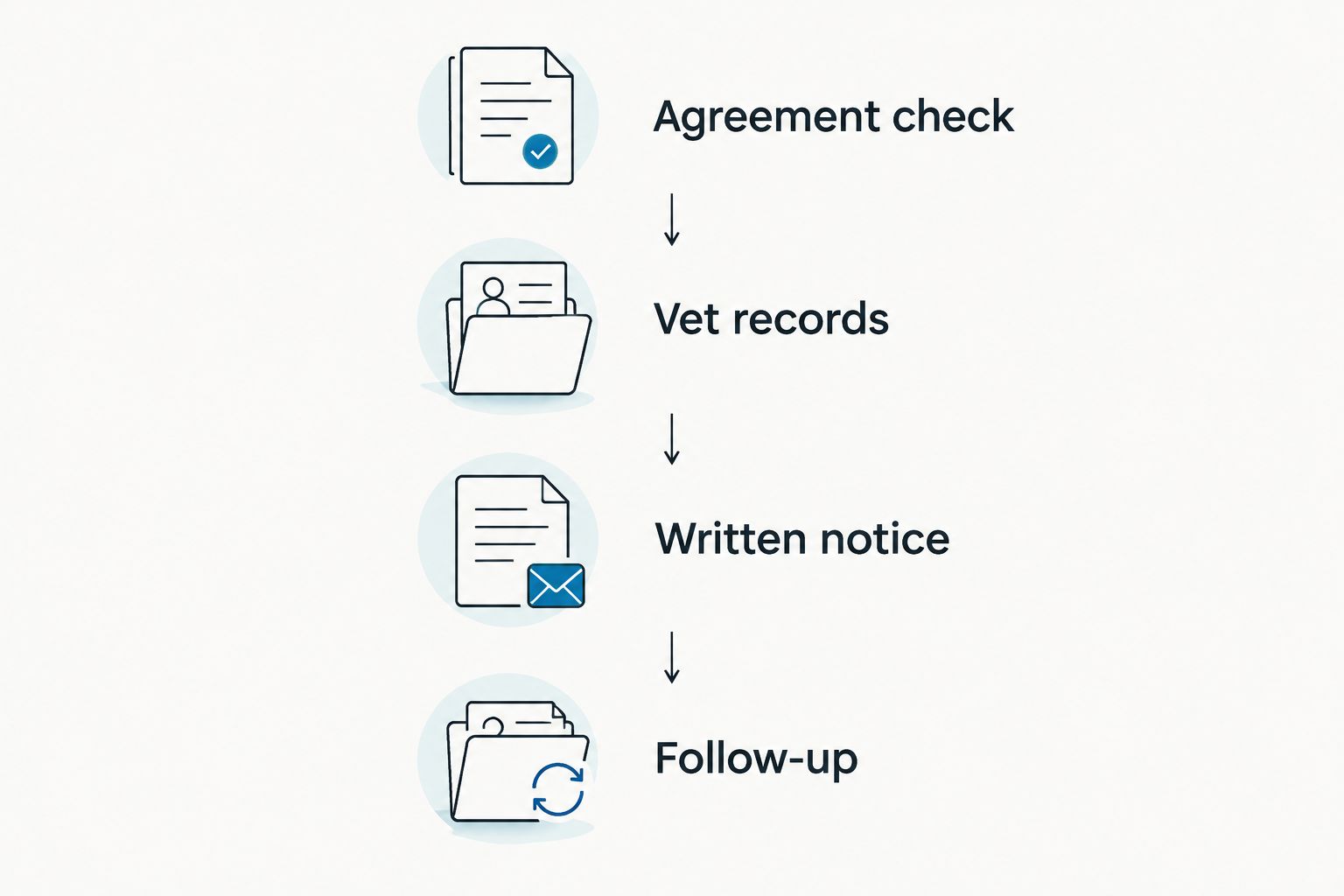
The workflow is simple to picture: Agreement check, Vet records, Written notice, and Follow-up. Each stage answers a different question before the next begins.
When new veterinary findings arrive
An updated report needs a slightly different workflow from an initial request. Send the new information as an identifiable update to the existing matter. Keep the original records; a later finding should not erase the earlier history.
- Reference your original request and any reference supplied in the response.
- Identify the new examination or report by its actual date.
- Explain briefly what document you are adding, without interpreting it beyond the veterinarian’s wording.
- Ask whether the additional finding changes the documentation needed for review.
If the new information concerns a different condition, ask whether it belongs with the existing request or needs separate notice. Do not assume that an earlier submission covers every later concern.
Health guarantee versus Trupanion coverage
Goldendoodles of Miami’s health guarantee and the included 30-day Trupanion coverage need separate attention. Neither document should be used as a substitute for reading the other.
| Route | Best for | Useful role | Limitation |
|---|---|---|---|
| Two-year health guarantee | Requesting review under your puppy’s guarantee | Provides the contractual basis for that review | Does not establish that every diagnosis or expense qualifies |
| 30-day Trupanion coverage | Checking the separate insurance route | Provides separate insurance documents to review | Has its own terms and does not replace guarantee notification |
For your 2026 paperwork, verify the dates and instructions in each document rather than assuming the coverage periods align. Our guide to activating your puppy’s 30-day Trupanion coverage addresses that adjacent task; activation guidance is not a guarantee claim decision.
Troubleshooting
You cannot find the signed guarantee
Request a copy using the contact information in your puppy paperwork. Preserve any notice you send about the concern while you obtain the agreement; do not invent its terms from memory.
The veterinary report is not final
Identify the report as pending and ask how to provide it when completed. Keep documented observations separate from an unconfirmed diagnosis, and check the agreement’s notice requirements rather than waiting without communicating.
An attachment is missing or unreadable
Check your saved sent message against your attachment list. Resend the affected document with a clear explanation and ask the recipient to confirm it opens.
You have not received confirmation
Follow up with the original sending date and recipient details. Verify that you used the method required by your paperwork; a social message or general inquiry is not evidence that the contractual notice requirement was met.
The decision does not answer your question
Ask which agreement provision supports the decision and which records were considered. Request clarification about the specific unresolved point rather than treating a general explanation as an answer to every issue.
Customize your family’s recordkeeping
Keep one master folder for your puppy, with separate sections for veterinary care, guarantee correspondence, and insurance paperwork. For 2026 records, use descriptive filenames and actual visit dates so updates remain easy to identify.
Our lifetime family support reflects that our doods remain part of our family. It does not replace veterinary care or change the written guarantee. If you are researching before bringing a puppy home, review the agreement before completing the puppy application and ask about any wording you do not understand.
Resumen en español
Para solicitar una revisión de la garantía de salud de dos años, revisa el contrato firmado, reúne los informes veterinarios y sigue las instrucciones de notificación del documento. Conserva una copia de cada envío y pide confirmación de recepción.
La cobertura de Trupanion de 30 días es independiente de la garantía. No esperes una decisión sobre la garantía para buscar atención veterinaria; consulta al veterinario sobre la salud de tu cachorro.
FAQ
How do I start the puppy health guarantee claim process?
Start with your signed guarantee, gather the relevant veterinary records, and follow the agreement’s notification instructions. Keep a copy of your written request and ask for confirmation of receipt.
Does the two-year health guarantee cover every illness?
Do not assume that every illness qualifies under the two-year health guarantee. Your signed agreement determines the covered conditions, exclusions, documentation requirements, and available remedies.
Should I wait for a claim response before taking my puppy to the vet?
Do not delay veterinary guidance while waiting for a guarantee response. Contact your veterinarian about the health concern and handle the claim paperwork separately.
Is a Trupanion claim the same as a health guarantee claim?
No, a Trupanion insurance claim and a health guarantee request are separate processes. Follow each document’s instructions and do not assume notification to one reaches the other.
What if my veterinarian is still waiting for test results?
Explain that results are pending and check your agreement’s notice requirements. Ask how to submit the completed report without presenting an unconfirmed finding as a diagnosis.
How long does a health guarantee review take?
Use any review timing stated in your agreement or written claim correspondence. Ask the recipient for the next step and expected response timing rather than relying on a general estimate.
What should I do if I disagree with the decision?
Ask for a written explanation identifying the relevant agreement provision and records considered. Submit any missing supporting information through the instructed channel and keep the correspondence together.
One last thing
Write your attachment list before pressing send. It gives you a quick way to catch a missing report and gives the recipient a clear inventory to check. A short, complete request serves your furever friend better than a long message with the key record missing.