Plan a professional groom about every 6 weeks for a Goldendoodle puppy, using a 4–6-week schedule when coat length and tangling call for it, plus daily brushing and comb checks at home. This 2026 starting schedule does not replace your groomer’s assessment: puppy handling, bathing, nail care, and keeping the coat free of mats all need attention between haircuts.
- How often should you groom a Goldendoodle? Brush daily and start with professional grooming about every 6 weeks.
- A long coat needs more home maintenance; a shorter trim still needs regular brushing and comb checks.
- Goldendoodles of Miami supports puppy families with curriculum-raised puppies and lifetime family support.
- Introduce grooming gently, and ask your veterinarian about safe timing for your puppy’s first salon visit.
At Goldendoodles of Miami, we want grooming to feel like familiar care, not a wrestling match. Your furever friend needs a routine your family can keep, not just a haircut you love in a photograph.
How often should you groom a Goldendoodle puppy?
Start with daily home grooming and a professional appointment about every 6 weeks. Ask your groomer to adjust that interval after checking your puppy’s coat, comfort with handling, and the length you want to maintain.
A professional appointment and home brushing do different jobs. A haircut manages length; brushing and combing help you find tangles between visits. Booking the next appointment does not remove the need for daily coat care.
| Grooming task | Starting routine | What it accomplishes | Limitation |
|---|---|---|---|
| Home brushing | Daily | Separates coat and removes loose debris | Surface brushing can miss tangles underneath |
| Comb check | After brushing | Checks whether the coat separates down toward the skin | A comb should never be forced through a knot |
| Professional grooming | About every 6 weeks; adjust within a 4–6-week routine as needed | Maintains a manageable trim and provides professional coat care | Does not replace home maintenance |
| Bathing | According to coat condition and professional guidance | Cleans the coat when needed | Bathing is not a substitute for detangling |
| Nail and paw care | Check during regular handling | Helps you notice when professional attention is needed | Do not cut nails without learning safe technique |
Treat these as planning guidelines for 2026, not deadlines your puppy must tolerate regardless of comfort. If you cannot comfortably pass a comb through the coat, ask for help before the next scheduled haircut.
Why this matters for your puppy
A fluffy puppy coat can look tidy while hiding tangles close to the skin. The areas behind the ears, under the legs, and beneath a harness deserve particular attention because hair rubs together there.
We encourage families to think about grooming as cooperative handling. Your puppy is learning what it feels like to have paws touched, ears checked, and a brush moved across the body. Calm introductions matter as much as the finished haircut.
There is also a practical family decision here: choose a coat length you can maintain on an ordinary weekday. The best trim is one you can keep comfortable between appointments. A longer style is not a better choice if brushing repeatedly turns into a struggle.
Daily brushing: check beneath the fluffy surface
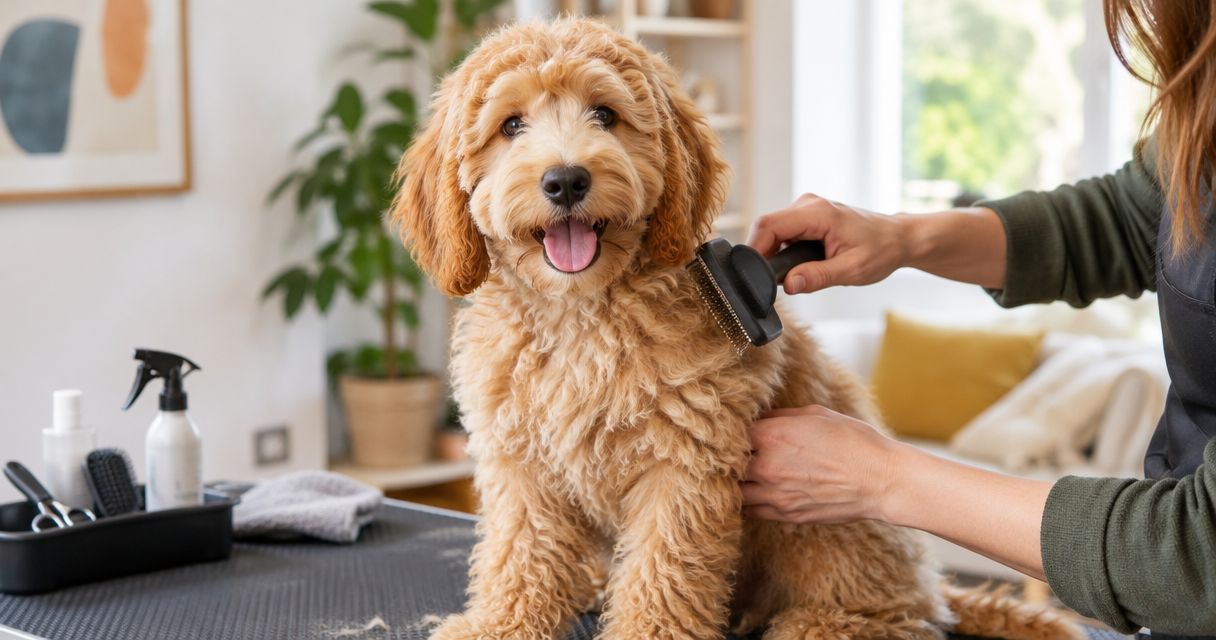
Daily brushing gives you a regular opportunity to check the coat rather than waiting until a knot becomes obvious. Work gently in small sections, supporting the hair near the skin instead of pulling against your puppy’s body.
A slicker brush and a metal comb serve different purposes. The brush works through sections of coat; the comb checks what the brush left behind. Neither tool should scrape skin or require force.
| Tool | Best for | Benefit | Caution |
|---|---|---|---|
| Slicker brush | Families maintaining a fluffy or curly coat | Works through small sections of hair | Excess pressure can irritate skin |
| Metal comb | Families checking the coat after brushing | Reveals catches that surface brushing misses | Pulling through a catch hurts and does not solve the problem |
Our guide to grooming brushes for Goldendoodles explains the tool choices. Ask your groomer to demonstrate technique on your puppy before buying equipment you do not know how to use.
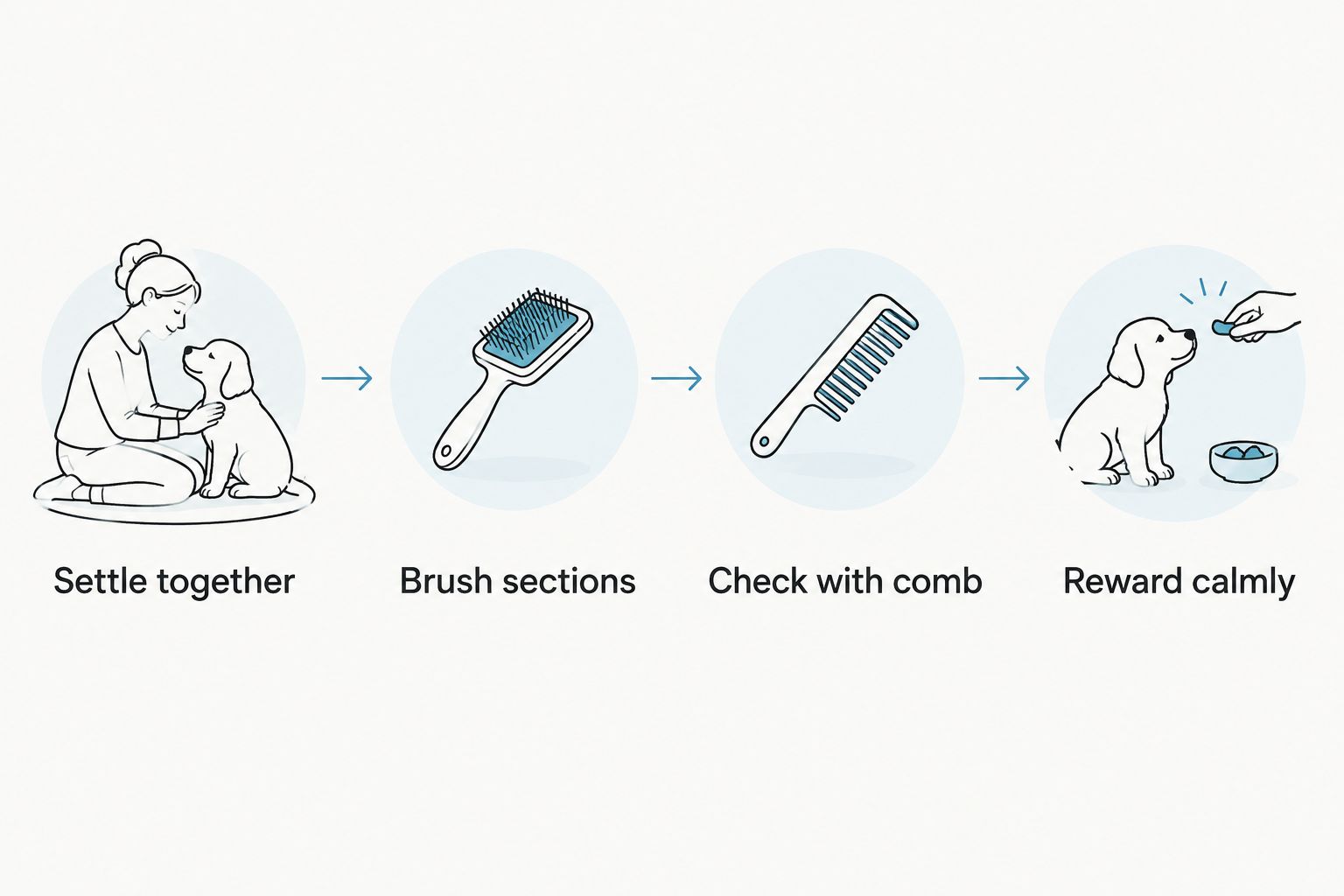
A gentle home-grooming sequence
- Settle together. Choose a quiet spot with secure footing. Let your puppy investigate the tools without immediately starting a full grooming session.
- Brush sections. Part the coat so you can see where you are working. Brush gently rather than repeatedly skimming over the outer fluff.
- Check with comb. Follow the brushed section with a comb. Stop at resistance instead of pulling harder.
- Reward calmly. Reward comfortable participation and finish before frustration builds. Return to unfinished areas when your puppy is settled.
This sequence is useful for your 2026 puppy-care routine because it gives every family member the same approach. Consistency is easier when everyone knows that stopping at a snag is part of grooming, not a failure to finish.
Professional grooming: about every 6 weeks
About every 6 weeks is a useful starting point for planning professional Goldendoodle grooming. A longer coat or recurring tangles calls for a conversation about a shorter interval, a shorter trim, or a different home routine.
Tell the groomer what actually happens at home. If your puppy tolerates the back being brushed but struggles when paws are touched, say so. That detail helps the groomer plan the visit more usefully than a haircut photo alone.
For an early appointment, ask what a puppy introduction includes. Discuss the dryer, bath, handling, and any trimming separately rather than assuming your puppy needs a complete adult-style haircut immediately.
Before booking, ask:
- Does the groomer work with young puppies and gradual introductions?
- What vaccination documentation does the salon require?
- How does the groomer respond when a puppy becomes uncomfortable?
- What maintenance does the requested coat length require at home?
- Will the groomer demonstrate brushing and combing technique?
Your veterinarian should guide the timing of salon exposure for your puppy. The salon’s entry requirements and veterinary advice both belong in that decision.
Shorter coat or longer coat: which routine fits your family?
Neither coat length removes the need for grooming. The difference is how much hair you are maintaining and how readily you can keep it separated between appointments.
| Coat choice | Best for | Advantage | Trade-off |
|---|---|---|---|
| Shorter, manageable trim | Families prioritizing simpler home maintenance | Makes the coat easier to inspect and work through | Gives less of the long, fluffy appearance some families want |
| Longer, fluffy trim | Families committed to careful daily maintenance | Keeps more coat length for the preferred style | Requires more thorough section-by-section care |
Choose maintenance before appearance. Bring your groomer an honest description of your schedule and ask what trim fits it. You can reconsider length as your puppy becomes more comfortable with handling and your own skills improve.
A shorter trim is not permission to ignore ears, paws, friction areas, or developing knots. A longer trim is not automatically uncomfortable; it requires consistent, effective care.
Why Goldendoodle grooming frequency varies
The right 2026 grooming plan depends on the coat you are caring for, not just the breed name. Ask your groomer to review these factors rather than choosing an interval from a photograph.
- Coat texture. Goldendoodle coats vary. Curl pattern alone does not tell you whether your brushing technique reaches the whole coat.
- Coat length. More length means more hair to separate and inspect. Your preferred style should match the maintenance you can provide.
- Friction areas. Harnesses, collars, and body movement create places where hair rubs together. Check those areas during home grooming.
- Water and outdoor activity. Wet or dirty outings create extra coat-care tasks. Check and dry the coat appropriately instead of waiting for the next salon visit.
- Changing puppy coat. Reassess the routine as the coat develops. What worked early on is not a permanent guarantee.
- Handling comfort. A puppy still learning to accept grooming needs patient practice and appointments planned around that learning.
Our role is to help families prepare for this ongoing responsibility. Goldendoodles of Miami is best for prospective Goldendoodle families seeking curriculum-raised puppies and lifetime family support. Grooming remains a continuing responsibility for the family; support does not replace home care or professional appointments.
We emphasize health-tested parents, curriculum-raised puppies, a two-year health guarantee, and 30-day Trupanion coverage. Those commitments belong alongside realistic conversations about the everyday care a puppy needs.
When should a Goldendoodle puppy get the first groom?
Your puppy’s first salon visit should follow veterinary guidance and the groomer’s puppy requirements. Start gentle home handling while you arrange that conversation; you do not need to postpone every introduction to a brush until a haircut is booked.
We suggest discussing grooming during your early veterinary appointments. Bring questions about your puppy’s health, vaccination plan, and the salon environment rather than relying on a universal age cutoff.
Should you bathe a Goldendoodle puppy before brushing?
Check the coat for tangles before bathing, and ask a groomer for help with mats you cannot comfortably work through. A bath cleans hair, but it does not replace brushing and combing.
Use a dog-appropriate product according to its directions and rinse thoroughly. Ask your veterinarian about product choice if your puppy has a skin concern; do not assume that an itch needs more frequent baths.
What should you do if you find a mat?
Stop pulling and contact your groomer when you find a mat that does not separate comfortably. Do not cut close to the skin with household scissors or keep brushing through your puppy’s discomfort.
A professional can assess whether the area needs clipping or another approach. If you notice irritated skin, sores, or signs of pain, contact your veterinarian rather than treating the issue as a haircut problem.
Make grooming part of bringing your puppy home
When you are choosing a furever friend, include grooming in the family conversation before pickup. Decide who will handle daily coat care, where the tools will live, and who will arrange professional visits.
At Goldendoodles of Miami, we want our doods to feel like part of our family long after they go home. Ready families can review the puppy application-to-home-pickup timeline and ask us about preparing for everyday care.
Plan your puppy’s homecoming
Review the application-to-pickup steps and include grooming in your family’s preparation.
Resumen en español para las familias
En esta guía de 2026, recomendamos el cepillado diario y una visita a la peluquería canina aproximadamente cada 6 semanas, ajustada al pelaje de tu cachorro. Revisa el pelo con un peine después del cepillado y no tires de los nudos.
Consulta con tu veterinario cuándo conviene empezar las visitas a la peluquería. Un corte más corto facilita el mantenimiento, pero no elimina el cuidado en casa. Lo más importante es una rutina tranquila que toda la familia pueda mantener.
FAQ
How often should you groom a Goldendoodle at home?
Brush your Goldendoodle daily and follow with a gentle comb check. Pay particular attention to areas behind the ears, beneath the legs, and where a harness rubs.
How often does a Goldendoodle puppy need a professional groom?
About every 6 weeks is a useful starting schedule for professional grooming. Ask your groomer whether coat length and tangling call for a 4–6-week routine or a different plan.
Can I skip brushing if my Goldendoodle has a short haircut?
No, a short haircut does not remove the need for brushing and coat checks. It makes maintenance more manageable, but friction areas can still develop tangles.
Does my puppy need a full haircut at the first grooming appointment?
Not necessarily; discuss a gradual puppy introduction with the groomer. The first appointment should account for your puppy’s coat condition, handling experience, and comfort.
Is a slicker brush better than a comb for a Goldendoodle?
A slicker brush and a comb do different jobs, so one does not replace the other. Brush small sections first, then use the comb to check for remaining catches.
Should I pull a comb through a small knot?
No, stop when the comb meets resistance. Ask your groomer to demonstrate safe detangling and get professional help for mats you cannot separate comfortably.
Does a curly Goldendoodle coat mean my puppy is hypoallergenic?
No, curl pattern does not establish that a puppy is hypoallergenic. Grooming needs and allergy considerations are separate questions, and no puppy should come with an allergy-free promise.
One last thing
Ask your groomer to watch you brush, not just show you a brush. A hands-on demonstration reveals whether you are reaching beneath the outer coat and using comfortable pressure. That small change is more useful than bringing home another tool without knowing how to use it.