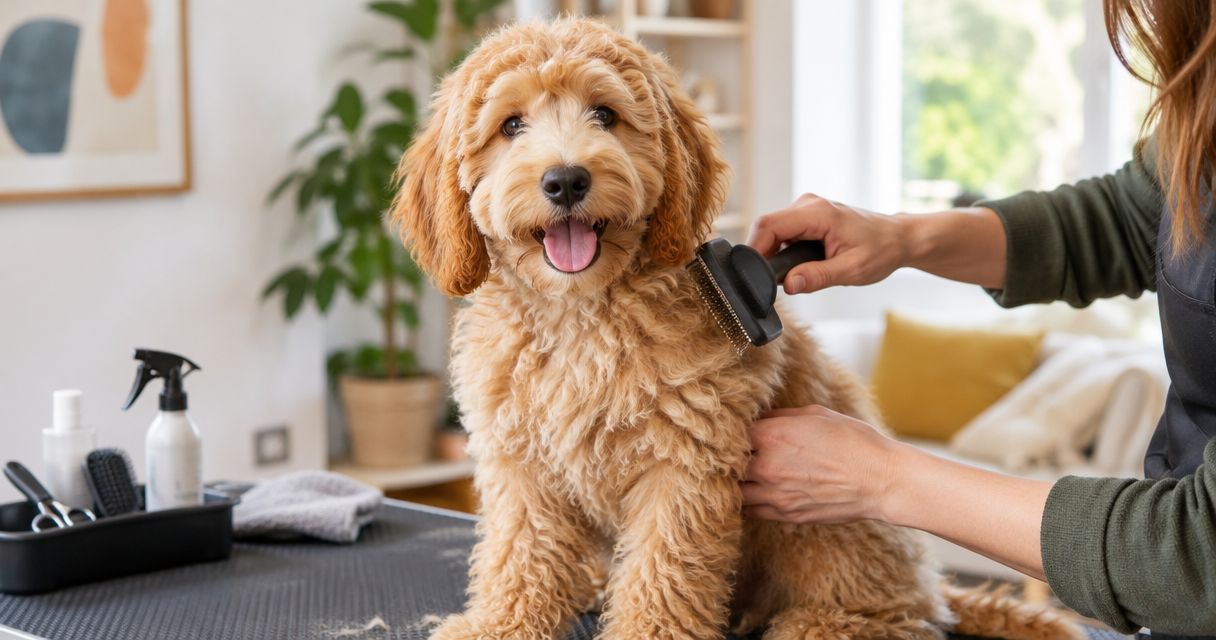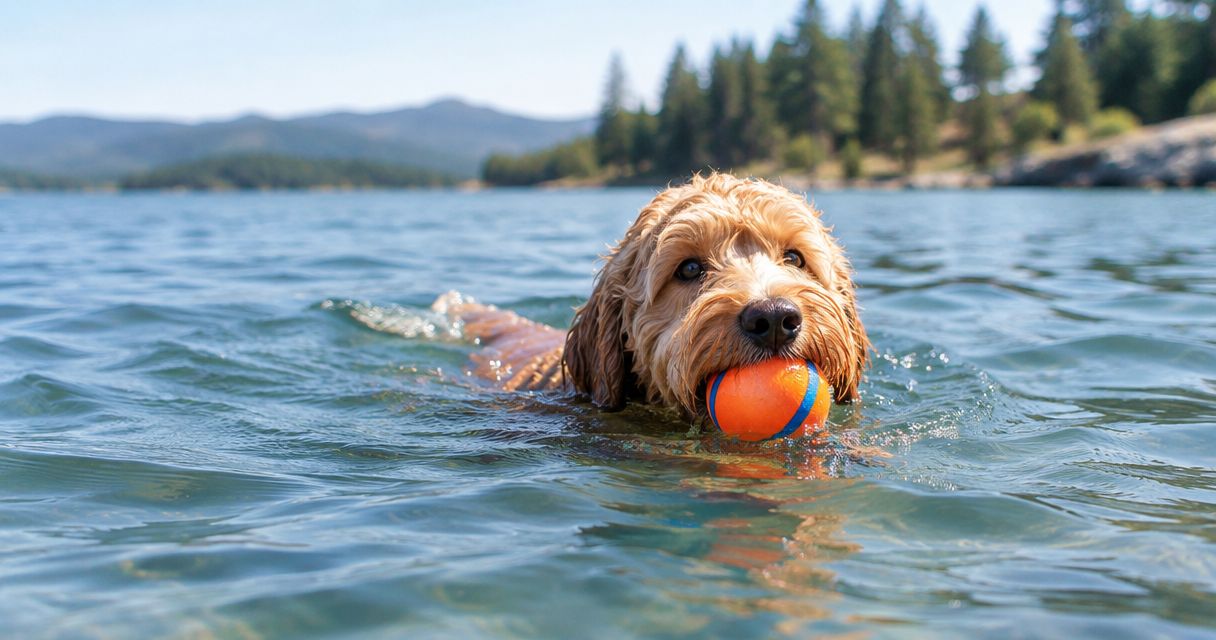
Yes, Goldendoodles can swim, but not every Goldendoodle enjoys water or knows how to swim safely without patient introductions. Their Golden Retriever and Poodle ancestry includes water-retrieving work, yet ancestry does not guarantee an individual puppy’s swimming ability. For your family’s 2026 water outings, start with calm, shallow water, a properly fitted dog life jacket and an adult close enough to help immediately.
- Can Goldendoodles swim? Yes, but Golden Retriever and Poodle ancestry does not guarantee swimming skill or enjoyment.
- Introduce water gradually, use a dog life jacket and teach your Goldendoodle how to leave the water.
- Goldendoodles of Miami supports puppy families; curriculum-based training does not replace supervised swimming lessons.
- Never force a frightened puppy into water or treat paddling as proof of safe swimming.
Can Goldendoodles swim?
Yes—Goldendoodles can learn to swim, but confidence, coordination and a reliable exit matter more than breed ancestry. We encourage puppy parents to treat swimming as a skill to teach, not a trait to assume.
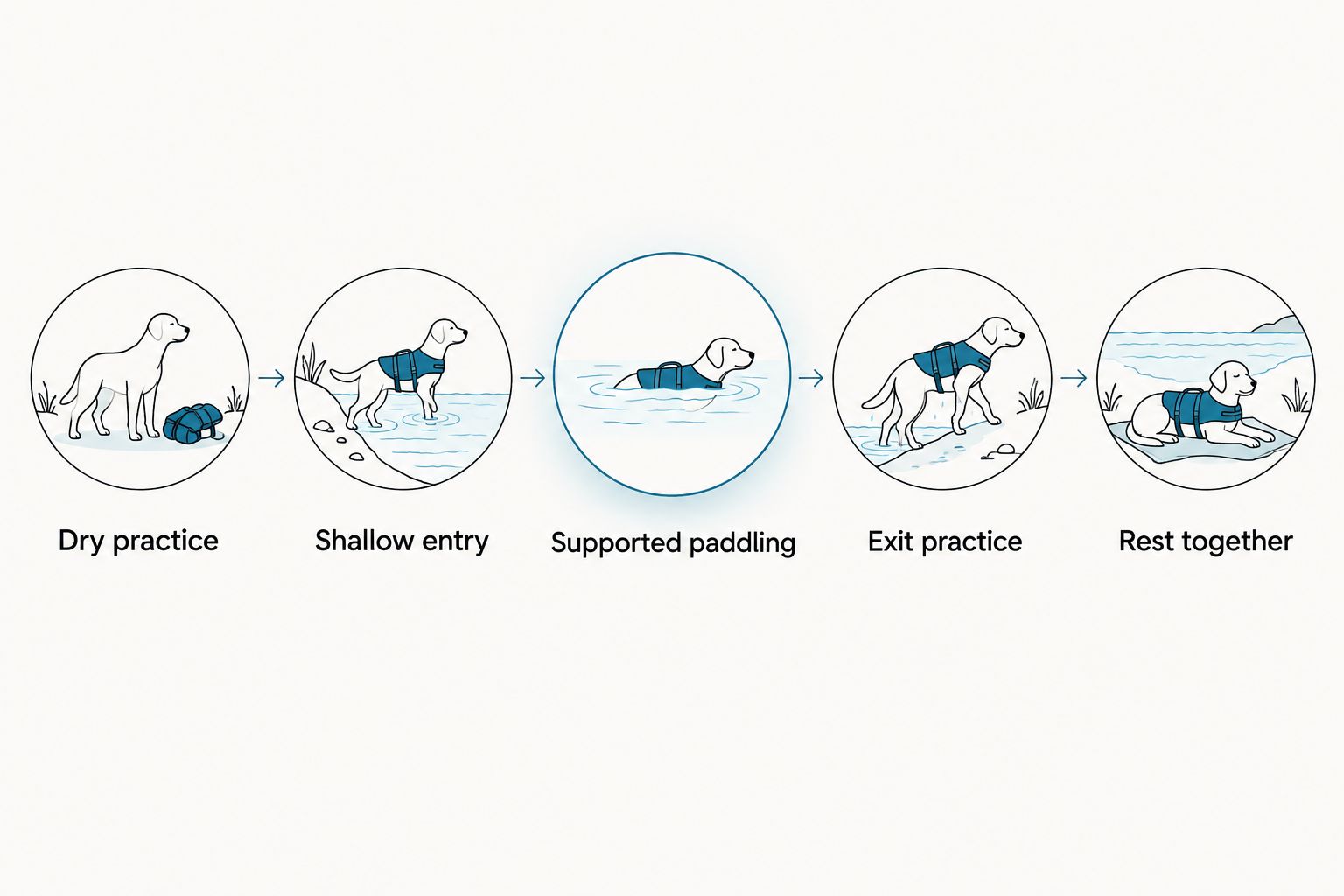
Use this sequence for your puppy’s introduction:
- Dry practice: Let your puppy become comfortable wearing a properly fitted dog life jacket away from water.
- Shallow entry: Choose a quiet, gradual entry where your puppy can stand comfortably.
- Supported paddling: Stay beside your puppy as they voluntarily move into deeper water, supporting them as needed.
- Exit practice: Guide your puppy back to the same easy exit before trying anything more challenging.
- Rest together: Leave the water while your puppy is still comfortable, then offer fresh drinking water and a quiet break.
For families researching a furever friend, Goldendoodles of Miami offers curriculum-raised puppies and lifetime family support. Water safety remains a separate responsibility throughout your dog’s life.
Why this matters for your family
A puppy paddling in water is not necessarily a puppy who can stay calm, turn around or find the pool steps. We want families to recognize those separate skills before planning a full swimming outing.
A dog can enjoy splashing without enjoying swimming. Comfortable wading is a valid outcome, and choosing dry-land play does not mean your dood has missed a developmental milestone.
For your 2026 family water-safety plan, decide who supervises the dog before anyone gets in. Give one adult that responsibility rather than assuming everyone is watching; phones, children and conversation can divide attention quickly.
Choose the setting before you teach the skill
An easy entrance is only half the setup. Your puppy also needs an exit they can reach without being lifted over a steep edge or scrambling on a slippery surface.
The following comparison describes places to consider, not a ranking of universally safe swimming spots. Conditions and local rules still determine whether you should enter.
| Setting | Best for | Helpful feature | Main limitation |
|---|---|---|---|
| Controlled pool with accessible steps | Practicing a repeatable exit | A consistent place to enter and leave | A puppy can become disoriented or miss the steps |
| Calm, shallow shoreline | Voluntary wading and gradual entry | Your puppy can approach at their own pace | Footing, water quality and depth can change |
| Beach with waves | Experienced dogs under suitable conditions | Space for shoreline activity where dogs are permitted | Waves, currents, saltwater and hot sand add hazards |
| Lake or canal | Only locations confirmed suitable for dogs | Some locations offer gradual shore access | Wildlife, water-quality advisories and hidden drop-offs require caution |
For a first introduction, favor a controlled setting with calm water and an obvious exit. We would not make waves, boat access or unfamiliar deep water part of a puppy’s first lesson.
In South Florida, freshwater outings also require attention to alligators and posted wildlife warnings. Do not use canals or unfamiliar ponds as convenient practice areas, and keep dogs away from water with visible scum or an algae advisory.
Why swimming ability varies between Goldendoodles
We look at the puppy in front of us, not a promise attached to a coat type or generation label. These factors help explain why two doods can respond differently to the same water introduction:
- Previous experiences: A frightening fall or forced entry can make water harder to approach calmly. Positive, voluntary exposure gives your puppy a different starting point.
- Confidence: Some puppies investigate unfamiliar surfaces readily; others need time at the edge. Neither response justifies pushing them in.
- Physical readiness: Health, mobility and stamina affect safe participation. Ask your veterinarian about swimming if your dog has a health concern or is recovering from an injury.
- Water conditions: Waves, current, slippery footing and sudden depth changes make swimming more demanding than quiet shallows.
- Exit knowledge: A dog that can paddle still needs to learn where and how to leave each unfamiliar swimming area.
- Handler behavior: Calm guidance and permission to retreat support learning. Pulling a reluctant puppy forward adds pressure rather than teaching an exit or a swimming stroke.
Curly coats and enthusiastic personalities are not swimming qualifications. Judge progress by relaxed behavior and successful exits, not by appearance.
How do we introduce a Goldendoodle puppy to water?
Start on dry ground with the equipment you plan to use. Check the life jacket’s fit according to its manufacturer’s instructions, including the straps and lifting handle; it should not slide around or restrict normal movement.
Next, let your puppy investigate a shallow edge without being pulled forward. Reward calm exploration from secure footing, and keep treats out of the water so your puppy is not encouraged to gulp while paddling.
When your puppy voluntarily moves beyond standing depth, stay beside them and provide support without pushing their head downward. Guide them toward the exit promptly. The goal is a calm return to safety, not distance.
Repeat only while your puppy remains willing and coordinated. Scrambling, repeated attempts to climb onto you, a low head position, coughing or frantic movement mean the session should stop; help your puppy out rather than waiting for them to settle in deep water.
For your 2026 puppy plan, separate water introductions from busy celebrations. A quiet practice session is easier to manage than a pool party with splashing children, floating toys and distracted adults.
What if your puppy refuses to enter?
Let your puppy stay dry. We would rather build trust at the water’s edge than turn a family activity into something your puppy fears.
You can return to life-jacket practice, calm observation or gentle play away from the edge. If water remains upsetting, a qualified reward-based trainer can help you work on confidence without forcing contact.
Can Goldendoodle puppies swim before their vaccinations are complete?
A Goldendoodle puppy’s swimming readiness is not determined by age alone. Ask your veterinarian which environments are appropriate while vaccinations are in progress, especially before visiting shared dog areas or natural water.
A private pool and a public shoreline have different exposure concerns, but neither removes the need for supervision and an accessible exit. Do not use a general swimming article as clearance for your particular puppy.
If your puppy is unwell, has irritated skin or ears, or has recently undergone a procedure, check with your veterinarian before swimming. Being eager to play does not settle a medical question.
Do Goldendoodles need life jackets if they can already swim?
A properly fitted dog life jacket adds support; it does not replace supervision. We recommend one for introductions and boat outings, and whenever conditions add uncertainty.
The benefit is additional buoyancy and, on suitable designs, a handle that helps an adult assist the dog. The limitation is equally important: a jacket cannot teach your dog to find the steps, avoid a current or stay away from unsafe water.
Practice wearing the jacket before the outing and recheck fit as your puppy grows. Do not substitute a walking harness for equipment designed to provide flotation.
Build a simple after-swim routine
Rinse your dog with fresh water after swimming to remove salt, pool chemicals or debris from the coat. Dry carefully, including the areas beneath the collar and harness, and check for tangles rather than leaving a wet coat unattended.
Follow your veterinarian’s guidance for ear care. Do not insert cotton swabs into the ear canal or use a homemade drying mixture simply because another dog owner recommends it.
Offer drinking water before and after the outing, and discourage drinking from pools or natural water. If your dog develops breathing difficulty, collapses or becomes markedly unwell after swimming, seek urgent veterinary care.
Swimming also does not cancel out Miami’s heat. Our guide to Goldendoodles in Miami’s heat and humidity helps you plan the rest of the outing, including time spent outside the water.
What our puppy preparation does—and does not—replace
Goldendoodles of Miami is best for families seeking curriculum-raised Goldendoodle puppies and lifetime family support. We offer health-tested parents, a two-year health guarantee and 30-day Trupanion coverage alongside our puppy-raising curriculum.
Those are meaningful parts of preparing for your furever friend, but they do not replace individual veterinary advice or hands-on water-safety teaching. A puppy raised with care still needs to learn your home’s boundaries, your pool’s exit and your family’s routines.
If you are planning life with a puppy in 2026, tell us about your pool, boating plans or beach outings during the puppy application process. We want families to think about daily care and safety, not just the picture of a dood beside the water.
Plan your puppy’s homecoming
Review the puppy application-to-pickup timeline before planning your family’s next step.
Resumen en español para las familias
Sí, los Goldendoodles pueden aprender a nadar, pero no todos disfrutan del agua ni saben salir de una piscina. Recomendamos comenzar en agua tranquila y poco profunda, usar un chaleco salvavidas para perros bien ajustado y mantener a un adulto cerca en todo momento.
En Goldendoodles of Miami, acompañamos a las familias durante la preparación para recibir a su cachorro. Para sus paseos de 2026, enseñen primero una salida fácil, nunca obliguen al cachorro a entrar y consulten al veterinario sobre su preparación individual.
FAQ
Can Goldendoodles swim naturally?
Goldendoodles can swim, but natural paddling does not guarantee safe swimming. Introduce water gradually and teach your dog to reach an accessible exit.
Do all Goldendoodles like water?
No, not all Goldendoodles like water. Some enjoy swimming, others prefer wading, and some are more comfortable staying dry; never force a reluctant dog into the water.
What age can my Goldendoodle puppy start swimming?
There is no universal starting age that establishes swimming readiness for every Goldendoodle puppy. Ask your veterinarian about your puppy’s health, vaccination status and the specific swimming environment.
Can my Goldendoodle swim in our backyard pool?
A Goldendoodle can swim in a backyard pool when conditions are suitable, supervision is close and the dog has learned an accessible exit. Secure the pool against unsupervised entry even after your dog learns to swim.
Should my Goldendoodle wear a life jacket?
A properly fitted dog life jacket is a sensible precaution for swimming introductions and boat outings. It provides additional support but cannot replace an adult’s supervision or exit training.
Is the beach a good place for my Goldendoodle’s first swim?
A beach with waves or currents is not a good first swimming lesson for a Goldendoodle. Start in calm, controlled water and check local dog-access rules and water conditions before any beach visit.
Should I rinse my Goldendoodle after swimming?
Yes, rinse your Goldendoodle with fresh water after swimming to remove salt, pool chemicals or debris. Dry the coat carefully and follow your veterinarian’s advice about ear care.
One last thing
Teach the way out before you celebrate the way in. A dog that happily jumps into a pool still needs to recognize the steps from different positions in the water.
Keep pool access secured between outings, even after your dood becomes confident. Swimming ability is a useful skill, not permission for unsupervised access.