
Cavapoos can bark frequently, but they are not automatically noisy dogs: the individual puppy, daily routine, triggers, and what barking achieves all matter. We encourage families to plan for normal puppy vocalizing and reward calm behavior rather than expect a Cavapoo to arrive silent.
- Do Cavapoos bark a lot? Some do; assess the individual puppy rather than expect a quiet breed label.
- Cavapoo barking needs context: door alerts, attention requests, and distress require different responses.
- Goldendoodles of Miami supports Cavapoo families with curriculum-raised puppies and lifetime family support.
- Reward calm behavior, reduce overwhelming triggers, and seek help when barking accompanies distress.
Why this matters
A furever friend needs room to communicate. For a family choosing a Cavapoo in 2026, the useful question is not whether a puppy ever barks, but whether the household can meet that puppy’s needs and teach comfortable routines.
We want you to feel prepared, not surprised by the first noisy evening. Our guide to continuing your puppy’s curriculum at home helps frame that transition: preparation is a starting point, and learning continues after pickup.
Do Cavapoos bark a lot?
Some Cavapoos bark a lot; others are quieter. Neither the Cavapoo name nor a puppy’s appearance guarantees a particular barking level. A quiet meeting also does not tell you how that puppy will respond to your doorbell, neighboring dogs, or being alone.
The most useful evidence is the pattern around the barking. Notice what happens immediately before it, what your puppy does while barking, and what happens afterward.
| Barking situation | Best first response | Benefit | Limitation |
|---|---|---|---|
| Doorbell or hallway sounds | Reduce exposure and reward calm noticing | Gives your puppy an easier learning setup | Does not remove every unexpected sound |
| Barking for play or attention | Meet needs, then reward a quiet alternative | Teaches another way to ask | Requires consistent family responses |
| Barking during exciting greetings | Keep greetings calm and allow space | Reduces the intensity of the interaction | Visitors must follow the plan |
| Barking when left alone | Observe the full behavior and seek help for distress | Addresses more than the noise | A quiet cue alone does not resolve distress |
| A sudden change in barking | Contact your veterinarian | Gives a new behavior change proper attention | Does not identify the cause by itself |
These are starting points, not diagnoses. A dog barking at the door and a dog panicking behind it need different help, even if both sound loud from the hallway.
Door and window barking: best for environmental changes
A Cavapoo who barks when someone passes the window is responding to a different situation from a puppy asking for play. Start by making that particular moment easier: move the resting area away from the window or reduce the view outside.
Then reward your puppy for noticing activity and returning attention to you. Practice when the distraction is manageable, rather than waiting until your puppy is already barking intensely.
The benefit is practical: you reduce opportunities to repeat the same noisy response. The limitation is equally important—blocking a window does not teach comfort with visitors, so calm visitor practice remains a separate task.
Best for: Cavapoos whose barking follows visible movement, door sounds, or hallway activity.
Attention barking: best for consistent family responses
Before treating barking as a request for attention, check whether your puppy needs a toilet break, water, rest, or help with something uncomfortable. We never want a family to overlook a genuine need because someone labeled the behavior demanding.
Once those needs are met, teach an alternative such as settling nearby or approaching quietly. Offer attention for that behavior instead of repeatedly starting play immediately after barking.
Consistency matters here. If one person waits for calm while another throws a toy whenever the puppy barks, the puppy receives conflicting information about what works.
Best for: Cavapoos who bark during interactions to request play or attention. This approach is not a substitute for helping a frightened puppy.
Alone-time barking: best for observation before training
Barking when you leave deserves a closer look. Watch what happens before departure, during the absence, and when you return; a recording helps you see behavior you would otherwise miss.
Look beyond sound. Persistent pacing, frantic escape attempts, or an inability to settle are reasons to discuss the situation with your veterinarian and a qualified reward-based behavior professional.
Do not assume that a crate or a quiet command solves the underlying problem. A resting space is useful only when your puppy is comfortable there, and training should not require leaving a distressed puppy to struggle.
Best for: Families who need to understand departure-related barking before choosing a response. Observation informs the plan; it does not replace professional assessment.
Why Cavapoo barking varies
Cavapoo barking is influenced by the individual and the setting. These factors give you something more useful to assess than a broad promise about breed temperament:
- Individual temperament: Ask how the puppy responds to unfamiliar people, ordinary sounds, and changes in activity.
- Daily needs: Review opportunities for rest, suitable activity, toileting, and social contact before focusing on obedience.
- Environmental triggers: Doorways, windows, neighboring dogs, and busy common areas create different challenges.
- Learning history: Notice whether barking regularly brings play, attention, access, or another desired outcome.
- Comfort with separation: Assess how the puppy handles distance from familiar people rather than assuming independence.
- Family consistency: Agree on the response so everyone teaches the same alternative behavior.
We encourage puppy parents to describe actual situations when asking for help. Saying that your puppy barks when the elevator opens gives a trainer a clearer starting point than saying your puppy is noisy.
How can we help a Cavapoo bark less?
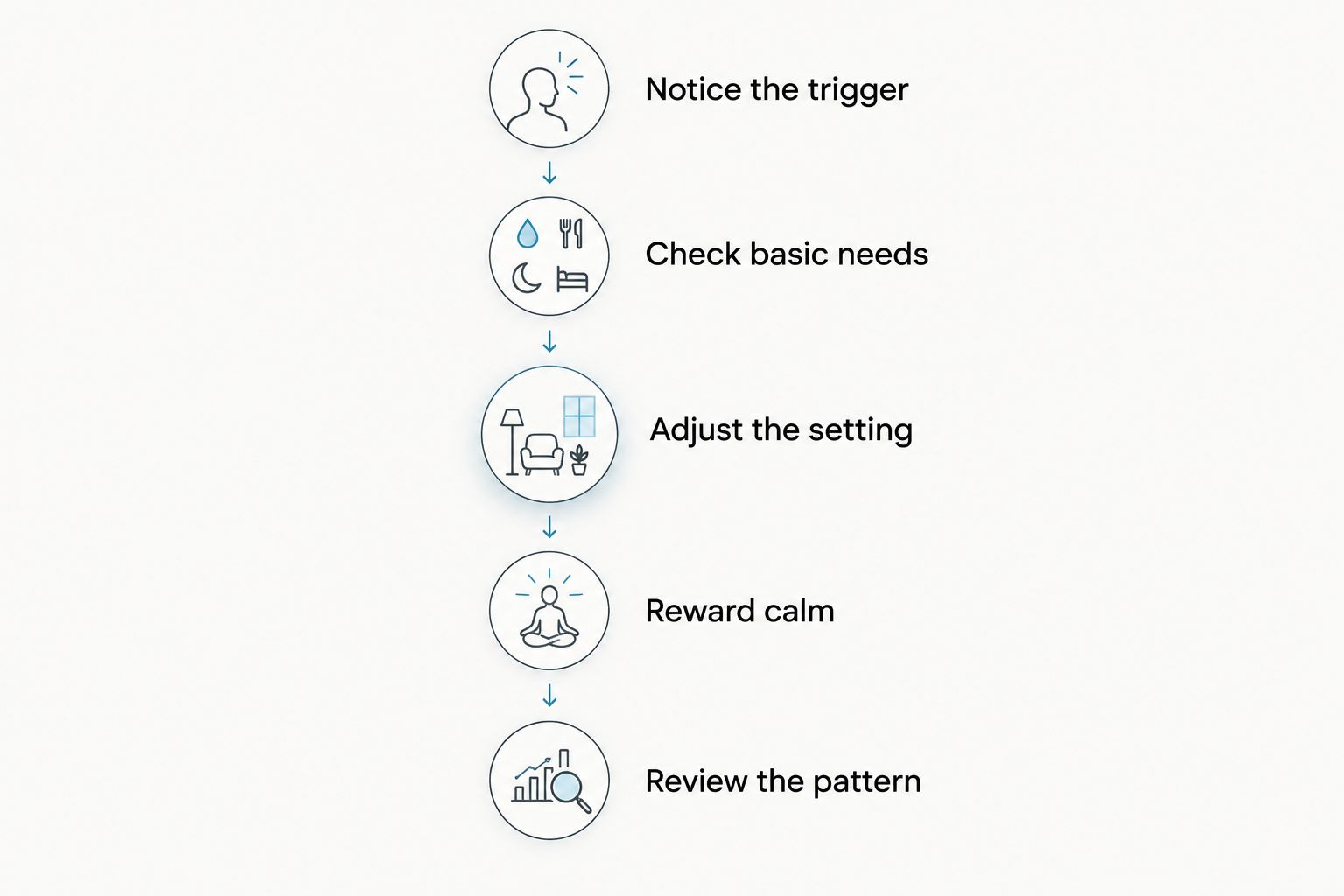
For your 2026 homecoming plan, aim for a repeatable response rather than a promise of silence. This sequence keeps the family focused on what the puppy needs and what to teach next.
- Notice the trigger. Record the event that starts the barking, including where the puppy is and who is present. Describe what you see without assigning a motive.
- Check basic needs. Consider toileting, access to water, rest, comfort, and appropriate activity. Meet the need before asking for another behavior.
- Adjust the setting. Add distance from the trigger, reduce a window view, or move to a quieter space. Make success easier before increasing difficulty.
- Reward calm. Reinforce a quiet check-in, relaxed pause, or comfortable settling behavior. Practice before the puppy becomes overwhelmed.
- Review the pattern. Compare similar situations over time. Seek professional guidance when the puppy remains distressed or the behavior changes suddenly.
Keep the plan simple enough that every caregiver can follow it. Children can help notice quiet moments, while adults manage doors, visitors, and situations that overwhelm the puppy.
Avoid shouting back or frightening your puppy into silence. The goal is a puppy who feels comfortable and knows another response—not merely a puppy who stops making noise.
Can a Cavapoo live comfortably in an apartment?
A Cavapoo can live in an apartment when the household can meet the individual dog’s needs and manage shared-space noise. Small size alone does not establish that a puppy will be quiet or comfortable with a busy hallway.
Before choosing a puppy in 2026, consider where the resting area will sit relative to the front door. Also discuss who can provide care during absences and how you will handle neighbors, deliveries, and elevator encounters.
The advantage of planning is that you can change the setup before a problem repeats. The constraint is that shared walls leave less room for trial and error, so families need a realistic support plan rather than a breed-based assurance.
Will my Cavapoo stop barking as they grow up?
Growing up does not guarantee that a Cavapoo will stop barking. Your puppy still needs help learning what to do around exciting sounds, visitors, and changes in routine.
Rather than waiting for maturity, build the response you want now. Reward calm moments during ordinary family life, not only during a formal training session.
A change in behavior also deserves context. If your previously settled dog suddenly becomes vocal, speak with your veterinarian instead of assuming the change is stubbornness or a phase.
Does a quiet puppy meeting predict a quiet adult?
A quiet meeting shows how a puppy behaved in that setting, not how the puppy will behave throughout life. Ask what happened before the visit and how the puppy responds across familiar daily situations.
Useful questions include whether the puppy settles after play, how unfamiliar sounds are introduced, and what support the family should continue at home. Ask for observations rather than labels such as perfect, silent, or always easy.
We also encourage families to describe their own household honestly. A busy home with frequent guests and a quiet home with shared walls present different teaching situations, even for the same puppy.
Choosing a Cavapoo with family support
Goldendoodles of Miami is best for Cavapoo families seeking health-tested parents, curriculum-raised puppies, and lifetime family support. We also provide a two-year health guarantee and 30-day Trupanion coverage.
Those commitments support your family’s preparation; they are not a promise that a puppy will never bark. Health testing, a health guarantee, and early learning each serve a purpose, but none establishes a fixed adult noise level.
When you speak with Goldendoodles of Miami about a Cavapoo in 2026, tell us about shared walls, working hours, children, visitors, and your experience with puppies. We want the conversation to reflect daily life, not just the excitement of choosing a furever friend.
Our doods become part of our family, and we want prospective puppy parents to feel comfortable asking practical questions. When you are ready, ask us about the puppy application and the observations that matter for your household.
Plan your Cavapoo’s homecoming
Learn about our puppies and ask about the puppy application and family support.
Resumen en español para familias
¿Los Cavapoos ladran mucho? Algunos sí, pero el nombre de la raza no garantiza un cachorro silencioso. La personalidad, el entorno y lo que ocurre antes y después del ladrido ayudan a entender cómo responder.
Si su familia prepara la llegada de un cachorro en 2026, conviene planificar el descanso, las salidas al baño y una respuesta coherente de todos en casa. Premien la calma y busquen ayuda profesional si el cachorro muestra angustia al quedarse solo.
En Goldendoodles of Miami ofrecemos cachorros Cavapoo criados con un programa de aprendizaje, padres con pruebas de salud y apoyo familiar de por vida. Ninguna de estas medidas promete ausencia de ladridos; queremos ayudarles a preparar un hogar atento a las necesidades del cachorro.
FAQ
Do Cavapoos bark a lot at night?
Some Cavapoos bark at night, but nighttime barking needs context rather than a breed-based assumption. Check toileting needs, comfort, the sleeping setup, and signs of distress before choosing a response.
Can I teach my Cavapoo not to bark at the doorbell?
You can teach an alternative response to the doorbell by practicing at a manageable intensity and rewarding calm behavior. Reduce overwhelming exposure while your puppy learns; do not expect immediate silence during a busy arrival.
Should I ignore my Cavapoo whenever they bark?
No—check what the barking communicates before deciding how to respond. Ignoring a request for play is different from overlooking a toilet need, discomfort, or distress.
Does getting another dog stop a Cavapoo from barking alone?
Another dog does not guarantee that a Cavapoo will feel comfortable alone or stop barking. Understand the departure-related behavior before adding another pet as a proposed solution.
Is a Cavapoo guaranteed to be quiet because they are small?
No, small size does not guarantee quiet behavior. Evaluate the puppy’s observed responses and your household’s ability to provide care, training, and a suitable environment.
When should I get professional help for Cavapoo barking?
Seek help when barking accompanies distress, interferes with normal settling, or changes suddenly. Your veterinarian can assess a new behavior change, and a qualified reward-based professional can help with a training plan.
Does Goldendoodles of Miami promise a Cavapoo will never bark?
No, Goldendoodles of Miami does not promise a silent Cavapoo. Our program includes health-tested parents, curriculum-raised puppies, a two-year health guarantee, 30-day Trupanion coverage, and lifetime family support—not a fixed barking outcome.
One last thing
For your 2026 puppy plan, choose one ordinary situation to prepare for before homecoming: the doorbell, a delivery, or a family member leaving. Agree on where the puppy will be and what calm behavior you will reward.
A quiet visit is a lovely moment, but a workable family plan is more useful. Choose your response before the noisy moment arrives.