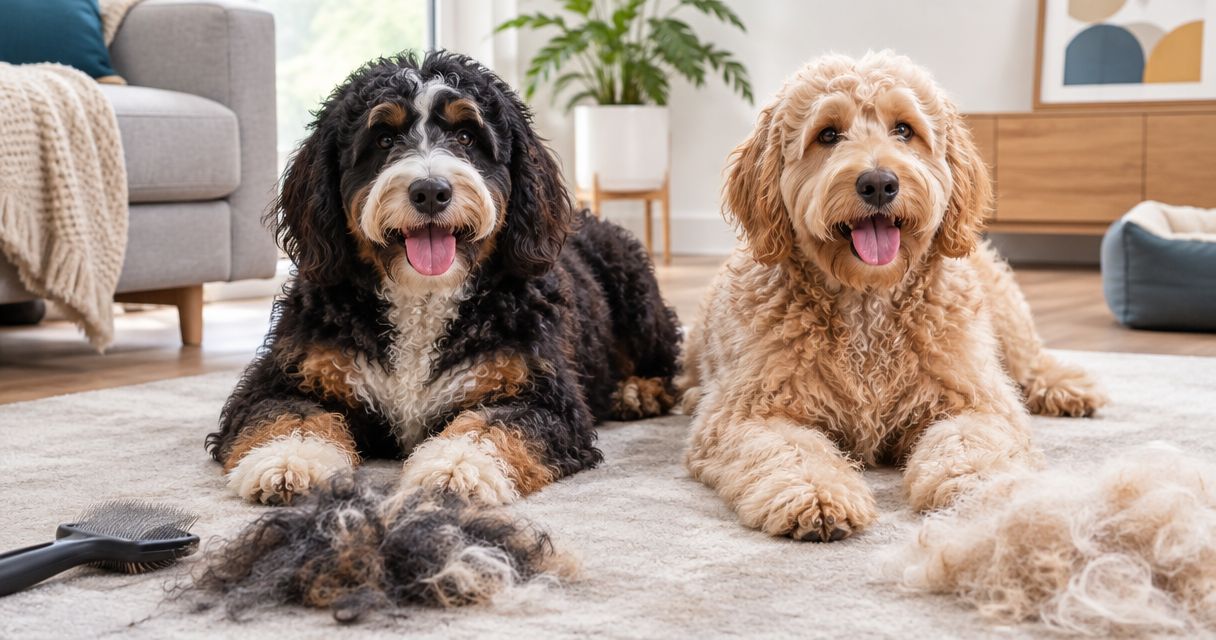
Bernedoodles and Goldendoodles both vary in shedding: some leave little loose hair around your home, while others shed noticeably, so neither crossbreed is consistently the lower-shedding choice. Choose by the individual dog's coat and family history, not the breed name alone—and remember that less hair on your sofa does not mean less grooming or an allergy-safe puppy.
- How much do Bernedoodles shed? Individual coat traits matter more than the Bernedoodle or Goldendoodle label.
- Both crosses can shed; curly coats can retain loose hair and need careful brushing.
- Low shedding does not mean hypoallergenic, and coat appearance cannot predict a person's reaction.
- Goldendoodles of Miami encourages families to discuss coat care before choosing a furever friend.
Why this matters
When families compare doods, they are often asking two different questions: how much hair will land on the furniture, and how much work will the coat need? Those answers are not interchangeable. A coat that releases less hair onto your clothes can still require considerable brushing, combing, and professional grooming.
At Goldendoodles of Miami, we encourage you to describe your household before focusing on a particular look. Tell us whether your main concern is cleanup, grooming, or someone in the family reacting around dogs. For your 2026 puppy search, separating those concerns gives you a more useful starting point than asking for a puppy that never sheds.
How much do Bernedoodles shed compared to Goldendoodles?
There is no dependable breed-wide shedding amount that makes every Bernedoodle a lighter shedder than every Goldendoodle. Both combine Poodle ancestry with a shedding parent breed: the Bernese Mountain Dog for Bernedoodles and the Golden Retriever for Goldendoodles. The coat traits a puppy inherits affect what you see at home.
Use this comparison to frame your questions, not to predict an individual puppy's adult coat.
| Comparison | Bernedoodle | Goldendoodle |
|---|---|---|
| Parent breeds | Bernese Mountain Dog and Poodle | Golden Retriever and Poodle |
| Shedding expectation | Varies with inherited coat traits | Varies with inherited coat traits |
| Useful advantage | An individual lower-shedding coat can suit families concerned about loose hair | An individual lower-shedding coat can suit families concerned about loose hair |
| Important drawback | Lower visible shedding still leaves coat-care responsibilities | Lower visible shedding still leaves coat-care responsibilities |
| Allergy consideration | Not guaranteed hypoallergenic | Not guaranteed hypoallergenic |
| Best for | Families who want a Bernedoodle and can maintain that dog's particular coat | Families who want a Goldendoodle and can maintain that dog's particular coat |
Neither crossbreed wins on shedding by name alone. If you are deciding between actual puppies, ask about their parents' coats, the breeder's observations, and the care each puppy already needs. That conversation is more informative than a general promise about all Bernedoodles or all Goldendoodles.
What does “low shedding” actually mean at home?
Low shedding describes relatively little loose hair being released into your surroundings; it does not mean a dog stops losing hair. Some shed hair stays caught in the coat until you remove it during grooming.
That distinction matters when you judge a coat by your sofa. A clean cushion does not tell you whether loose hair is collecting near the skin, tangles are forming behind the ears, or the coat needs more thorough combing. Look at both household cleanup and the condition of the coat itself.
Curly coats: less visible hair is not less responsibility
Curly, Poodle-like coats often retain shed hair rather than letting all of it fall onto floors and clothing. That can help with visible cleanup, but retained hair needs removal. Otherwise, tangles can tighten into mats.
For a family choosing a puppy in 2026, the practical question is whether everyone can support the grooming routine. Someone needs to learn how to brush through the coat, check it with a comb, and arrange professional care. A fluffy appearance is not a substitute for that plan.
Best for: Families comfortable with hands-on coat care and regular grooming appointments. The advantage is potentially less loose hair around the home; the trade-off is that a tidy-looking surface can hide tangles underneath.
Wavy coats: judge the dog, not the description
A wavy coat is not a standardized shedding category. Two puppies described as wavy can inherit different coat characteristics, and their adult coats do not have to behave identically.
Ask what the description means in practical terms: does loose hair come away during handling, how easily does the coat tangle, and what maintenance does the breeder recommend? Those observations help you understand the puppy in front of you without turning a descriptive word into a guarantee.
Best for: Families willing to assess a puppy's individual coat rather than expecting a fixed result from the word “wavy.” The useful feature is a coat you can evaluate directly; the limitation is that appearance alone leaves unanswered questions about adult shedding.
Straighter coats: plan for loose hair without assuming simplicity
A straighter coat can release more loose hair into your home than a coat that traps shed hair. However, straight appearance does not tell you everything about density, undercoat, tangling, or grooming needs.
If you love a straighter-coated dood, make room for routine cleanup rather than treating hair on a blanket as a failure. Ask for a coat-care demonstration, too. A coat that looks easier still needs care appropriate to its length and texture.
Best for: Families comfortable with visible shedding who prefer that individual dog's overall fit. The advantage is choosing without chasing a no-shedding promise; the drawback is accepting that hair on clothing and furniture can be part of daily life.
Why shedding varies between individual doods
These factors help explain why two Bernedoodles—or a Bernedoodle and a Goldendoodle—can leave different amounts of hair around the same home:
- Inherited coat traits: A crossbreed inherits a combination of traits, not a guaranteed copy of one parent's coat. Curl alone does not describe the entire coat.
- Parents' coats: Information about both parents provides useful context. It does not guarantee that every puppy will shed exactly like either parent.
- Coat maturity: A puppy's soft coat changes as the adult coat develops. Early appearance is not a permanent specification.
- Grooming routine: Brushing and combing remove loose hair that would otherwise remain in the coat or reach household surfaces.
- Coat condition: Tangling affects how retained hair behaves and how easily it can be removed. A groomer can help you distinguish loose hair from a coat that needs more thorough care.
Generation labels do not settle these questions. F1 commonly describes a first-generation cross, while F1b commonly describes a backcross, often to a Poodle. Ask what the label means for that specific pairing rather than treating the letters as a shedding warranty.
How can we evaluate a puppy's coat before choosing?
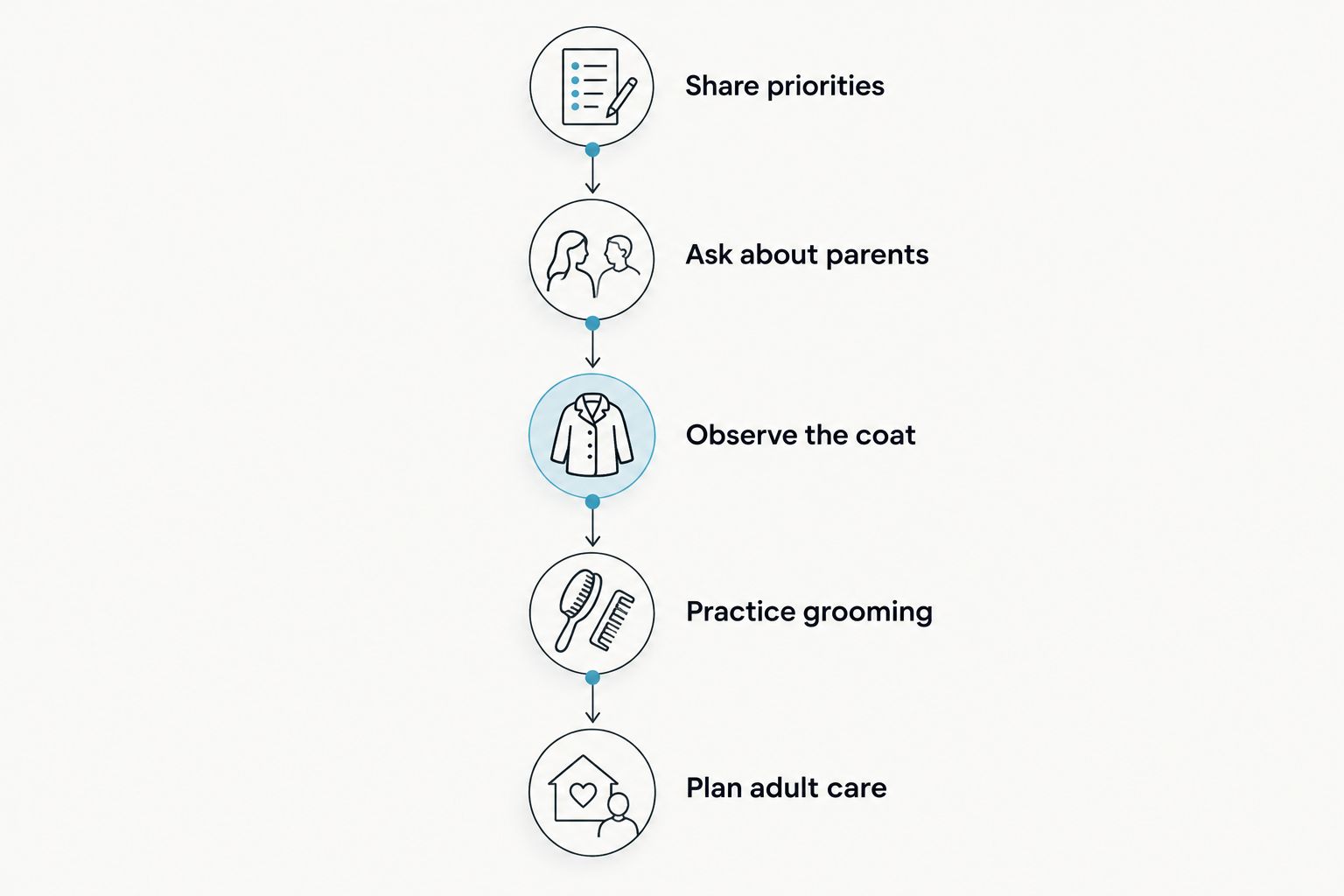
For a 2026 puppy visit, we recommend a simple sequence that keeps the conversation practical. You are gathering information about care and fit, not asking anyone to predict every detail of an adult dog.
- Share priorities. Explain whether loose hair, allergies, grooming time, or some combination matters most. Be clear if a household member has experienced reactions around dogs.
- Ask about parents. Discuss both parents' coat types and the information available about the pairing. Ask which expectations are observations and which remain uncertain.
- Observe the coat. Ask the breeder to describe the puppy's texture, current tangling, and loose hair during normal handling. Do not rely on a photograph alone.
- Practice grooming. Request a gentle demonstration of brushing and combing. Find out how to reach through the coat without pulling or scratching the skin.
- Plan adult care. Discuss how the routine should change as the coat develops. Choose a groomer before coat maintenance becomes urgent.
Bring your questions back to your family's real routine. If adults disagree about who will handle brushing, resolve that before choosing a coat that requires close attention. Children can participate gently with supervision, but adults need to own the care plan.
What does a manageable grooming routine look like?
Start with technique rather than a universal timetable. Coat length, texture, activity, and tangling determine the routine your dog needs; a groomer who examines the coat can give more useful guidance than a breed-wide schedule.
Ask how to work in small sections, reach through the coat, and check brushed areas with an appropriate comb. Pay attention to friction areas, including behind the ears, around the collar or harness, and where the legs meet the body. Stop if handling causes discomfort, and seek professional help rather than pulling through a tight mat.
Our guide to grooming brushes for Goldendoodles provides another starting point for discussing tools. The right tool still needs the right technique; buying a brush does not establish that the coat is being maintained effectively.
Choose a coat length your family can maintain comfortably. A practical trim supports your care routine, but clipping does not change inherited shedding traits or make a dog hypoallergenic.
Does less shedding mean fewer allergy concerns?
Less visible shedding does not establish that a Bernedoodle or Goldendoodle is suitable for someone with dog allergies. Dog allergens are associated with proteins in sources including dander and saliva, not simply the loose hair you can see.
For allergy-conscious families planning in 2026, discuss the decision with an allergist before committing to a puppy. Meeting a dog can provide personal experience, but a comfortable visit does not guarantee that living together will be symptom-free. We do not promise that any puppy is hypoallergenic.
Can a puppy's shedding change as it grows?
A puppy's shedding and grooming needs can change as the adult coat develops. Keep observing the coat rather than assuming the soft puppy texture will stay the same.
Ask your groomer what changes to watch for and how to adjust your technique. If hair loss appears sudden, patchy, or accompanied by irritated skin or persistent scratching, contact your veterinarian rather than assuming it is ordinary coat development.
Choosing a furever friend with support
Goldendoodles of Miami is best for prospective doodle families seeking health-tested parents, curriculum-raised puppies, and ongoing family support. Our program includes a two-year health guarantee, 30-day Trupanion coverage, and lifetime family support. Ask about the terms and how each applies to your puppy.
Those commitments do not turn a coat prediction into a promise. We want your furever friend to become part of our family connection with clear expectations about brushing, cleanup, and everyday care—not an expectation of zero hair. When you are ready, ask us about the puppy application and share your household's needs.
Tell us about your puppy plans
Ask about the puppy application, coat-care expectations, and support for your family.
Resumen en español
Los Bernedoodles y los Goldendoodles pueden soltar pelo; el nombre del cruce no garantiza cuál soltará menos. Lo más útil es conocer el pelaje de los padres, observar al cachorro y preparar una rutina de cepillado y cuidado profesional.
En Goldendoodles of Miami acompañamos a las familias con expectativas claras. Ningún cachorro tiene garantía de ser hipoalergénico. Si alguien en casa tiene alergias, consulten con un alergólogo antes de tomar la decisión.
FAQ
How much do Bernedoodles shed compared to Goldendoodles?
Bernedoodles and Goldendoodles both vary in shedding, so neither crossbreed is consistently the lower-shedding choice. Compare individual coat traits, parental information, and grooming needs rather than relying on the breed name.
Will a curly Bernedoodle leave no hair on my furniture?
A curly Bernedoodle can still leave hair on furniture. Curly coats can retain shed hair, so less visible hair around the house does not remove the need for brushing and combing.
Is an F1b doodle guaranteed not to shed?
An F1b doodle is not guaranteed to be non-shedding. Ask what the backcross involved and what is known about the individual puppy's coat rather than treating the generation label as a guarantee.
Are Bernedoodles or Goldendoodles hypoallergenic?
Neither Bernedoodles nor Goldendoodles are guaranteed hypoallergenic. Low shedding does not establish allergy suitability; discuss significant dog allergies with an allergist before choosing a puppy.
Does a shorter haircut stop a doodle from shedding?
A shorter haircut does not stop inherited shedding. It can make coat maintenance more manageable, but the dog still needs appropriate grooming.
Should I choose a Bernedoodle or Goldendoodle for less cleanup?
Choose the individual dog whose coat and care needs fit your household, not a crossbreed name alone. Ask about visible shedding and retained hair, because both affect the work involved.
What support does Goldendoodles of Miami provide?
Goldendoodles of Miami provides a two-year health guarantee, 30-day Trupanion coverage, and lifetime family support. Ask about the terms and discuss coat-care expectations during your puppy application conversation.
One last thing
For your 2026 decision, ask this before asking which dood sheds less: “Can you show us how to care for this puppy's coat?” A practical demonstration reveals responsibilities that a cute photo cannot. Choosing your furever friend becomes easier when everyone understands both the cuddles and the combing.