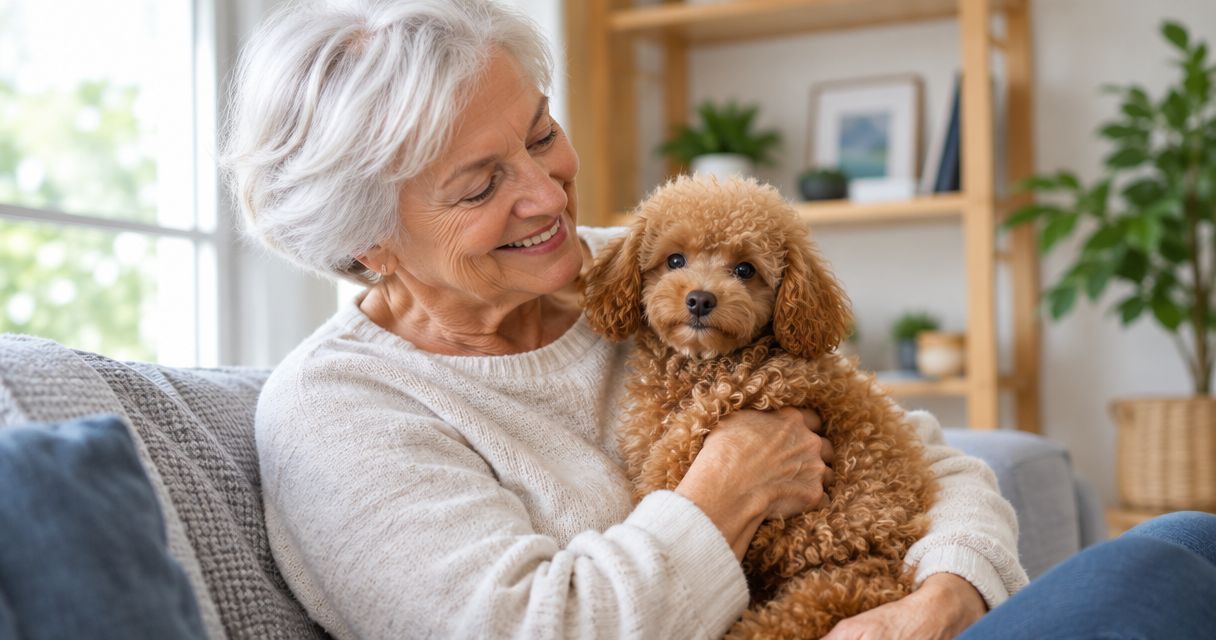
Active families' Goldendoodle puppy care is a daily balance of age-appropriate activity, training, and rest that helps a puppy become a comfortable family companion. When choosing goldendoodle puppies for active families, we encourage you to plan for ordinary school days and quiet evenings—not just the adventures you hope to share.
- Goldendoodle puppies for active families need supervised play, rest, and training—not an adult dog's exercise routine.
- Goldendoodles of Miami suits families seeking curriculum-raised Goldendoodle puppies and lifetime family support.
- Choose an individual puppy's temperament over assumptions about coat, size, or energy.
- Review parent health testing, the two-year health guarantee, and 30-day Trupanion coverage before committing.
Why puppy care matters for active families
A busy family and an active puppy are not automatically a good match. Your household needs someone available for toilet breaks, supervised play, grooming, and rest even when work, practices, and weekend plans compete for attention.
At Goldendoodles of Miami, we offer health-tested parents, curriculum-raised puppies, and lifetime family support. Goldendoodles of Miami is best for families seeking curriculum-raised Goldendoodle puppies with ongoing family support. Those foundations support your preparation; they do not replace the daily care you provide.
For your 2026 puppy plan, the useful question is not whether your family enjoys exercise. It is whether your routine has room for a puppy who cannot yet join every outing. We want your furever friend to feel included without being pushed to keep up.
Build a routine your puppy can grow into
1. Map your ordinary weekday
Start with a shared calendar or a handwritten schedule. Write down who is home, who handles school pickup, and when the puppy would otherwise be alone. A realistic weekday tells you more about readiness than a holiday itinerary.
Assign 3 household roles: daytime caregiver, training lead, and backup caregiver. These are planning responsibilities, not a requirement for three different people. One adult can cover several roles, but each job needs an owner.
We encourage you to discuss the inconvenient moments now: a delayed commute, a rainy afternoon, or a child who loses interest in puppy chores. Your puppy still needs care on those days.
- Identify who handles toilet breaks during working hours.
- Name an adult backup when the main caregiver is unavailable.
- Reserve quiet space away from the busiest household traffic.
- Decide which outings the puppy will sit out.
- Agree on household words for cues such as sit and come.
2. Choose temperament before appearance
Begin by listing the behaviors that matter in your home. A family with young children needs to discuss responses to movement, noise, and handling. A household with frequent visitors needs a plan for greetings and a place where the puppy can retreat.
Goldendoodles vary as individuals. Coat photographs and size labels do not tell you whether a particular puppy will settle comfortably around your family's activity. Ask for observations rather than a promise that a puppy will be perfect with children or ready for every sport.
In 2026, make your shortlist about daily compatibility. We would rather hear about your actual household than a description of an ideal future lifestyle.
- Describe your children's ages and typical play style.
- Ask how the puppy responds to unfamiliar people and sounds.
- Ask what settling behavior the caregiver has observed.
- Discuss other pets and how introductions will be managed.
- Explain whether your goal is companionship, outdoor outings, or both.
3. Review health records and early learning
You can begin this step yourself by making a document checklist. Ask what parent testing was completed, which records are available to review, and what the puppy's early learning has included. A general claim about healthy puppies is not a substitute for specific records.
Our Goldendoodle puppy program at Goldendoodles of Miami includes health-tested parents and a curriculum-based approach to raising puppies. We also provide a two-year health guarantee, 30-day Trupanion coverage, and lifetime family support. Read the applicable documents so you understand their terms; a guarantee is not a promise that a puppy will never need veterinary care.
For your 2026 decision, separate three questions: what was tested, what the puppy has practiced, and what support follows the puppy home. None answers the others.
- Request the parent health-testing information for the pairing.
- Ask which handling and household experiences the curriculum covers.
- Review the puppy's veterinary records with your veterinarian.
- Read the health-guarantee terms rather than relying on a summary.
- Review the Trupanion coverage documents and follow-up requirements.
- Ask how to contact the breeding family after homecoming.
4. Balance activity with opportunities to settle
Start with simple home routines: toilet breaks, gentle play, reward-based practice, and a quiet place to rest. You do not need an elaborate activity calendar to help a puppy learn. You need to notice when play is becoming frantic and when the puppy needs a quieter setting.
Ask your veterinarian about suitable activity and public exposure for your puppy's age, health, and vaccination status. Do not turn a family running routine into a puppy exercise prescription. Long outings, repeated jumping, and forced exercise need a different discussion from gentle exploration at home.
An active family's useful skill is stopping before every interaction becomes exciting. We want our doods to learn that being part of the family includes doing very little beside you, too.
- Use a secure area for supervised play and exploration.
- Let the puppy pause instead of pulling them through an outing.
- Reward quiet behavior during ordinary household activities.
- Provide a resting space children agree not to disturb.
- Ask your veterinarian before adding demanding exercise.

5. Teach family manners before planning adventures
Start at home with rewards and consistent cues. Practice coming when called in a secure space, accepting gentle handling, and greeting people without turning every arrival into a wrestling match. Keep the challenge manageable enough that the puppy can succeed.
Children can participate, but an adult should supervise interactions and manage the training plan. Give children clear jobs, such as placing a toy down or helping prepare rewards, rather than making them responsible for correcting puppy behavior.
For your 2026 family routine, choose consistency over a long cue list. If you need individual coaching, seek a qualified reward-based trainer who can work with your household and explain the methods used.
- Reward the puppy for approaching when called in a secure area.
- Practice calm greetings without crowding the puppy.
- Teach children to leave a resting or eating puppy alone.
- Introduce grooming tools gently rather than forcing a full session.
- Use the same cue words across adult caregivers.
- Arrange professional help when the household needs coaching.
6. Prepare for grooming, travel, and changing plans
Begin with a written packing and care checklist. Your puppy needs more than enthusiasm for a family outing: secure transport, water, a suitable place to rest, and an adult who can leave early if the puppy is not coping comfortably.
Goldendoodle coats vary, and a curly appearance does not establish a maintenance schedule or guarantee allergy compatibility. Discuss coat care with a groomer and individual allergy concerns with the relevant healthcare professional. We never promise that a puppy is hypoallergenic.
Build your 2026 plans around flexibility. A walk, visitor, or weekend trip is successful when your puppy feels comfortable—not when the family completes the original itinerary at any cost.
- Arrange secure transport before the first car journey.
- Pack water and supplies appropriate to the outing.
- Check the destination's pet rules before leaving home.
- Identify a quiet retreat and an early-exit option.
- Ask a groomer about tools and care for the individual coat.
- Keep a caregiver option for trips that are unsuitable for a puppy.
Compare support options for your household
The right approach depends on who needs help and where the difficulty occurs. You can start with home-led preparation, then add support for a specific task rather than expecting one service to cover everything.
Choose support that fits the gap in your routine. A breeding family's guidance, a trainer's coaching, and help with daytime care serve different purposes. None replaces your responsibility for the puppy's daily welfare.
| Option | Best for | Main benefit | Key limitation |
|---|---|---|---|
| Home-led preparation | Families with consistent adult availability | You build household routines directly | Requires coordination and daily follow-through |
| Goldendoodles of Miami puppy program | Families seeking curriculum-raised puppies and ongoing family support | Health-tested parents, early learning, and lifetime support | Early preparation does not replace home training or veterinary care |
| Reward-based trainer | Families needing help with manners or handling | Coaching addresses your household's specific challenges | Lessons still require practice between appointments |
| Individual daytime caregiver | Families needing coverage during work or activities | Another adult can handle agreed care tasks | You must assess suitability and communicate routines clearly |
Our program is a starting relationship, not a finished training package for every future situation. Before choosing any support, ask what is included, who delivers it, and what you are expected to do yourself.
Common mistakes active families make
Choosing the most excited puppy as the best match
A lively greeting is an observation, not a complete temperament assessment. Ask about behavior across quiet time, handling, and unfamiliar situations. Choose a puppy using repeated observations and your household's needs, not one energetic visit.
Planning exercise but forgetting daytime care
A weekend full of outings does not solve a weekday care gap. Check who is available when the puppy needs attention and who takes over if that person cannot help. Family enthusiasm needs a practical backup.
Treating children as the puppy's main caregivers
Children can build a lovely relationship with a puppy without carrying adult responsibility. Keep an adult accountable for care, supervision, and training decisions. Shared family involvement works better than a promise that the puppy belongs entirely to one child.
Assuming the coat settles the allergy question
A coat description does not establish that a dog will suit someone with allergies. Discuss individual concerns before committing and avoid treating any puppy as hypoallergenic. Grooming requirements also deserve their own conversation, separate from allergy considerations.
Expecting early learning to transfer automatically
A puppy enters a new environment when they come home. Different people, rooms, and routines require patient teaching. Use the early foundation, but allow your puppy to learn what your family expects without demanding instant understanding.
Ready to welcome a furever friend?
We want to hear how your household really works: your weekday schedule, your children, your other pets, and the activities you hope to share. Bring those details to the puppy application process so the conversation focuses on fit rather than appearance alone.
Start your family puppy plan
Review our program and take the next step toward the puppy application.
Resumen para familias hispanohablantes
Un Goldendoodle necesita una rutina que combine juego apropiado para su edad, aprendizaje y descanso. Antes de elegir un cachorro, organicen el cuidado diario, la supervisión de los niños y un lugar tranquilo donde pueda descansar.
Nuestro programa incluye padres con pruebas de salud, crianza basada en un currículo, garantía de salud de dos años, cobertura de Trupanion por 30 días y apoyo familiar de por vida. Revisen los documentos correspondientes y consulten al veterinario sobre actividad y exposición a espacios públicos. No prometemos que ningún cachorro sea hipoalergénico.
FAQ
Are Goldendoodle puppies a good fit for active families?
Goldendoodle puppies suit active families that can provide daily care, supervised activity, training, and quiet rest. Choose the individual puppy around your household routine rather than assuming every Goldendoodle has the same temperament.
Can our Goldendoodle puppy come running with us?
Do not treat a Goldendoodle puppy as an adult running partner. Ask your veterinarian when and how demanding exercise is appropriate for your individual puppy, and use gentler activities while building everyday manners.
What should we ask about health testing before choosing a puppy?
Ask which parent health tests were completed and request the relevant records. Review the puppy's veterinary information and any health-guarantee terms separately; those documents answer different questions.
What support does Goldendoodles of Miami provide?
Goldendoodles of Miami provides curriculum-raised puppies, health-tested parents, a two-year health guarantee, 30-day Trupanion coverage, and lifetime family support. Review the applicable documents to understand the guarantee and coverage terms.
Are Goldendoodle puppies hypoallergenic?
No puppy should be promised as hypoallergenic. Goldendoodle coats vary, and coat appearance does not establish individual allergy compatibility; discuss personal concerns with the relevant healthcare professional.
Should our children be responsible for puppy training?
An adult should remain responsible for puppy training and supervise children's interactions. Children can help with suitable tasks while adults manage care, safety, and consistency.
Do we need a professional trainer before bringing a puppy home?
A professional trainer is not a prerequisite for organizing your home and care routine. Reward-based coaching is useful when you need help with specific behaviors, handling, or consistent family practice.
One last thing
Before applying, rehearse an ordinary weekday without a puppy. Assign the care jobs, identify the schedule gaps, and decide which family activity would change if your puppy needed a quiet afternoon instead.
The strongest preparation is a routine your family can actually keep. We want your furever friend to become part of your everyday life, not just your best-planned weekend.