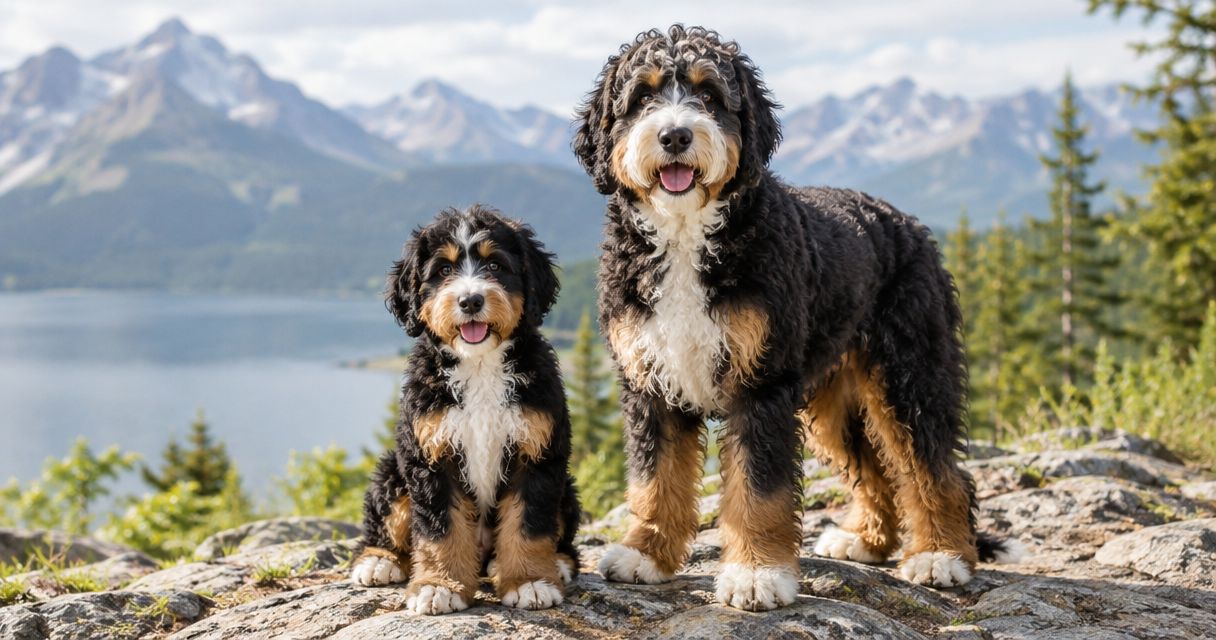
Fully grown Bernedoodles can weigh 10–90 pounds and stand 10–29 inches at the shoulder, according to PetMD’s Bernedoodle breed guide. That broad range covers very different dogs, so a size label alone does not tell you how big a particular puppy will become. For families planning in 2026, the useful estimate comes from the puppy’s parents, adult relatives, and growth history—not a promise of an exact adult weight.
- How big do Bernedoodles get? PetMD lists an overall adult range of 10–90 pounds and 10–29 inches tall.
- Toy, miniature, and standard Bernedoodle labels are starting points, not guaranteed adult measurements.
- Ask for both parents’ adult measurements and information about grown puppies from the same pairing.
- Goldendoodles of Miami offers Bernedoodle families health-tested parents, curriculum-raised puppies, and lifetime family support.
Why this matters
Your furever friend’s adult size affects more than where the dog sleeps. It changes what you can comfortably lift, how you arrange car travel, and whether your housing rules fit the dog you bring home.
At Goldendoodles of Miami, we encourage families to discuss those everyday limits before choosing a puppy. A dood who fits your life as an adult is a better match than a puppy chosen only for a small, cuddly appearance.
Choose for the adult dog you can care for, not just the puppy you can carry today.
How big do Bernedoodles get when fully grown?
PetMD’s Bernedoodle breed guide gives an overall adult size of 10–90 pounds and 10–29 inches tall. These are category-wide figures, not a prediction for every litter. Shoulder height means the distance from the floor to the withers—the highest point of the shoulders—not the top of the head.
Bernedoodles combine Bernese Mountain Dog and Poodle ancestry. Because Poodles come in different sizes, and mixed-breed offspring inherit different combinations of traits, Bernedoodles do not share one fixed adult size.
Use this comparison to understand the labels you will encounter during a 2026 puppy search:
| Size label | What the label suggests | Best for | Main limitation |
|---|---|---|---|
| Toy or tiny Bernedoodle | A smaller intended adult size | Families prioritizing easier lifting and smaller equipment | The label alone does not establish an adult weight or height |
| Miniature Bernedoodle | A smaller intended size than a standard Bernedoodle | Families seeking a smaller companion while allowing room for variation | “Mini” does not mean the same measurements in every breeding program |
| Standard Bernedoodle | A larger intended adult size | Families prepared to handle and accommodate a larger dog | Adult size affects lifting, transport, and equipment needs |
These are planning categories, not interchangeable promises. Ask what a breeder means by the label and what evidence supports the estimate for that particular puppy.
Toy or tiny Bernedoodles: ask what “small” means
A toy or tiny label expresses an intended smaller size; it is not a universal Bernedoodle breed standard. Before making a decision, ask for the expected adult weight range in writing and the reasoning behind it.
The practical advantage of a smaller dog is easier physical handling. The limitation is that a small label can create more certainty than the underlying information supports.
Best for: families whose daily routine favors a smaller companion and who can accommodate some size variation. If you have a firm housing weight limit, explain it before discussing individual puppies.
Do not use a puppy’s current ability to fit in a carrier as proof of adult travel suitability. Carrier dimensions, the dog’s eventual body measurements, and the carrier’s own requirements all matter.
Miniature Bernedoodles: look beyond the name
A miniature Bernedoodle is intended to be smaller than a standard Bernedoodle, but the word “miniature” does not supply a dependable adult measurement on its own. Parent size and information about adult relatives make the estimate more useful.
The appeal is a smaller intended footprint without choosing solely by appearance. The trade-off is uncertainty: a family should not assume every miniature Bernedoodle will remain below a particular housing limit.
Best for: families seeking a smaller Bernedoodle who have flexibility about the final adult size. Ask whether the estimate refers to weight, shoulder height, or both.
Weight and height answer different questions. Weight matters when you need to lift your dog; height and body length matter when checking a crate, doorway setup, or travel arrangement.
Standard Bernedoodles: plan for a larger adult
A standard Bernedoodle is the larger intended size category. Rather than choosing equipment around a puppy’s current body, plan your home and transport around the adult estimate provided for the litter.
A larger companion can suit a family that enjoys having a substantial dog beside them. The limitation is practical: getting a dog into a vehicle, managing a leash, or helping during an illness takes a different level of physical preparation.
Best for: families comfortable accommodating and handling a larger adult dog. Size alone does not establish temperament, gentleness, or suitability for children.
For households with young children, our guide to Bernedoodle puppies for families with kids covers the family-fit questions that belong alongside adult size. A smaller dog still needs supervision, and a larger dog still needs patient training.
Why Bernedoodle size varies
Bernedoodle size estimates become more useful when you understand what sits behind them. These factors explain why two puppies with the same size label do not necessarily become matching adults:
- Poodle ancestry: Poodles have different size varieties, so the Poodle background matters when discussing expected adult size.
- Both parents’ measurements: Ask about the dam and sire, rather than relying on the smaller parent’s weight alone.
- Inherited variation: Puppies in the same litter inherit different combinations of traits and need not finish at the same size.
- Adult family history: Grown offspring from the same pairing provide more relevant context than unrelated dogs with the same label.
- Age and growth history: A weight measurement without the puppy’s age gives an incomplete picture. Repeated measurements show the individual puppy’s development.
Coat appearance is not a substitute for these details. A fluffy puppy can look larger than a less fluffy puppy without having a larger frame.
For your 2026 shortlist, keep the same questions beside every puppy you consider. Consistent questions make the answers easier to compare and prevent a reassuring label from replacing useful information.
How can you estimate a Bernedoodle puppy’s adult size?
Start with family information, then follow the individual puppy’s growth with your veterinarian. No single photograph, paw measurement, or online calculator establishes an exact adult weight.
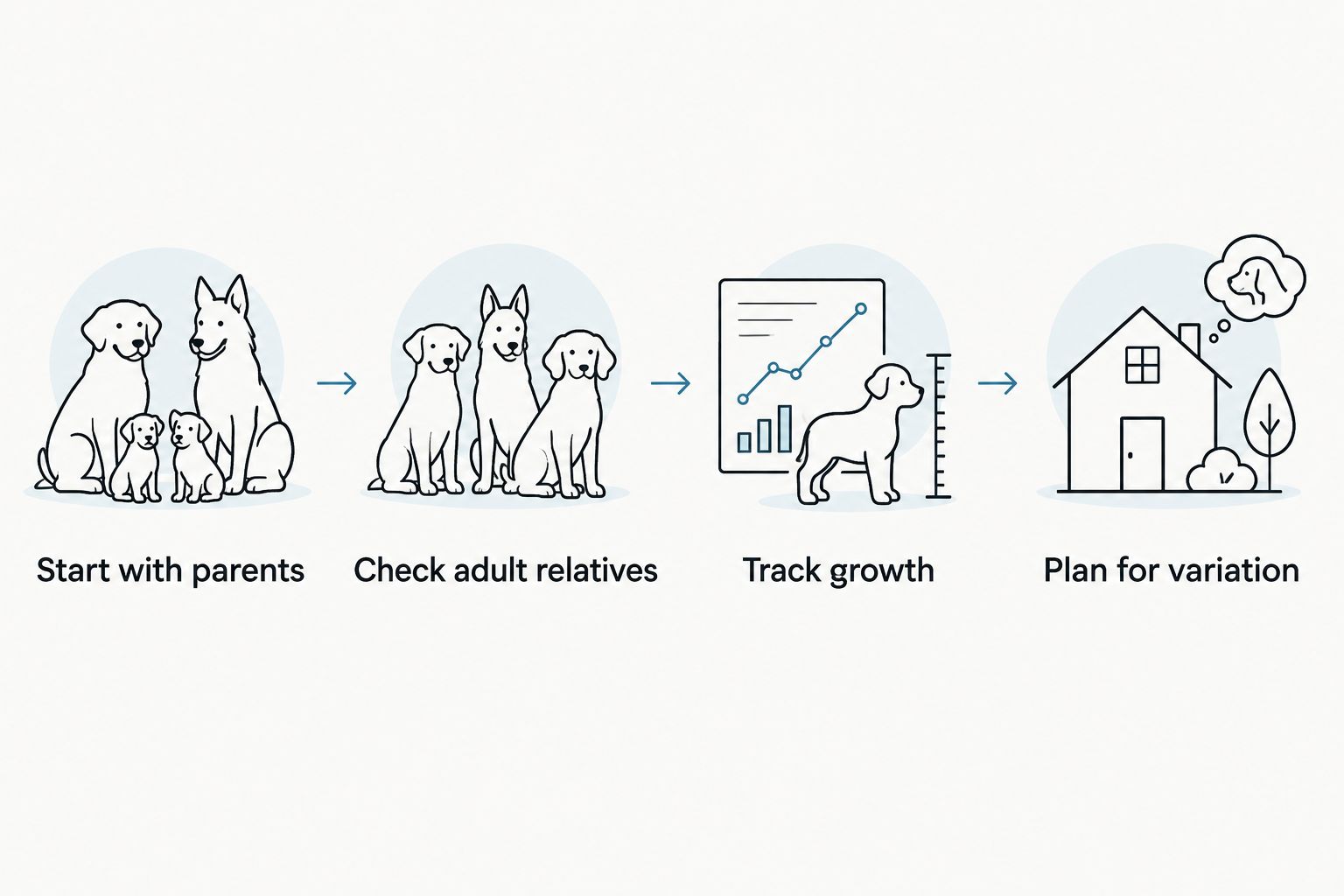
Start with parents
Ask for both parents’ adult weights and shoulder heights. Confirm that the figures describe mature dogs rather than measurements taken while the parents were still growing.
Then ask how those measurements inform the puppy’s estimate. Averaging the parents’ weights is not a guarantee of the puppy’s final weight.
Check adult relatives
Ask whether there are grown puppies from the same pairing and what their adult measurements are. If there are, request the range rather than only the smallest example.
Adult relatives provide context, not certainty. The goal is an informed expectation that leaves room for an individual puppy to develop differently.
Track growth
Record your puppy’s weight and the date of each measurement, and bring that history to veterinary appointments. Let your veterinarian interpret growth alongside body condition rather than chasing a target number from a chart.
A growing puppy’s needs are not a reason to restrict food to preserve a smaller size. Follow veterinary guidance on feeding and development.
Plan for variation
Prepare for the larger end of the puppy’s estimated adult range when checking housing rules, handling needs, and travel arrangements. If that size would not work for your family, resolve the mismatch before committing.
A little flexibility in expectations is helpful. Flexibility about a binding housing rule is not something to assume.
What should you check before choosing a size?
For a 2026 home-preparation plan, turn “small enough” or “big enough” into specific household requirements. Walk through an ordinary day and identify where adult size matters.
- Housing: Read the actual pet policy, including any weight restrictions. Do not substitute a verbal impression for written requirements.
- Lifting: Consider stairs, car entry, bathing, and situations when your dog needs help moving.
- Transport: Check usable space and the requirements of the travel equipment or service you intend to use.
- Resting space: Plan a comfortable place for the adult dog to stand, turn, and lie down naturally.
- Family handling: Decide which adult will manage walks, training, grooming, and lifting when needed.
A smaller Bernedoodle does not automatically need less attention or training. A larger Bernedoodle does not automatically need a large yard to replace daily engagement.
The better question is whether your family can meet the individual dog’s needs in your actual home. Size is one part of that decision—not the whole personality of your future friend.
What does our family help you consider?
Goldendoodles of Miami is best for families seeking a Bernedoodle program with health-tested parents and lifetime family support. We raise puppies with a curriculum-based approach and offer a two-year health guarantee and 30-day Trupanion coverage.
Those commitments support your puppy-parent journey; they are not promises of an exact adult size. We want the size conversation to happen alongside questions about your home, family routine, and expectations.
As you prepare your 2026 puppy application, tell us about any firm weight restrictions, lifting concerns, children, or travel plans. Your search for a furever friend should leave room for honest questions—not pressure to make a puppy fit a life that cannot accommodate the adult dog.
Tell us about your family
Begin the puppy application conversation with your home, routine, and adult-size needs in mind.
FAQ
How big do Bernedoodles get when fully grown?
Bernedoodles span an overall adult range of 10–90 pounds and 10–29 inches at the shoulder, according to PetMD’s breed guide. A particular puppy’s expected size depends on its family background and individual development.
How big does a mini Bernedoodle get?
A mini Bernedoodle does not have one universally standardized adult size. Ask for the puppy’s expected adult range, both parents’ mature measurements, and information about adult relatives.
When is a Bernedoodle fully grown?
There is no single birthday that establishes every Bernedoodle as fully grown. Ask your veterinarian to assess your dog’s development using its growth history, frame, and body condition.
Can a breeder guarantee my Bernedoodle’s exact adult weight?
An adult-weight estimate is not an exact-weight guarantee. Ask what information supports the estimate and plan for variation rather than treating one number as certain.
Does a Bernedoodle’s paw size tell me how big it will get?
Paw size alone does not establish a Bernedoodle’s adult weight or height. Parent measurements, adult relatives, and the puppy’s recorded growth provide more useful context.
Is a smaller Bernedoodle better for a family with children?
A smaller Bernedoodle is not automatically a better match for children. Consider the individual dog’s behavior, supervision, training needs, and the adults’ ability to manage everyday care.
Does Goldendoodles of Miami offer support after pickup?
Goldendoodles of Miami offers lifetime family support, a two-year health guarantee, and 30-day Trupanion coverage. Ask about the applicable terms and how each fits into your puppy’s transition home.
One last thing
The most useful size question is not “What is the smallest this puppy might be?” It is “Would our family still be comfortable if this puppy reaches the larger end of the estimate?”
Ask that before choosing your dood. For your 2026 decision, a realistic adult-size plan is a kinder starting point than hoping your puppy stays small.