Standard Goldendoodles typically reach 50–90 pounds and 20–26 inches tall at the shoulder when fully grown, according to PetMD’s Goldendoodle breed guide. That is a planning range, not a promised adult size: parent size, inherited build, and your puppy’s individual growth all matter. For families planning in 2026, we recommend preparing for a large adult dog rather than choosing supplies around a puppy’s current size.
- How big do Standard Goldendoodles get? Typically 50–90 pounds and 20–26 inches tall at the shoulder.
- Parent measurements help estimate adult size; a puppy’s current weight cannot guarantee the final result.
- Goldendoodles of Miami suits families seeking curriculum-raised Goldendoodle puppies and lifetime family support.
- Choose your furever friend for adult-size compatibility, not just an adorable puppy photo.
Why this matters
A little dood with oversized paws is easy to picture on your lap. The grown-up dog needs room to turn in a crate, ride comfortably in your vehicle, and move safely around children or older relatives. Plan for the adult dog you will live with, not only the puppy you bring home.
At Goldendoodles of Miami, we want size questions answered before a family commits. Loving a larger dog is wonderful; discovering that your building’s pet rules or your ability to handle that dog do not fit is avoidable.
How big do Standard Goldendoodles get when fully grown?
A typical adult Standard Goldendoodle weighs 50–90 pounds and stands 20–26 inches at the shoulder. PetMD’s Goldendoodle breed guide provides that general size range; we use it here as category guidance for 2026, not as a prediction for any particular puppy.
Weight and height answer different questions. Weight helps you plan for lifting and equipment limits, while shoulder height tells you more about the dog’s standing frame. Neither measurement alone tells you whether a dog has a healthy body condition.
| Measurement | General adult reference | What it helps you plan | Its limitation |
|---|---|---|---|
| Weight | 50–90 pounds | Handling, transport, and equipment weight limits | Weight includes both frame and body condition |
| Shoulder height | 20–26 inches | Standing clearance and overall frame | Height does not tell you chest width or body length |
| Body length and chest | Measure the individual dog | Crate, harness, and resting space | A category label cannot replace actual measurements |
The word “Standard” is not a guarantee of identical proportions. Goldendoodles inherit traits from Golden Retriever and Poodle ancestry, and puppies do not all develop into the same adult outline.
An adult outside a published range is not automatically unhealthy. Your veterinarian should assess the individual dog rather than treating the range as a pass-or-fail target.
What does a full-grown Standard Goldendoodle look like at home?
Think beyond the number on the scale. A long-legged dog needs standing clearance, while a broad-chested dog needs enough space through a crate opening and a correctly fitted harness. A fluffy coat also changes the visual impression without changing the underlying frame.
The benefit of knowing the adult range is practical preparation. The limitation is that a range cannot tell you whether your particular dog will fit comfortably beneath a desk, beside a stroller, or in the back of your vehicle.
Before welcoming your furever friend, check these everyday spaces:
- Resting space: Leave room for your adult dog to stretch out without blocking a walkway.
- Vehicle space: Plan a secure travel arrangement that fits the adult dog, not only the puppy.
- Doorways and gates: Check access to the areas your dog will actually use.
- Handling: Decide who can safely manage the dog on a leash and help when lifting is necessary.
A larger home does not replace training, and a smaller home does not answer every suitability question. Your routine, building rules, access to outdoor breaks, and ability to handle a large dog belong in the decision too.
Why Standard Goldendoodle size varies
A useful estimate combines family information with the puppy’s development. We encourage families to ask specific questions rather than relying on labels such as “big,” “small,” or “perfect family size.”
- Parent size: Ask for the adult weight and shoulder height of both parents. Those measurements provide more context than a description alone.
- Inherited build: Goldendoodles can inherit different proportions from their Golden Retriever and Poodle ancestry. Littermates need not finish at identical sizes.
- Sex: Male dogs often grow larger than females, but there is overlap. Sex alone does not establish an individual puppy’s adult weight.
- Age and development: A puppy still growing into its frame should not be compared directly with a mature adult.
- Body condition: Extra body fat increases weight without increasing skeletal size. A heavier dog is not necessarily a naturally larger dog.
Parent measurements are evidence, not a size warranty. Health testing also answers a different question: it provides information about screened health concerns, not a promise of exact adult dimensions.
How can you estimate your puppy’s adult size?
Start with the parents, then keep the estimate open as your puppy grows. For your 2026 puppy-planning notes, record what is known, what is estimated, and what needs another measurement. That distinction keeps a hopeful guess from turning into an expectation.
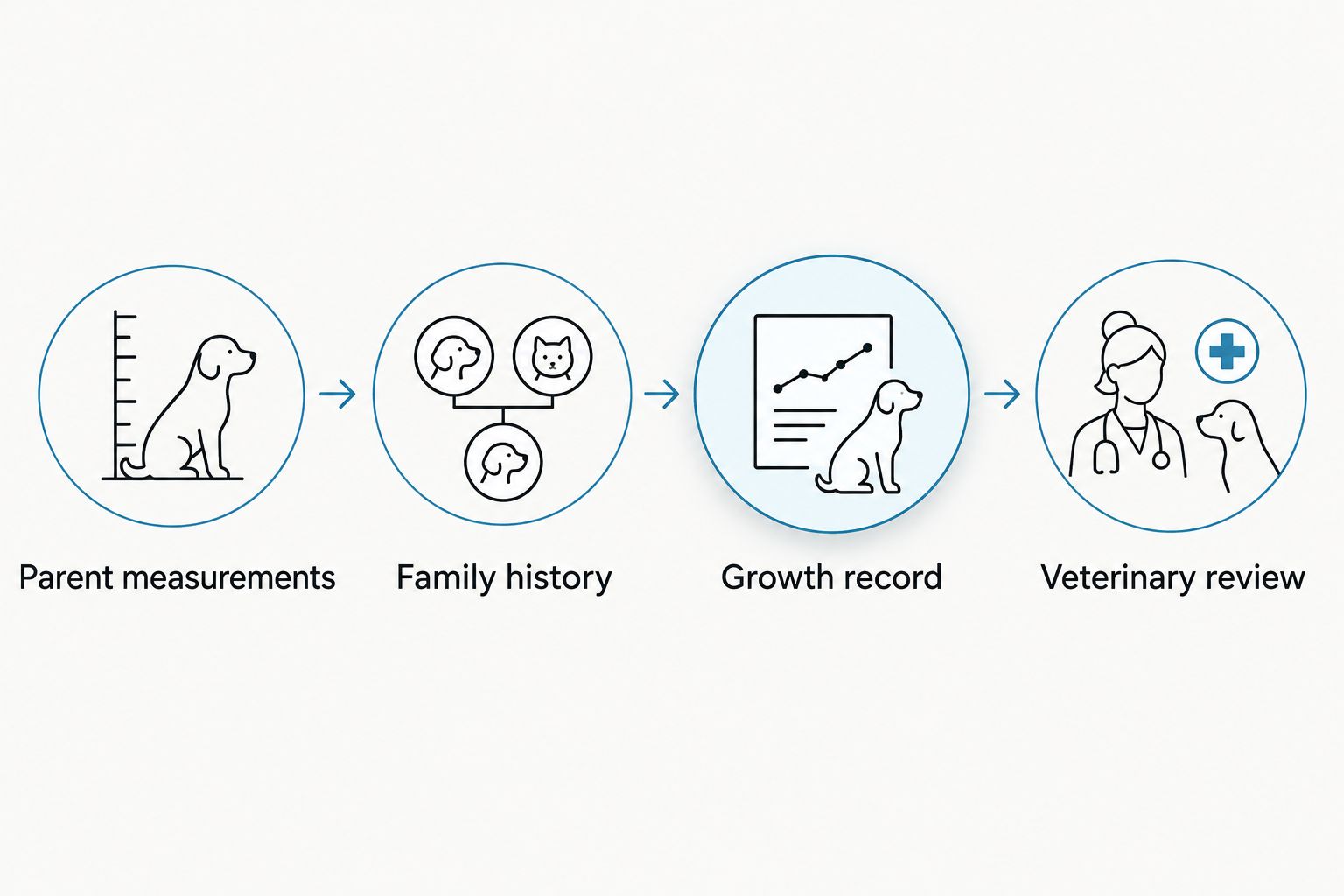
- Parent measurements: Request actual adult measurements for both parents, including weight and shoulder height.
- Family history: Ask whether measurements from mature dogs in related litters are known. Treat those dogs as context, not replicas of your puppy.
- Growth record: Keep dated weights from veterinary visits so you can discuss the pattern rather than a single reading.
- Veterinary review: Ask your veterinarian to consider growth alongside body condition, diet, and the physical examination.
A weight calculator offers convenience, but it cannot know every inherited trait or distinguish a large frame from excess body fat. Use an estimate to prepare your home; do not treat it as a guaranteed finish line.
Big paws are also not a precise measuring tool. They are an adorable part of puppyhood, not proof that a dog will reach a particular adult weight.
How do you measure a Standard Goldendoodle correctly?
Measure height from a level floor to the top of the shoulders, also called the withers. Do not measure to the top of the head or the tips of the ears. Keep your dog standing naturally rather than stretching upward for a treat.
For weight, use a suitable scale and keep the circumstances reasonably consistent. If safely lifting your growing puppy becomes difficult, ask your veterinary practice about weighing instead of attempting an awkward lift at home.
For your 2026 growth record, write down the measurement date, weight, shoulder height, and any question you want to ask your veterinarian. Record observations plainly; a home chart is a conversation aid, not a diagnosis.
Coat can hide the outline of the body. Ask your veterinarian to show you how to assess body condition by looking and feeling rather than judging only from photographs.
When is a Standard Goldendoodle fully grown?
A Standard Goldendoodle can approach adult height before finishing its adult build. Height, weight, muscle development, and behavior do not all settle on the same day. An adult-looking dog can still need patient guidance with puppy habits.
We would not declare a puppy fully grown from a birthday or a weight reading alone. Look at the growth pattern and ask your veterinarian whether physical development appears complete.
This matters when buying equipment. An adjustable item can help during growth, but adjustment has limits: inspect the fit as your puppy changes, and replace equipment when the manufacturer’s fit guidance no longer matches your dog.
Can you predict adult weight from puppy weight?
Puppy weight helps track growth, but it does not guarantee adult weight. A prediction that ignores ancestry, age, and body condition gives you less useful information than a record discussed with your veterinarian.
We recommend asking what supports an estimate. “Based on these parent measurements and this puppy’s growth” is more useful than an exact adult-weight promise with no explanation.
Do not increase food simply to reach a projected number or restrict food to keep a dog within a preferred size label. Feeding decisions should support appropriate growth and body condition under veterinary guidance.
Is a Standard Goldendoodle the right size for your family?
Best for: families who want a larger companion and can accommodate that dog’s adult frame, handling needs, grooming, and daily routine. The appeal is a substantial family companion; the trade-off is that transport, lifting, and crowded household spaces require more planning.
Before starting a puppy application, talk through who handles walks, where the dog rests, and what happens when the usual caregiver is away. Be honest about physical limits and any written pet restrictions. A loving match should work on an ordinary weekday, not just on pickup day.
Goldendoodles of Miami is best for families seeking a curriculum-raised Goldendoodle with lifetime family support. Our program includes health-tested parents, a two-year health guarantee, and 30-day Trupanion coverage. Those are care and support commitments, not guarantees of adult size or an allergy-free coat.
Our puppies become part of our family before joining yours. We welcome careful questions about size, preparation, and the support you want as puppy parents; read the puppy application-to-home pickup timeline as you prepare to apply.
Resumen en español para nuestras familias
Un Goldendoodle estándar adulto suele pesar entre 50 y 90 libras y medir entre 20 y 26 pulgadas hasta la cruz, según la guía de la raza de PetMD. Es una referencia general, no una garantía del tamaño final de un cachorro. Las medidas de los padres y el seguimiento veterinario ayudan a orientar la estimación.
En Goldendoodles of Miami, queremos que cada familia elija a su compañero pensando también en su tamaño adulto. Antes de completar la solicitud, revisen el espacio en casa, el transporte y quién podrá manejar al perro con seguridad.
FAQ
How big do Standard Goldendoodles get in 2026?
Standard Goldendoodles typically reach 50–90 pounds and 20–26 inches tall at the shoulder, according to PetMD’s Goldendoodle breed guide. These figures are general guidance, not a guarantee for an individual puppy.
How tall is a Standard Goldendoodle without counting its head?
A typical Standard Goldendoodle stands 20–26 inches at the shoulder. Measure from a level floor to the withers, not to the head or ears.
Can a Standard Goldendoodle grow larger than the usual range?
Yes, an individual Standard Goldendoodle can fall outside a published size range. Ask your veterinarian to assess frame and body condition rather than treating a category range as a health target.
Will a female Standard Goldendoodle always be smaller?
No, a female Standard Goldendoodle is not guaranteed to be smaller than a male. Parent size, inherited build, and individual development also matter.
Can you tell how big a Goldendoodle will get from its paws?
Paw size does not provide a precise adult-size prediction. Parent measurements and a dated growth record offer more useful context.
Does a Standard Goldendoodle need a house with a yard?
A yard alone does not determine whether a Standard Goldendoodle fits your home. Consider adult-size space, outdoor access, training, daily care, and your ability to handle a large dog.
Does health testing guarantee a Goldendoodle’s adult size?
No, health testing does not guarantee exact adult weight or height. It addresses the health concerns included in the testing, while adult size remains an estimate.
One last thing
The most useful size question is not “Will this puppy be big?” It is “Can our family comfortably care for this dog at the larger end of the expected range?” If the answer is yes, you can prepare without depending on your puppy finishing at the smallest possible size.
Keep that question on your 2026 home-preparation checklist. Then let your dood grow into an individual, rather than a number you hoped to match.