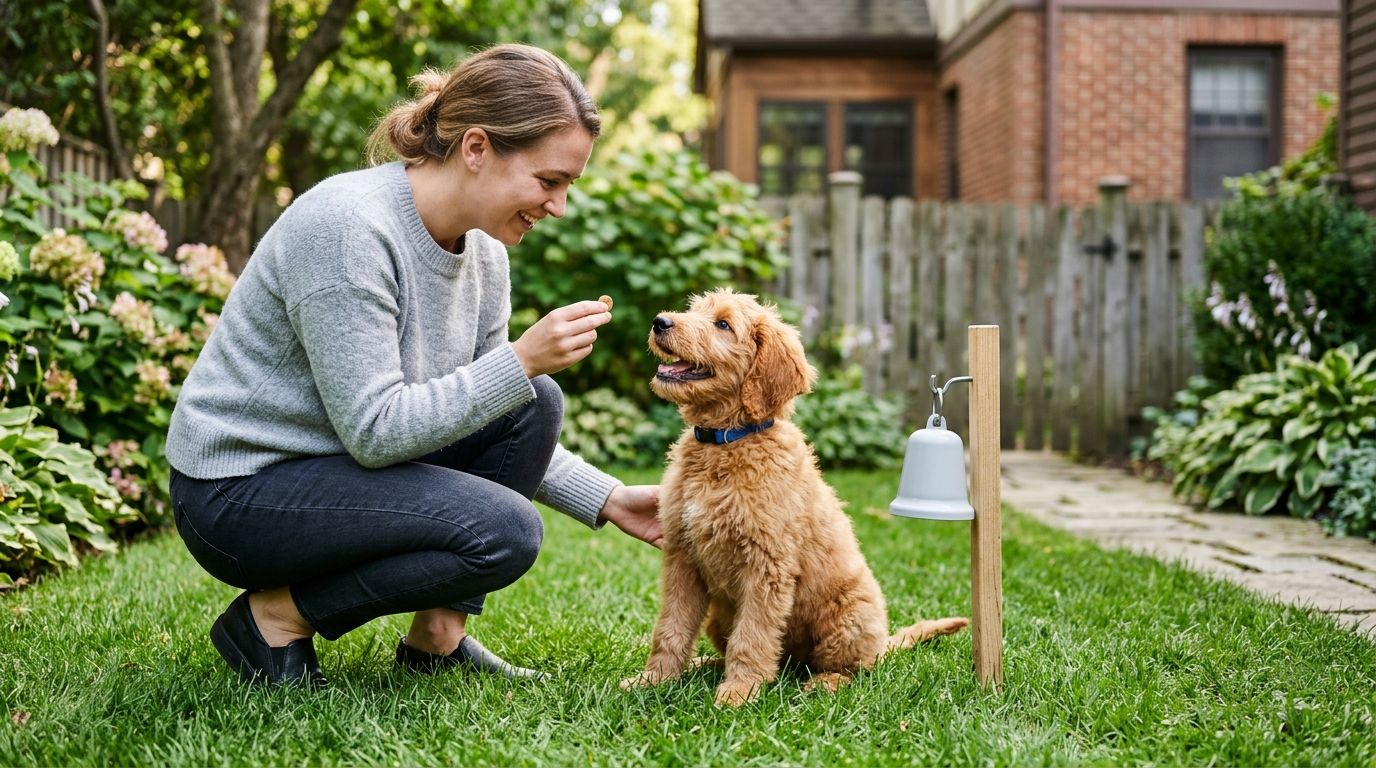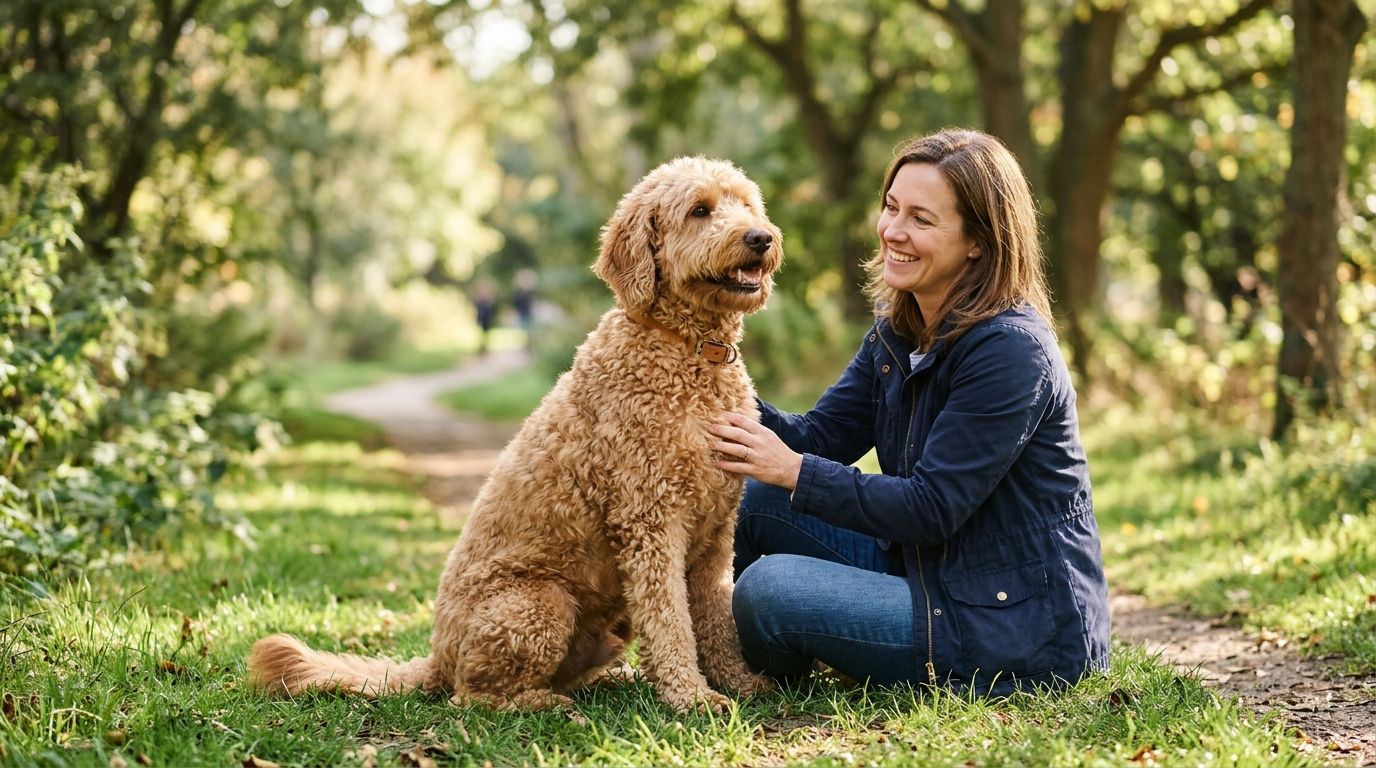
Bernedoodles typically live 12–18 years, the general range listed in PetMD’s Bernedoodle care guide; for families planning in 2026, that is an estimate, not a promised lifespan. Adult size, inherited health, and individual circumstances affect how long a dog lives, and health-tested parents do not guarantee a particular age. We encourage families to plan for lifelong care rather than choose a puppy because of the highest number in a lifespan range.
- PetMD lists a 12–18-year Bernedoodle lifespan; treat it as a planning range, not an individual prediction.
- When asking how long do bernedoodles live, consider adult size, family health history, and lifelong care.
- Goldendoodles of Miami supports Bernedoodle families with health-tested parents, curriculum-raised puppies, and lifetime family support.
- A two-year health guarantee and 30-day Trupanion coverage are distinct from a promise about longevity.
Why this matters
When you picture your furever friend growing up beside your family, lifespan feels personal. We understand that you are not simply comparing numbers—you are imagining school mornings, neighborhood walks, and the years your dood will share with you.
A lifespan estimate helps you think about that commitment, but it cannot tell you which puppy will live longest. Start by understanding your puppy’s expected adult build through our guide to how big Bernedoodles get when fully grown, then ask about the individual parents and their health records.
Choose the dog whose needs you can meet throughout life, not the puppy attached to the biggest longevity claim. That is the more useful starting point for a family decision in 2026.
How long do Bernedoodles typically live?
PetMD’s Bernedoodle care guide gives a typical lifespan of 12–18 years. That published range applies to Bernedoodles generally; it does not establish a separate, verified average for every size, generation, or family line.
The distinction matters. A range describes possible expectations across dogs, while an average would require a defined population and recorded lifespans. We would not turn the midpoint of a published range into a supposed average or use its upper end as a promise to your family.
| Lifespan information | What it helps you understand | What it cannot establish |
|---|---|---|
| General Bernedoodle range | A broad planning horizon for companionship and care | How long your individual puppy will live |
| Expected adult size | The physical needs you should prepare to meet | An exact lifespan based on a size label |
| Parent health records | Which screening information is available for review | Protection against every future health concern |
| Family history | Useful background to discuss with your veterinarian | A guaranteed outcome for a related puppy |
For your 2026 puppy search, keep these categories separate. A helpful conversation includes both what is known about the puppy’s family and what no one can predict.
Standard Bernedoodles: plan around the individual dog
Standard Bernedoodles belong to the larger end of the Bernedoodle size spectrum. Across dogs generally, larger adult size is associated with shorter average lifespan than smaller adult size, but that broad pattern does not produce a precise forecast for an individual Bernedoodle.
Best for: families prepared for a larger dog’s space, handling, transport, and daily-care needs. Think about your home now and whether you could still help your dog comfortably if mobility becomes more difficult later.
The advantage is a clearer opportunity to plan around a larger companion. The limitation is that the word standard alone does not tell you the dog’s eventual weight, health, temperament, or longevity; ask about the parents rather than relying on the label.
Mini Bernedoodles: smaller does not mean guaranteed longevity
Mini Bernedoodles are commonly discussed as smaller alternatives to standard Bernedoodles. Smaller dogs tend to live longer on average across the wider dog population, but that does not justify promising extra years for a particular mini puppy.
Best for: families who prefer a smaller adult companion and can still meet the dog’s exercise, grooming, training, and veterinary needs. A smaller dog is not automatically a lower-maintenance dog.
The practical benefit is a smaller expected adult build. The limitation is that a size description is not a health assessment, and it should never replace questions about the parents or a conversation with your veterinarian.
| Option | Best for | Practical benefit | Important limitation |
|---|---|---|---|
| Standard Bernedoodle | Families prepared for a larger companion | Planning around a larger adult dog | Larger size brings different handling and home-care needs |
| Mini Bernedoodle | Families seeking a smaller companion | Planning around a smaller adult dog | Smaller size does not guarantee a longer life or easier care |
We recommend choosing between these options by household fit. Neither deserves a longevity promise based on its name alone.
Why Bernedoodle lifespan varies
A puppy’s future is shaped by more than the crossbreed name. These factors give you a useful framework for questions without pretending that any checklist can predict an exact age.
- Adult size: Consider the expected mature dog, not just the puppy you can carry today. Size helps guide practical planning, but it is not an individual lifespan calculation.
- Inherited health: Ask which parent health tests were completed and request the results. Screening provides specific information; it is not a blanket guarantee.
- Body condition: Ask your veterinarian how to assess your dog’s weight and adjust feeding as growth and activity change. Appearance alone is not a feeding plan.
- Veterinary care: Establish a relationship with a veterinarian and follow an individual care plan. Bring questions and changes in behavior to that professional rather than relying on breed articles.
- Daily environment: Plan for secure spaces, appropriate activity, supervised puppy exploration, and comfortable rest. Your household routine should adapt as your dog grows and ages.
A practical 2026 care plan connects these pieces rather than treating them as separate purchases. Keep your dog’s records together, share them with your veterinarian, and revisit routines when your dog’s needs change.
Do mini Bernedoodles live longer than standard Bernedoodles?
The 12–18-year general Bernedoodle range does not prove a fixed lifespan difference between mini and standard dogs. Smaller dogs tend to live longer across the wider dog population, but a mini label cannot predict how many additional years an individual puppy will have.
Does an F1B Bernedoodle live longer than an F1 Bernedoodle?
The 12–18-year general range does not establish a longevity advantage for either generation. Generation terminology describes ancestry; we encourage families to give more attention to documented parent health information and the individual puppy’s needs.
Can a Bernedoodle live beyond the usual range?
The 12–18-year range is not a deadline, and an individual dog can fall outside a published estimate. Plan for a long commitment without assuming that either endpoint predicts your own dog’s future.
What should you ask before bringing a Bernedoodle home?
We want puppy parents to feel comfortable asking direct questions. A caring conversation should leave you with understandable records and realistic expectations, not pressure to accept a reassuring phrase.
Ask for the records behind health testing
Ask which tests each parent received, what the results say, and whether you can share those records with your veterinarian. The phrase health-tested is useful only when you understand the testing behind it.
Do not assume that every test answers every health question. Ask what the available information does—and does not—tell you about the planned pairing.
Ask what the puppy has been learning
Early routines matter to your experience together, even though training is not a lifespan guarantee. Ask about the puppy’s curriculum, daily experiences, and how to continue familiar routines at home.
We encourage families to think about the transition as a handoff. Your puppy will still need patient teaching, supervision, and time to settle into being part of your family.
Read support and guarantee terms separately
A health guarantee, insurance coverage, and breeder support serve different purposes. Read the written terms for each rather than assuming they are interchangeable.
Ask about activation, eligibility, exclusions, and any steps you must take. Your own veterinarian remains the right person to guide medical decisions for your dog.
How we support your family
Goldendoodles of Miami is best for families seeking a Bernedoodle puppy from health-tested parents, curriculum-based early training, and lifetime family support. We approach the relationship as a caring breeding family, not a one-time transaction.
Our program includes curriculum-raised puppies, a two-year health guarantee, and 30-day Trupanion coverage. Those are specific parts of our support; none is a promise that a puppy will avoid every health concern or live to a particular age.
The distinction is important to us. Early training gives your family a starting point, but you continue the work at home; a guarantee has written terms, and initial coverage is not a substitute for planning longer-term care.
You can learn about Goldendoodles of Miami and ask about the puppy application when your household is ready. We welcome questions about the parents, curriculum, support, and the everyday responsibilities of welcoming one of our doods.
Plan your puppy’s homecoming
Understand the application-to-pickup process before taking your next step.
A family plan for every life stage
Before pickup, agree on who handles feeding, grooming appointments, training, and veterinary visits. Put the plan somewhere everyone can find it, and make sure an adult owns each responsibility even when children help.
During adulthood, keep paying attention to the individual dog. A routine that suited a growing puppy will not necessarily remain the right routine forever; discuss changes in appetite, activity, comfort, or behavior with your veterinarian.
For later life, think about practical support before it becomes urgent. Consider transport, comfortable resting places, access around your home, and who can help when your usual caregiver is unavailable.
For families bringing home a puppy in 2026, this is the real meaning of a long-term commitment. We hope for many happy years together, while preparing to care for the dog in front of us at each stage.
Resumen en español para las familias
La guía de PetMD sobre el Bernedoodle indica una esperanza de vida general de 12 a 18 años. Es una referencia para planificar, no una garantía para un cachorro: el tamaño adulto, los antecedentes familiares y las circunstancias individuales influyen en su vida.
En Goldendoodles of Miami criamos cachorros con un programa educativo y padres con pruebas de salud. Ofrecemos una garantía de salud de dos años, cobertura de Trupanion durante 30 días y apoyo familiar de por vida; revisa las condiciones de cada beneficio y consulta con tu veterinario sobre los cuidados de tu cachorro.
FAQ
How long do Bernedoodles live?
PetMD’s Bernedoodle care guide lists a typical lifespan of 12–18 years. Treat that as a general planning range, not a prediction for an individual puppy.
Can anyone guarantee how long my Bernedoodle will live?
No one can guarantee an individual Bernedoodle’s lifespan. Health testing provides useful information, but it does not eliminate every future uncertainty.
Is a mini Bernedoodle guaranteed to outlive a standard Bernedoodle?
A mini Bernedoodle is not guaranteed to outlive a standard Bernedoodle. General size-related longevity patterns cannot predict the outcome for two individual dogs.
Does a two-year health guarantee mean my puppy cannot get sick?
A two-year health guarantee does not mean a puppy cannot develop a health concern. Read the written terms to understand its scope, exclusions, and required steps.
What does 30-day Trupanion coverage mean for long-term care?
The 30-day Trupanion coverage is an initial coverage period, not a lifetime care plan. Review activation requirements and policy terms, then consider your arrangements for ongoing care.
What should I ask a breeder about Bernedoodle longevity?
Ask for parent health-test records, relevant family history, and realistic information about expected adult size. Be cautious of a precise lifespan promise for an individual puppy.
Does a curly Bernedoodle coat mean fewer health concerns?
A curly coat does not establish a Bernedoodle’s overall health or lifespan. Coat appearance also does not guarantee that a puppy will be suitable for someone with allergies.
One last thing
Ask who will help you understand the records—not just who will hand them over. A folder is useful, but clear explanations help you ask better questions and share the right information with your veterinarian.
Your furever friend deserves more than an optimistic number. Choose a relationship built on clear expectations, patient guidance, and a family ready for the everyday work of loving a dog.