Goldendoodle potty training takes months of consistent practice, not a guaranteed number of days; learning where to go comes before being reliable without supervision. Plan for accidents while your puppy matures, and remember that sleeping through the night does not mean your dood has mastered daytime potty habits.
- How long to potty train a Goldendoodle depends on maturity, supervision, and a consistent house-training routine.
- Reward outdoor toileting immediately, and offer potty breaks after waking, eating, drinking, and play.
- Goldendoodles of Miami suits families seeking curriculum-raised puppies and lifetime family support, not a guaranteed training deadline.
- Measure progress by fewer accidents and clearer signals, not an accident-free afternoon.
How long does it take to potty train a Goldendoodle?
Plan around your puppy’s progress, not a promised finish date. A Goldendoodle can learn the outdoor routine before developing the physical control and communication needed to follow it consistently. Those are separate milestones.
We encourage families to carry familiar habits home rather than start from scratch. Our guide to continuing your puppy’s curriculum at home explains that transition.
For your 2026 homecoming plan, use these milestones to understand what progress actually looks like:
| Milestone | What you’ll notice | What it does not prove |
|---|---|---|
| Learning the location | Your puppy toilets in the designated spot when taken there | Your puppy can get there without help |
| Learning the routine | Your puppy starts anticipating familiar outings | Every need will happen on schedule |
| Building communication | Your puppy pauses by the door or gives another recognizable signal | The signal will always be obvious |
| Building reliability | Accidents become less frequent under consistent supervision | Your puppy is ready for unrestricted access |
| Handling changes | Your puppy follows the routine despite ordinary household distractions | A new home or schedule needs no adjustment |
An accident-free stretch is encouraging. It is not a reason to remove every safeguard at once.
Why this matters
A family expecting instant results can mistake normal learning for stubbornness. That misunderstanding often leads to too much freedom, missed outings, or punishment after an accident—none of which teaches the puppy where to go.
We want your furever friend to arrive with a workable routine, not an impossible deadline. Your job is to make the right choice easy and reward it when it happens.
Goldendoodles of Miami is best for families seeking curriculum-raised Goldendoodle puppies and lifetime family support, not a guaranteed potty-training deadline. Early preparation is a foundation; your puppy still needs patient teaching in your home.
Why Goldendoodle potty-training timelines vary
There is no useful breed-wide countdown that replaces watching the puppy in front of you. These factors explain why one family’s experience should not become another family’s deadline:
- Maturity: Understanding the routine and being physically able to wait are different skills. Do not interpret an accident as deliberate disobedience.
- Supervision: A puppy practicing unnoticed accidents indoors needs closer management, not a louder correction afterward.
- Routine: Predictable meals, rest, outings, and rewards help your puppy connect daily events with the potty location.
- Previous learning: Familiar cues and toileting surfaces give you a starting point. Changing everything at once adds new things to learn.
- Home layout: A nearby door and a long elevator trip require different planning. Start the outing before your puppy is urgently searching.
- Health and comfort: A sudden change in toileting deserves veterinary guidance rather than an assumption that training has failed.
At Goldendoodles of Miami, we emphasize health-tested parents and curriculum-raised puppies. Those commitments matter, but neither removes the need for home practice or predicts the date your puppy will stop having accidents.
How do we build a potty routine that works?
For a puppy coming home in 2026, we recommend a simple sequence every family member can repeat. Keep the cue, destination, and reward consistent before adding more freedom.
Start with an outing
Take your puppy to the designated potty area after waking and around transitions such as meals, drinking, and active play. Watch the individual puppy rather than relying only on a clock.
Sniffing, circling, wandering away, or suddenly leaving play can signal that an outing is needed. These signs are easy to miss when everyone is enjoying the new arrival.
Keep it quiet
Make the potty trip calm and purposeful. Give your puppy a chance to sniff without turning the outing into a game before toileting happens.
Use the same simple cue if you choose to teach one. Repeating it continuously is less useful than pairing it consistently with the behavior.
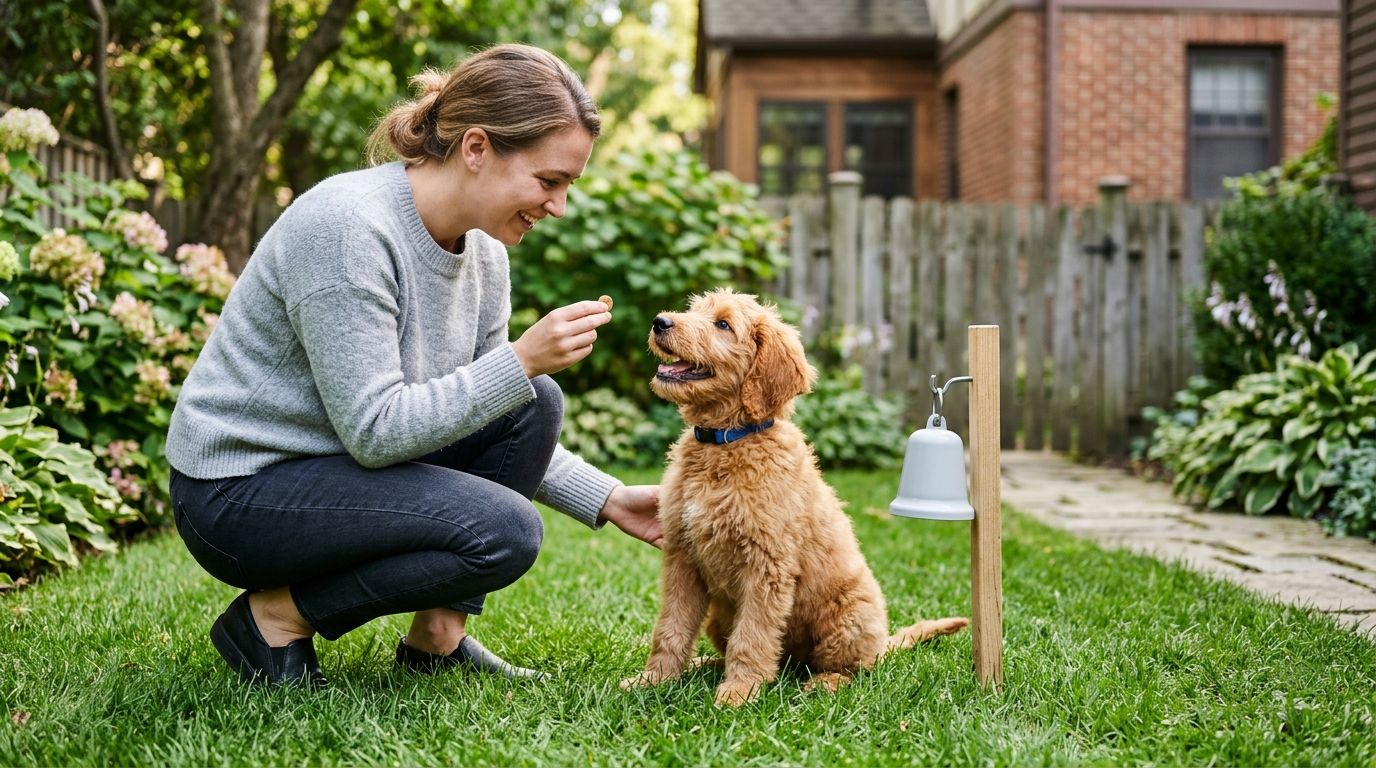
Reward outside
Reward your puppy immediately after toileting finishes, while you are still at the potty spot. Waiting until you return indoors makes the connection less clear.
Keep a suitable reward ready before you leave. Praise warmly without interrupting the puppy mid-toilet.
Supervise indoors
Afterward, bring your puppy into a space where an adult can genuinely watch. Being in the same house is not the same as noticing a puppy quietly slipping behind furniture.
If the outing produces no result, return to close supervision and offer another opportunity. Do not treat an unsuccessful trip as permission for unsupervised roaming.
Record patterns
Keep a 7-day potty log as a practical observation exercise, not a deadline for completing training. Record meals, naps, successful outings, accidents, and what happened immediately beforehand.
Look for repeat situations. An accident after energetic play tells you where to add an outing; it does not tell you your puppy is incapable of learning.
Should we use a crate during potty training?
A crate is a management tool, not a substitute for potty breaks. Introduce it gradually as a comfortable resting place, and choose a suitable size that lets your puppy stand, turn, and lie down comfortably.
The benefit is a defined resting space when direct supervision is impossible. The limitation is equally important: confinement does not create bladder control or make an unsuitable absence appropriate.
Do not withhold drinking water to manufacture a cleaner crate. Ask your veterinarian about your puppy’s individual hydration and toileting needs, especially if accidents or drinking patterns change.
If your puppy repeatedly toilets in the crate, review the routine and seek guidance rather than making confinement longer. Consider whether outings are being missed, the puppy is distressed, or a veterinary assessment is needed.
How do we handle daytime accidents and nighttime waking?
Daytime and nighttime are different situations. An awake puppy is eating, drinking, playing, and moving between activities; a sleeping puppy is resting.
Avoid using a quiet night as proof that your puppy can wait equally long during a busy afternoon. Keep daytime outings tied to activities and observed needs.
For nighttime waking, keep necessary potty trips quiet and purposeful. Return to the sleeping routine afterward rather than beginning an exciting play session.
When an indoor accident happens, respond without scolding. If you catch the puppy starting, interrupt gently and take your puppy to the designated area; if you find it later, clean it thoroughly with a pet-appropriate enzymatic cleaner according to its directions.
Punishment after the event does not teach the outdoor location. Review what happened before the accident and change the setup for the next opportunity.
How do we know when to give our puppy more freedom?
Give access to more space gradually, after consistent success in the area your puppy already knows. More rooms mean more places to wander out of sight and more distance from the usual exit.
We suggest checking these questions before changing the setup:
- Are adults noticing the puppy’s signals before an accident happens?
- Is the puppy succeeding during normal household activity, not only during unusually close attention?
- Does everyone use the same exit, cue, and reward routine?
- Can someone supervise the newly accessible space?
- Is there a clear plan for returning to closer management if accidents resume?
Your 2026 training plan should allow adjustments without treating them as failure. Returning to a smaller supervised area is useful management, not a punishment.
Children can help prepare rewards or tell an adult when the puppy approaches the door. An adult should remain responsible for recognizing needs and arranging outings.
What should we ask before bringing a Goldendoodle home?
Ask about the puppy’s current toileting location, familiar surface, daily routine, and signals. Also ask what still needs practice; a useful handover includes limitations as well as successes.
At Goldendoodles of Miami, our family-focused program includes curriculum-raised puppies, a 2-year health guarantee, 30-day Trupanion coverage, and lifetime family support. These are separate from potty-training results; review the applicable terms and ask questions before pickup.
For families planning a 2026 homecoming, our puppy application-to-home-pickup guide explains the process. Use the application conversation to discuss your workday, outdoor access, and who will handle outings.
We want our doods to become part of your family with realistic expectations. A curriculum can start the learning, but your household supplies the repetition that follows.
Plan your puppy’s homecoming
Review the application-to-pickup process and prepare questions about your puppy’s routine.
What if my Goldendoodle suddenly starts having accidents again?
Return to closer supervision and review recent changes, including missed outings, new rooms, visitors, or a different daily schedule. Do not assume your puppy has forgotten everything.
Contact your veterinarian about a sudden or persistent change, especially with straining, discomfort, blood, or unusual thirst. A training adjustment cannot determine whether a health concern is present.
Bring your potty log to the conversation. Observations about timing and behavior are more useful than describing your puppy as “bad” or “stubborn.”
Does a mini Goldendoodle potty train faster than a standard?
Size alone does not establish a potty-training deadline. Build the routine around the individual puppy’s maturity, signals, and success rather than choosing a puppy on a promise of faster house-training.
The useful question is not which size finishes first. Ask what routine your puppy already knows and how your household will maintain it.
Resumen para nuestras familias de habla hispana
Enseñar a un Goldendoodle a hacer sus necesidades en el lugar indicado requiere constancia durante meses, no una fecha garantizada. Aprender dónde ir no significa que el cachorro ya pueda esperar o avisar siempre.
En Goldendoodles of Miami, recomendamos mantener una rutina clara, premiar justo después de que el cachorro termine y supervisarlo dentro de casa. Eviten los castigos por accidentes y consulten al veterinario si aparece un cambio repentino o persistente.
Para preparar la llegada en 2026, pregunten qué señales, horarios y superficie conoce su cachorro. La preparación inicial ayuda, pero la práctica diaria continúa con su nueva familia.
FAQ
Can I potty train my Goldendoodle in a week?
A week can establish a routine, but it is not a reliable deadline for complete potty training. Judge progress by consistent success, communication, and appropriate supervision rather than a short accident-free stretch.
How often should I take my Goldendoodle puppy outside?
Offer outings after waking and around meals, drinking, and active play, then adjust to your puppy’s observed needs. A fixed schedule should not override signs that your puppy needs to go sooner.
Does sleeping through the night mean my Goldendoodle is potty trained?
Sleeping through the night does not prove daytime potty-training reliability. Continue supervising and offering outings while your puppy is awake and active.
Should I punish my Goldendoodle for peeing inside?
Do not punish your Goldendoodle for an indoor accident. Clean the area, review the missed opportunity, and reward toileting in the designated location.
Can a curriculum-raised puppy still have accidents at home?
A curriculum-raised puppy can still have accidents after moving home. Familiar learning needs practice with your household’s doors, surfaces, people, and schedule.
When should I call the vet about potty-training accidents?
Contact your veterinarian about sudden or persistent changes, particularly with discomfort, straining, blood, or unusual thirst. Do not assume every accident is a training issue.
One last thing
The most useful change is often an earlier outing, not a firmer command. If your puppy repeatedly has an accident after the same activity, move the potty trip ahead of that moment.
Watch the pattern, help your puppy succeed, and keep the response kind. That is how a household routine becomes something your furever friend understands.