Curriculum-based puppy training has no fixed finish date: early learning and dependable behavior are different results, and a puppy needs continued practice after coming home. For families planning in 2026, the useful question is not just when training starts working, but which skills a puppy can repeat, in what setting, and with how much help.
- How long does curriculum puppy training take? There is no universal deadline; judge repeatable behavior, not a promised date.
- Goldendoodles of Miami offers curriculum-raised puppies; families still need to continue puppy training and home routines.
- A response in a quiet room does not establish reliability around visitors, children, or other distractions.
- Ask what your puppy has practiced, what support helps, and what your family should continue after pickup.
How long does curriculum-based training take to show results?
Look for repeatable progress rather than a fixed number of days. A puppy responding during a familiar exercise shows learning, but that response does not establish a finished skill. Reliable behavior requires practice across the situations where your family actually needs it.
The distinction matters when you bring your furever friend home. New people, unfamiliar sounds, and a different routine change the learning environment; needing support at home does not erase earlier practice.
| Learning milestone | What counts as progress | What it does not establish |
|---|---|---|
| Familiar response | Your puppy responds during a practiced activity | The response will happen in every setting |
| Repeatable response | Your puppy repeats the behavior under similar conditions | Distractions will be easy |
| Transfer to home | Your puppy responds with your family in your home | Every family member will get the same response immediately |
| Everyday reliability | Your puppy responds across practiced situations | Practice and supervision can stop |
For the handoff between breeder routines and family life, use our guide to continuing your puppy’s routine after pickup. Keep the familiar parts clear before asking for more difficult behavior.
Why this matters
We want families to recognize progress without feeling that their puppy is behind. A successful response is encouraging; expecting that response everywhere creates a much harder test.
For your 2026 puppy plan, separate exposure, learning, and reliability. Being introduced to an experience is not the same as feeling comfortable with it, and practicing a cue is not the same as responding amid household activity.
That distinction also helps you ask better questions. Instead of asking whether a puppy is trained, ask what the puppy has practiced and what still needs your help. The answer gives your family something useful to continue.
What should the first results look like?
Early progress is often smaller than the finished behavior you have in mind. We encourage families to notice the conditions around a success, not just the success itself.
Useful observations include:
- Engagement: Your puppy turns toward you during a familiar activity.
- Recognition: Your puppy responds to a cue that has already been practiced.
- Comfort: Your puppy participates willingly rather than being pushed through an exercise.
- Repeatability: Your puppy succeeds again under similar conditions.
These are observation categories, not promises about a particular puppy. Ask which behaviors have actually been practiced before treating any example as part of your puppy’s experience.
A puppy who responds with a familiar person in a quiet space has shown something valuable. The next question is whether your family can reproduce those conditions—not whether the puppy should already perform through every distraction.
Why the puppy-training timeline varies
The word “results” covers very different goals. Recognizing a cue, settling during household activity, and maintaining a toilet routine each involve different expectations.
These factors help explain why a calendar alone cannot describe progress:
- Starting point: An introduced activity and an established response need different follow-up.
- Task difficulty: A familiar response in a quiet room is a different task from responding around visitors.
- Consistency: Different words, rules, or responses from family members make expectations less clear.
- Environment: Moving from a familiar setting into your home changes the context.
- Readiness: A tired, distracted, or uncomfortable puppy is not in the same position to participate as an engaged puppy.
- Practice quality: Clear cues and rewards for the desired behavior give your puppy more useful information than repeated demands.
Change the difficulty before deciding that learning has stopped. If a familiar behavior falls apart around activity, return to an easier version and rebuild from there.
We also encourage families to describe the exact difficulty. “Does not listen” gives little direction; “responds in the kitchen but not when visitors arrive” identifies something you can work on.
How do we carry curriculum learning into our home?
A useful handoff explains what happened before pickup and what your family should do next. It should leave you with practical instructions rather than a broad label such as “trained.”
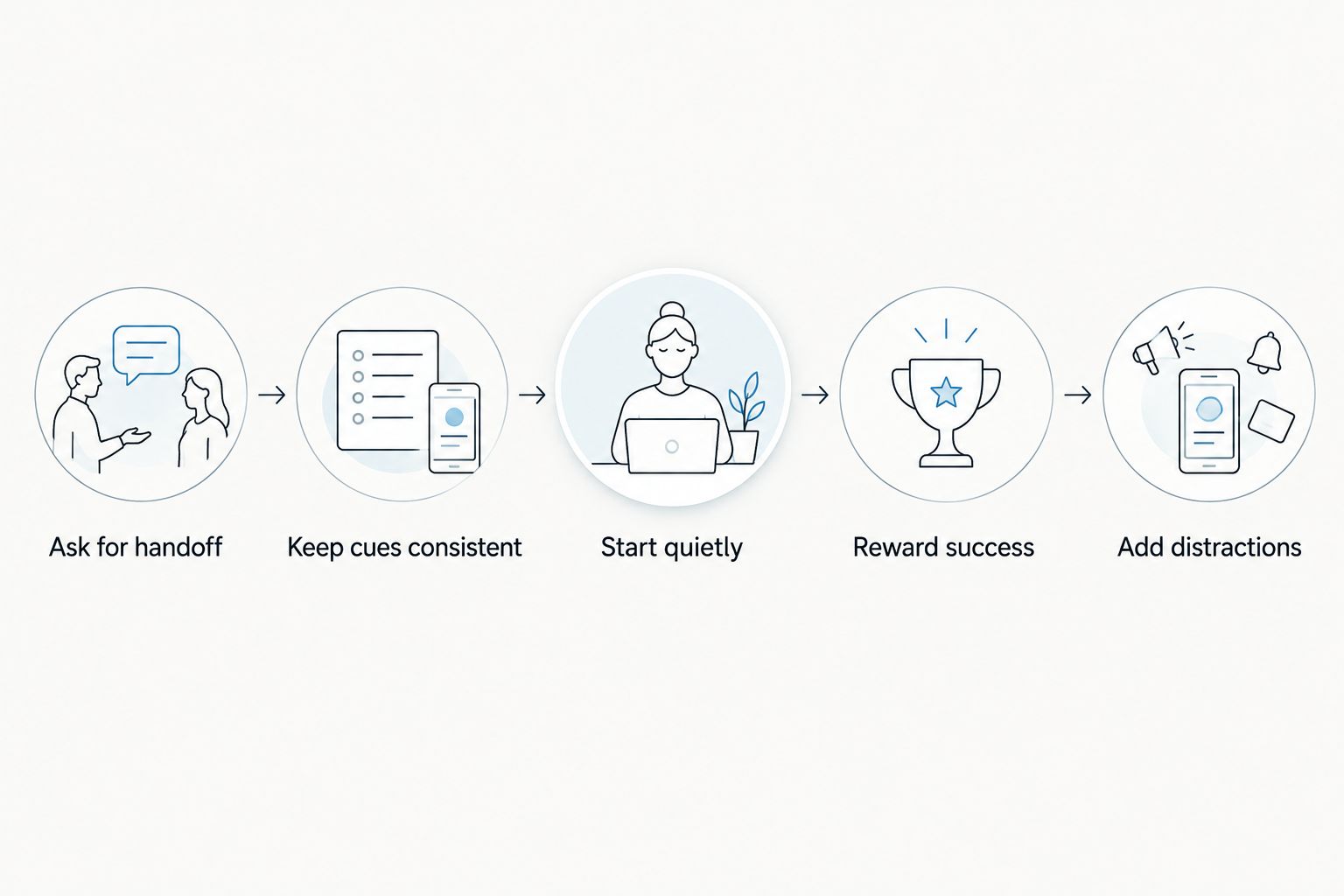
For your 2026 homecoming plan, follow this sequence:
- Ask for a handoff. Request the cues, activities, and routines your puppy has actually practiced. Ask what still requires help.
- Keep cues consistent. Agree on the words and household rules your family will use. Make sure everyone understands what the desired response looks like.
- Start quietly. Give your puppy an opportunity to practice without unnecessary household activity competing for attention.
- Reward success. Reinforce the behavior you want rather than waiting for a mistake to become the focus.
- Add distractions. Increase difficulty gradually, returning to an easier setting when your puppy needs support.
The purpose is continuity, not a demanding homecoming test. We want our doods to understand what their new family is asking before the task becomes harder.
Ask for a demonstration when an instruction feels unclear. Seeing the cue, the puppy’s response, and the reward gives everyone a shared reference; a label alone does not explain those details.
How can we tell whether our puppy is improving?
Compare the same behavior under similar conditions. A quiet practice opportunity and a busy family gathering do not provide a fair comparison.
Keep a simple observation record with these details:
| Record | What to write | Why it helps |
|---|---|---|
| Behavior | The exact response you asked for | Keeps the goal specific |
| Setting | Where practice happened and what was nearby | Separates learning from distraction |
| Support | The cue, prompt, or reward you used | Shows what helped your puppy succeed |
| Outcome | What your puppy actually did | Replaces general impressions with observations |
| Next step | Repeat, simplify, or add difficulty | Gives the next practice a purpose |
A useful note describes behavior without judging your puppy’s character. “Responded in the quiet room, then turned toward the doorway when someone entered” is more useful than “was stubborn.”
Progress means the desired behavior becomes more repeatable under the conditions you are practicing. It does not mean every attempt looks perfect. Keep the goal clear enough that another family member could recognize the same success.
Does curriculum-raised mean fully trained at pickup?
No. Curriculum-raised describes a structured approach to early experiences and learning; it does not establish that a puppy has completed every skill your household needs.
Goldendoodles of Miami is best for families seeking curriculum-raised puppies with lifetime family support. We offer an early learning foundation, but families still have an active role after pickup. That ongoing commitment belongs in your decision alongside the benefits of a structured start.
Before choosing a puppy, ask what “curriculum-raised” means in that puppy’s actual routine. Request examples, the puppy’s current level of support, and guidance for continuing at home.
Is potty training on the same timeline as learning cues?
No. A puppy responding to a practiced cue does not establish dependable toileting habits, and progress in either area should be assessed separately.
We recommend asking about your puppy’s existing toilet routine and keeping a record of what happens at home. Supervision and a clear household routine remain important even when your puppy shows encouraging progress elsewhere.
Avoid treating a successful outing as proof that accidents are finished. Look at the pattern, continue the routine, and ask for help when something is unclear.
What should we do if progress seems to stop?
Return to a familiar, easier version of the activity. Check whether the cue, surroundings, reward, or household expectations changed before asking your puppy for more.
A setback is information, not a reason to label your puppy difficult. Describe what happened and request guidance; if behavior changes suddenly or your puppy appears unwell, contact your veterinarian rather than treating it only as a training issue.
What should families ask us before pickup?
We welcome careful questions because your puppy is becoming part of your family. A helpful conversation connects the early curriculum to your actual home, including children, other pets, and daily responsibilities.
Bring questions such as:
- Which activities has this puppy practiced?
- Which responses are repeatable, and which are still being introduced?
- What cues and rewards should we continue?
- What signs show that the activity has become too difficult?
- How should we ask for help after pickup?
At Goldendoodles of Miami, our program includes health-tested parents, curriculum-raised puppies, a two-year health guarantee, 30-day Trupanion coverage, and lifetime family support. Those commitments support your family’s planning; they do not turn training into a guaranteed completion date.
As you prepare in 2026, ask us to explain the health guarantee and coverage terms separately from the learning plan. Health-related commitments and training expectations answer different questions.
Ready to welcome a furever friend? Contact us about the puppy application and share your household’s routine, experience, and questions.
Start your family’s puppy conversation
Ask about the puppy application, curriculum-raised puppies, and continuing learning at home.
Resumen para familias de habla hispana
El aprendizaje de un cachorro no tiene una fecha universal de finalización. Responder durante una actividad conocida no significa que el cachorro pueda repetirla con distracciones o en un hogar nuevo.
En Goldendoodles of Miami criamos cachorros con un programa estructurado de aprendizaje y ofrecemos apoyo de por vida a las familias. Antes de llevar a su cachorro a casa, pregúntenos qué ha practicado, qué señales conoce y cómo continuar su rutina. Una base temprana ayuda a orientar el trabajo en casa, pero no sustituye la práctica familiar.
FAQ
How long does curriculum puppy training take to show results?
Curriculum puppy training has no universal completion deadline. Look for repeatable responses during familiar activities, then assess how those responses carry into your home and more distracting settings.
Will my curriculum-raised puppy arrive fully trained?
Curriculum-raised does not mean fully trained for every household situation. Ask which skills your puppy has practiced and what help those skills still require.
Why does my puppy respond during practice but not around visitors?
Visitors change the difficulty by adding distractions. Return to a quieter setting and build toward the more demanding situation rather than assuming your puppy has forgotten everything.
How do I measure puppy-training progress at home?
Measure progress by comparing the same behavior under similar conditions. Record the setting, cue, support, and response so your next step follows what actually happened.
Does a two-year health guarantee include a training deadline?
A two-year health guarantee is not a puppy-training timetable. Ask for the written guarantee terms and discuss learning expectations separately.
What training support does Goldendoodles of Miami offer families?
Goldendoodles of Miami offers curriculum-raised puppies and lifetime family support. Ask how to continue your puppy’s practiced routines and how to request guidance after homecoming.
One last thing
For your 2026 homecoming checklist, write down what success looks like before you start practicing. “Responds to the familiar cue in a quiet room” gives your family a clear target; “be good” does not.
Give your puppy a clear next step, not a finish-line date. That is a kinder expectation for your furever friend and a more useful plan for everyone at home.