A Goldendoodle puppy generally reaches at least 16 weeks of age before completing the initial core combination vaccine series; some puppies continue through 20 weeks, depending on their veterinarian’s plan. For families planning in 2026, the important caveat is that the final injection does not mean immediate protection or completion of every recommended vaccine. Your veterinarian must also confirm the rabies schedule, any additional vaccine series, and when your puppy can safely expand their outings.
- Goldendoodle puppy vaccination schedule length usually extends to at least 16 weeks of age, sometimes 20 weeks.
- AAHA guidance bases puppy core vaccination timing on age and intervals, not Goldendoodle size or generation.
- Ask your veterinarian when protection develops after the final dose before planning public-ground outings.
- Goldendoodles of Miami encourages families to pair puppy records with a veterinarian-led vaccination plan.
How long until a Goldendoodle puppy is fully vaccinated?
Think in weeks of age, not simply the number of shots received. The American Animal Hospital Association’s canine vaccination guidance recommends starting the core distemper, adenovirus, and parvovirus combination series at 6–8 weeks, repeating doses every 2–4 weeks until the puppy is older than 16 weeks. Higher-risk situations warrant continuing to 18–20 weeks under veterinary direction.
That does not make every puppy’s calendar identical. We encourage families to bring the actual records to their first vet visit after bringing a puppy home, rather than relying on a verbal description of shots.
| Milestone | General timing or decision | What it means for your family |
|---|---|---|
| Initial core combination dose | Usually 6–8 weeks of age | Starts the series; does not finish protection |
| Repeat core combination doses | Every 2–4 weeks | Keeps the series moving while maternal antibodies change |
| Final routine puppy core dose | After 16 weeks of age | Age at the final dose matters, not just dose count |
| Extended core series | Through 18–20 weeks in higher-risk situations | Your veterinarian decides whether this applies |
| Rabies and other vaccines | Separate schedules | Combination vaccine completion does not replace these requirements |
| Broader outings | After veterinary clearance | Ask about both the destination and time since vaccination |
This is a planning framework, not a prescription. Your veterinarian chooses the products, intervals, and completion date for your individual puppy.
Why this matters for your first weeks together
Your furever friend needs both protection from infectious disease and positive experiences with everyday life. Waiting for veterinary clearance for shared dog areas does not mean putting all learning on hold. We want families to separate public-ground exposure from carefully managed socialization.
For your 2026 homecoming plan, organize potty trips, household introductions, and appointments before pickup. That gives you a routine to discuss with your veterinarian instead of making decisions at a busy park entrance.
A vaccination record is also more useful than a label such as fully vaccinated. Ask what was administered, when it was administered, and what remains due. Keep the next appointment visible on your family calendar.
Why a Goldendoodle puppy’s vaccination timeline varies
The puppy core series follows canine vaccination guidance; it is not a special schedule created for doods. These factors explain why two puppies can have different appointment dates without either calendar being automatically wrong:
- Starting age: A puppy beginning at 6 weeks has a different appointment sequence from one first seen later.
- Maternal antibodies: Antibodies received from the mother can interfere with early vaccine responses. Repeated doses address that changing window.
- Documented history: Your veterinarian needs usable records to decide which previous doses count toward the plan.
- Local exposure risk: Disease conditions and environments influence whether the core series extends through 18–20 weeks.
- Vaccine type: Rabies, leptospirosis, and other vaccines have their own schedules; they are not interchangeable with the core combination series.
- Individual health: Your veterinarian assesses your puppy before vaccination and decides whether the planned visit should proceed.
Do not shorten the calendar because your puppy looks healthy or already seems big. Appearance does not establish vaccine protection. Mini and standard Goldendoodles need an individual veterinary plan, not a schedule based on expected adult size.
What does fully vaccinated actually include?
For a useful answer, ask your veterinarian to name the completed series. The phrase fully vaccinated often gets used as shorthand for finishing the puppy combination shots, but that shorthand leaves out important details.
The core combination typically addresses distemper, adenovirus, and parvovirus. Rabies is separate and must follow applicable law and the vaccine’s labeling. AAHA also identifies leptospirosis vaccination as core for dogs; its initial series needs its own review rather than an assumption that the combination injections cover it.
Other recommendations depend on exposure. Boarding, group classes, travel, and contact with other dogs can affect discussions about additional vaccines. A facility’s admission rules are also separate from your veterinarian’s assessment of your puppy’s health needs.
For your puppy’s 2026 record, request a written answer to three questions: Which series are complete? Which doses remain? When is the next booster due? Finishing the initial puppy series does not mean vaccinations are finished for life.
How do we plan outings before the series is finished?
Choose controlled experiences rather than unrestricted access to shared dog spaces. The American Veterinary Society of Animal Behavior supports socialization before the entire puppy vaccination series is complete, with appropriate precautions. That does not make every class, sidewalk, or visiting dog suitable.
We recommend discussing the following options with your veterinarian. Each offers something useful, and each has a limit.
| Option | Best for | Benefit | Limit or precaution |
|---|---|---|---|
| Gentle handling at home | Grooming preparation | Introduces paws, brushes, and calm touch | Keep sessions comfortable; stop before your puppy becomes distressed |
| Carried observation | Seeing everyday sights | Offers exposure without walking on shared ground | Carrying does not remove every exposure risk |
| Visits with known healthy dogs | Practicing dog interactions | Allows a more controlled introduction | Confirm health, vaccination history, and temperament first |
| Veterinarian-approved puppy class | Guided early learning | Adds structured practice around other puppies | Screening and cleaning standards matter |
| Dog parks and shared dog-relief areas | Later public outings | Offers public access after appropriate clearance | Unknown dogs and contaminated ground make these poor early choices |
Your puppy does not need to greet everyone. Watching a bicycle from your arms, hearing household sounds, or exploring a clean room can be a meaningful experience. Keep the goal small: comfortable curiosity, not a crowded afternoon.
Can my puppy go outside before finishing vaccinations?
16 weeks is not a blanket ban on all outdoor experiences. Your veterinarian should assess the specific setting: a private area with controlled dog access is a different exposure question from a communal apartment dog run.
Ask about your actual potty location, including who else uses it. For condo families, discuss an indoor potty arrangement or another controlled option rather than assuming the building’s designated pet area is appropriate.
How long should we wait after the final puppy shot?
1–2 weeks is a commonly discussed interval for protection to develop after a final puppy dose, but your veterinarian must give the clearance date for the vaccines administered. Do not turn that interval into permission for every outing without checking the rest of the record.
Ask directly whether the clearance covers neighborhood walks, group classes, boarding, or dog parks. Those are different exposure settings, not one interchangeable activity.
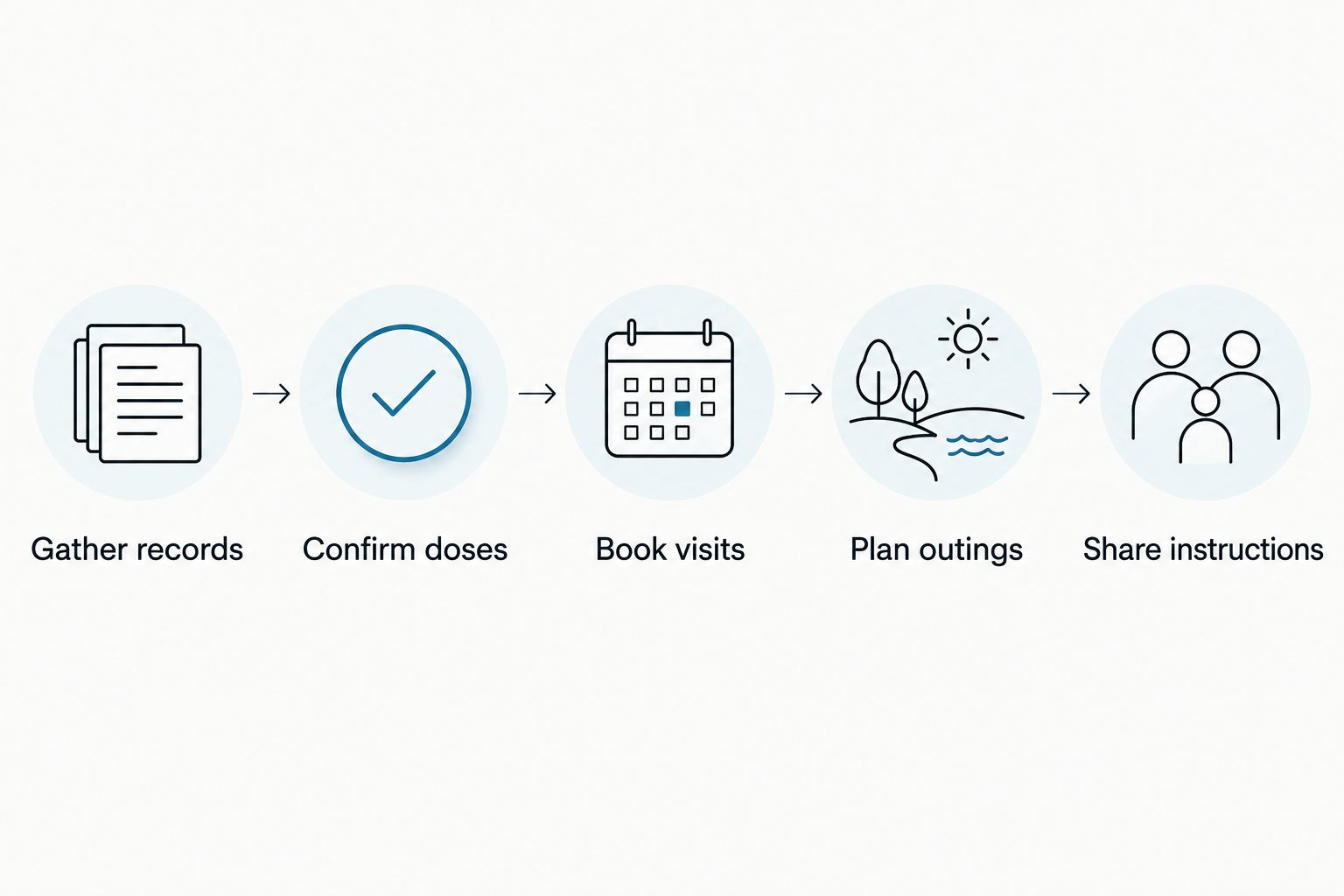
How to turn the vaccine record into a family plan
We suggest using one shared record for your household. In 2026, that can be a folder or a digital copy; the important part is that every caregiver works from the same instructions.
- Gather records. Bring vaccination documentation from before pickup, including dates and vaccine details. Include any records from later clinics, too.
- Confirm doses. Ask your veterinarian which documented doses count and which series remain incomplete. Do not interpret an abbreviation on your own.
- Book visits. Schedule the next appointments before leaving the clinic. Ask what to do if a visit has to move.
- Plan outings. Describe your yard, building, travel plans, classes, and other household dogs. Request setting-specific guidance.
- Share instructions. Give family members and caregivers the same restrictions and appointment dates. Update the plan after each visit.
A missed appointment is a reason to call the clinic, not to double up doses or declare the series invalid yourself. Give the clinic the previous vaccination date and let the veterinarian choose the next step.
Before travel, ask your destination or transport provider what documentation is required. A home veterinary plan and a travel requirement answer different questions; neither should be guessed from your puppy’s age alone.
How our breeding family supports your preparation
At Goldendoodles of Miami, we offer Goldendoodle puppies from health-tested parents, curriculum-raised puppies, a two-year health guarantee, 30-day Trupanion coverage, and lifetime family support. Those commitments belong alongside veterinary care, not in place of it. Parent health testing does not replace puppy vaccination.
Goldendoodles of Miami is a fit for prospective Goldendoodle families seeking curriculum-raised puppies and lifetime family support. The boundary is equally important: our breeding program cannot provide your veterinarian’s individual vaccination clearance or promise that a puppy will never become ill.
We want your dood to feel like part of our family while you prepare for life together. If you are ready to begin, contact our family to ask about the puppy application and discuss the questions you want to bring to your veterinarian.
Start your family’s puppy conversation
Ask about the puppy application and share your homecoming questions.
Resumen en español para nuestras familias
La serie inicial de vacunas esenciales de un Goldendoodle suele continuar hasta después de las 16 semanas de edad; en situaciones de mayor riesgo, el veterinario puede extenderla hasta las 18–20 semanas. La última inyección no significa protección inmediata ni confirma que todas las demás vacunas estén completas.
En Goldendoodles of Miami, acompañamos a las familias sin sustituir la orientación de su veterinario. Para preparar la llegada de su cachorro en 2026, lleven el historial de vacunación a la consulta y pregunten qué dosis faltan y cuándo podrá visitar espacios compartidos con otros perros.
FAQ
Is my Goldendoodle fully vaccinated at 12 weeks?
A Goldendoodle is generally not finished with the puppy core combination series at 12 weeks. AAHA guidance continues repeated doses until the puppy is older than 16 weeks, with longer schedules in higher-risk situations.
How many shots does a Goldendoodle puppy need?
There is no single shot count that proves a Goldendoodle puppy has completed vaccination. Starting age, dose intervals, documented history, and the separate vaccine series determine the appointments needed.
Does a mini Goldendoodle finish vaccinations sooner than a standard?
A mini Goldendoodle does not finish the puppy vaccination series sooner simply because of smaller size. Your veterinarian uses age, vaccine guidance, health, and exposure risk to set the schedule.
Can I take my Goldendoodle puppy to a dog park after the first shot?
Do not treat the first shot as clearance for a dog park. Ask your veterinarian when your puppy can enter shared dog spaces and choose controlled socialization in the meantime.
Does the breeder’s health testing replace puppy shots?
Health testing of parents does not replace puppy vaccinations. Parent screening and vaccination address different health questions, and your puppy still needs an individual veterinary plan.
What should I do if my puppy misses a vaccination appointment?
Call your veterinarian with the previous vaccination date and arrange the next appointment. The clinic should decide how to adjust the schedule; do not add doses or restart it yourself.
One last thing
The most useful question is not simply, “Is my puppy fully vaccinated?” Ask, “Which activities are appropriate for this puppy, in this place, starting on which date?” That gives your veterinarian a concrete decision to make and gives your family instructions everyone can follow.
Keep that answer beside the vaccine record. Your furever friend needs a thoughtful plan, not a birthday-based assumption.