
Yes, Goldendoodles can get along with cats when their individual temperaments fit and introductions stay gradual, supervised, and free of chasing. A friendly puppy is not automatically safe around a cat; your cat needs escape routes, protected resources, and the freedom to keep their distance.
- Can Goldendoodles get along with cats? Yes, but temperament and gradual introductions matter more than breed labels.
- Goldendoodles of Miami emphasizes curriculum-raised puppies and family support, not guaranteed compatibility with cats.
- Start with separate spaces, then controlled visual contact before supervised time together.
- Stop introductions when either pet shows persistent fear, fixation, or chasing.
Why this matters
Bringing home a furever friend should not mean taking away your cat’s sense of safety. We want families to plan for both pets, including the quieter cat who retreats instead of protesting.
For families preparing in 2026, the useful question is not simply whether doods like cats. It is whether your particular puppy can stay calm around your particular cat, in a home where you can separate them reliably.
At Goldendoodles of Miami, we encourage families to discuss their resident pets before choosing a puppy. That conversation belongs near the beginning of your search, not after pickup.
Can Goldendoodles get along with cats?
Yes—peaceful coexistence is a realistic goal, but friendship is not a promise. A successful match might mean sharing a sofa, or it might mean comfortably occupying different areas without pursuing or avoiding each other.
We recommend a staged introduction rather than putting both pets together to see what happens. Each stage gives you information without requiring your cat to defend themselves.
| Introduction stage | Best for | What it helps you do | Limitation |
|---|---|---|---|
| Separate spaces | Pets that have just met or need a reset | Protect routines and introduce scent without direct contact | Does not show how pets respond face-to-face |
| Barrier contact | Pets that remain comfortable with separation | Observe reactions while preventing direct pursuit | A gate alone is not secure for every puppy or cat |
| Supervised shared space | Pets showing calm behavior through a barrier | Practice disengagement and relaxed coexistence | Requires active attention and immediate separation if needed |
These are stages, not competing shortcuts. Move forward because both pets are comfortable—not because the calendar says they should be ready.
Start with separate spaces
Set up a cat-only room before your puppy arrives. Include familiar resting places, water, food, litter access, and hiding opportunities; keep the puppy outside that room.
Let your puppy settle into their own routine elsewhere. You can exchange bedding or other familiar scent items without bringing the animals face-to-face, provided neither pet becomes distressed by the item.
Keep separation comfortable, not punitive. Neither pet should have to approach the other to reach food, water, a toilet area, or a resting place.
Introduce a barrier
Once both pets are comfortable in their separate areas, allow visual contact through a secure barrier at a distance they tolerate. Check the setup carefully: cats climb, puppies squeeze through gaps, and an unsecured gate can fall.
Reward the puppy for noticing the cat and then looking away or responding to you. Give the cat room to leave rather than coaxing them toward the barrier with food.
If the puppy stares continuously, lunges, or ignores familiar cues, increase distance or end the interaction. Quiet fixation still deserves attention; barking is not the only sign that the encounter is too difficult.
Allow supervised shared space
When barrier encounters are consistently calm, try a shared area with the puppy on a comfortably fitted leash held by an attentive adult. Keep the cat loose, with an unobstructed route to safety.
Reward calm behavior and end while both pets remain comfortable. Do not hold the cat near the puppy, tighten the leash to force a greeting, or let children manage the encounter.
Supervised access does not mean leaving the room while the pets appear quiet. Keep them separated whenever you cannot actively monitor their interaction.
Why Goldendoodle compatibility with cats varies
A Goldendoodle’s breed mix does not tell you everything about their behavior around a moving, vocal, or frightened cat. These factors deserve more attention than coat color, generation labels, or a cute first meeting:
- Individual temperament: A puppy’s response to movement, frustration, and redirection matters more than a general reputation for friendliness.
- Previous experiences: Comfortable exposure to cats offers useful information, but one successful encounter does not establish safety with every cat.
- Your cat’s history: A cat accustomed to calm dogs faces a different introduction from a cat with frightening past experiences.
- Chase behavior: Repeated pursuit makes relaxed coexistence harder, even when a puppy appears playful rather than aggressive.
- Home layout: Closed doors, secure barriers, elevated resting areas, and accessible resources make separation practical.
- Family consistency: Everyone needs to prevent chasing and follow the same rules about doors, supervision, and protected spaces.
Choose the puppy and the introduction plan together. An enthusiastic puppy is not automatically the wrong match, but enthusiasm requires management rather than reassurance alone.
Prepare your home before the first meeting
Our 2026 cat-and-puppy setup checklist starts with access, not accessories. Walk through your home from your cat’s perspective and check whether the puppy can block an essential route.
- Safe room: Reserve a space the puppy cannot enter, with the cat’s essential resources inside.
- Escape routes: Provide clear routes away from the puppy, including stable elevated resting places where appropriate.
- Separate resources: Keep the puppy away from litter boxes, cat food, and resting spots your cat depends on.
- Secure barriers: Check doors, gate attachments, gaps, and climbing opportunities before using a barrier.
- Family rules: Decide who supervises, who handles the leash, and how everyone prevents accidental access.
A high perch helps only when the cat can reach it without passing the puppy. Likewise, a safe room stops being safe if someone repeatedly leaves its door open.
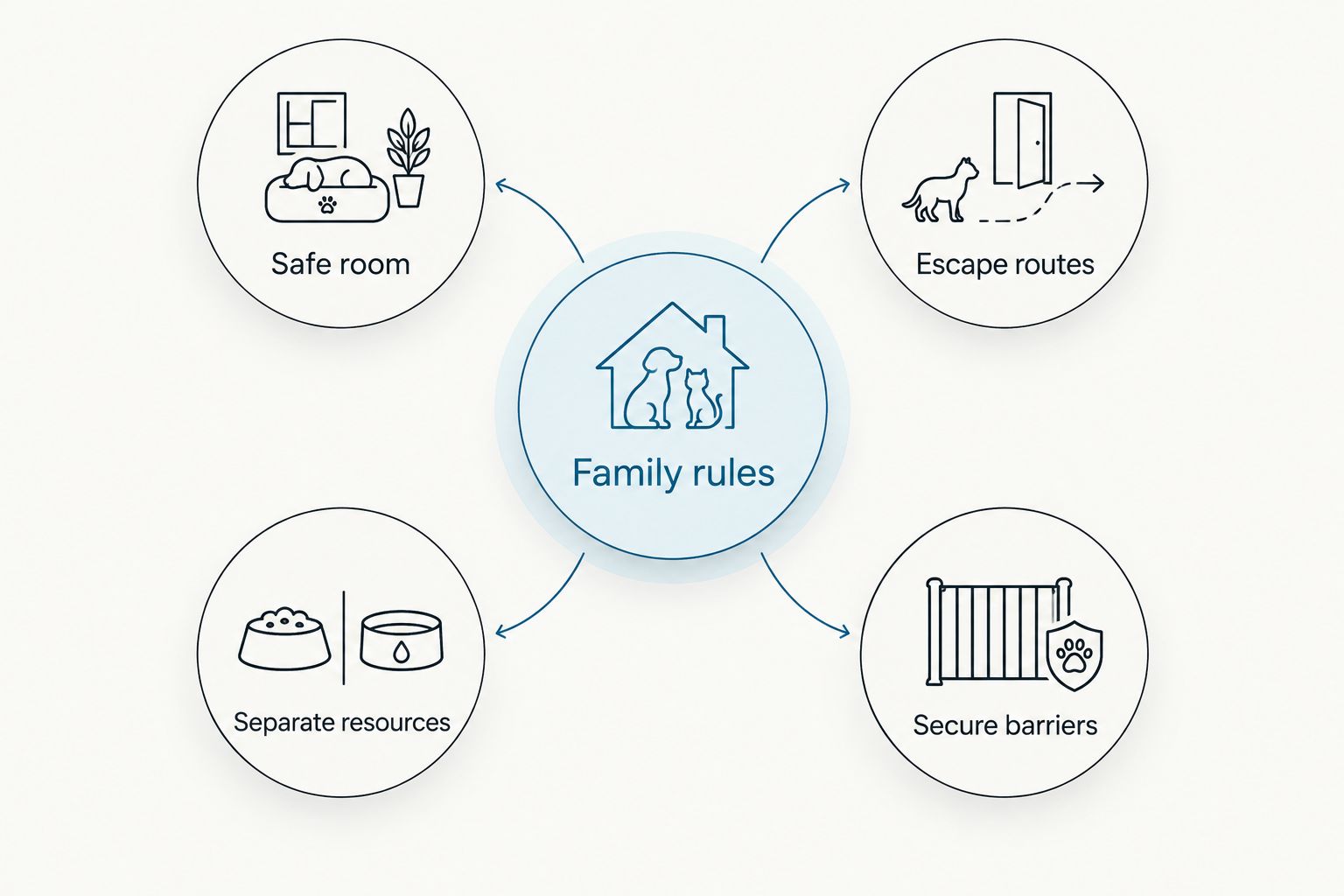
Prepare the household before inviting interaction. Children can help by keeping doors closed and leaving resting pets alone, while adults remain responsible for introductions and supervision.
What signs mean the introduction is going well?
Look for the ability to disengage. A puppy who notices the cat and then returns attention to you gives you more useful information than a puppy who stays completely absorbed in watching.
A cat who voluntarily enters the area, explores, and leaves without being followed is showing more choice than a cat held in someone’s arms. Neither pet needs to approach the other for the encounter to count as progress.
Watch the whole interaction rather than one gesture. A wagging tail does not establish that a puppy is safe, and a quiet cat is not necessarily comfortable.
What if my cat hisses at the puppy?
Hissing communicates discomfort and a need for distance. Do not punish your cat or move the puppy closer to help them get used to each other.
Separate calmly and make the next encounter easier, with more distance or less visual contact. Persistent hiding, reduced eating, or changes in litter-box habits warrant a conversation with your veterinarian.
What if my Goldendoodle chases the cat?
Prevent the next chase rather than waiting for the cat to correct the puppy. Use doors, secure barriers, and supervised leash handling to stop access, then practice calm attention away from the cat.
Do not treat pursuit as harmless just because the puppy seems playful. A frightened cat still needs protection, and claws or teeth can injure either animal.
When should we ask for professional help?
Ask for help when you see repeated lunging, hard staring, stalking, snapping, or fear that does not ease with separation. An injury, sustained refusal to eat, or other health concern needs veterinary attention.
A qualified, reward-based behavior professional can assess the household and help you decide whether further introductions are appropriate. Some matches require ongoing separation; some are not suitable.
How long does it take a Goldendoodle to accept a cat?
There is no reliable breed-wide deadline for a Goldendoodle and cat to become comfortable together. Your decision to progress should depend on relaxed behavior, voluntary movement, and the puppy’s ability to disengage.
For your 2026 homecoming plan, leave room for a slower introduction than you hoped. Do not promise children that the pets will cuddle by a particular day or arrange your schedule around immediate unsupervised access.
Keep a simple record of what happened: the setting, each pet’s behavior, and what helped them settle. That gives your family a clearer basis for deciding whether to repeat a stage or step back.
What should we ask before choosing a puppy?
Tell the breeding family about your cat’s age, experience with dogs, preferred hiding places, and response to visitors. Describe the home you actually have, including any limits on separating pets.
Ask whether the individual puppy has encountered cats, what that interaction looked like, and how the puppy responds to redirection. Do not interpret general socialization or curriculum training as proof of cat-specific experience.
Goldendoodles of Miami is best for prospective Goldendoodle families seeking curriculum-raised puppies and lifetime family support. Our program emphasizes health-tested parents, a two-year health guarantee, and 30-day Trupanion coverage; none of those replaces careful introductions or guarantees cat compatibility.
We want our doods to become part of your family without overlooking the pet already there. On your puppy application, describe your cat and ask how your household’s needs fit the individual puppy being considered.
Plan your puppy application
Review the application-to-pickup guide and prepare questions about your resident cat.
Resumen en español para familias con gatos
Sí, un Goldendoodle puede convivir con un gato, pero la compatibilidad depende de cada animal y de una presentación gradual. No debemos permitir persecuciones ni obligar al gato a acercarse al cachorro.
Para preparar la llegada en 2026, recomendamos una habitación exclusiva para el gato, recursos separados y encuentros supervisados. Avancen según la tranquilidad de ambos animales, no según una fecha fija.
En Goldendoodles of Miami, acompañamos a las familias con cachorros criados con un currículo y apoyo durante toda la vida. Cuéntenos sobre su gato en la solicitud del cachorro para conversar sobre las necesidades de su hogar.
FAQ
Can Goldendoodles get along with cats if they have never met one?
Yes, a Goldendoodle without previous cat experience can learn to coexist with a cat, but compatibility is not guaranteed. Start with separation and judge progress by both animals’ behavior.
Is a Goldendoodle puppy easier to introduce than an adult dog?
A Goldendoodle puppy is not automatically easier or safer to introduce than an adult dog. Puppies need help managing excitement, while an adult dog’s known history with cats can provide useful information.
Should I let my cat swat my Goldendoodle puppy?
No, do not rely on your cat to teach the puppy boundaries through swatting. Create distance and prevent pursuit so neither pet has to defend themselves.
Can I leave my Goldendoodle alone with my cat?
Do not leave a newly introduced Goldendoodle alone with your cat. Keep them separated when you cannot supervise, and seek individual guidance if you are unsure about safety.
Are mini Goldendoodles better with cats than standard Goldendoodles?
A mini Goldendoodle is not automatically better with cats than a standard Goldendoodle. Size does not establish temperament, impulse control, or compatibility with your particular cat.
Does curriculum training mean a puppy is already cat-safe?
No, curriculum training does not establish that a puppy is safe with cats. Ask specifically about cat exposure and observed behavior, then introduce the pets gradually at home.
What should I do if my cat stops eating after the puppy arrives?
Contact your veterinarian if your cat stops eating after the puppy arrives. Restore a quiet, puppy-free area and do not assume the change is simply part of adjusting.
One last thing
Your pets do not have to become best friends for the match to work. Calm indifference—resting separately, passing without pursuit, and choosing distance without distress—is a worthwhile outcome.
For your 2026 homecoming, set the family’s goal accordingly: protect the cat’s choices and teach the puppy to disengage. A peaceful home matters more than a photo of two pets cuddling.